
Non-FictionHealth & WellnessBack Health
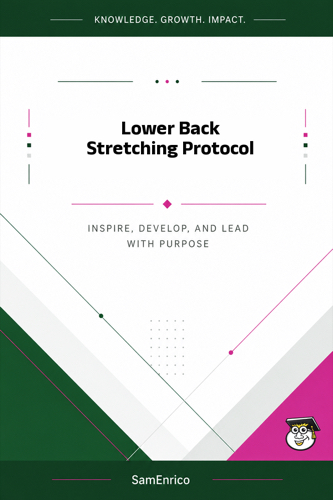
Lower Back Stretching Protocol eBook
Alleviate lumbar discomfort with cat-cow, child's
Alleviate lumbar discomfort with cat-cow, child's pose, and knee-to-chest stretches.
Formats
Free sample
Chapter 1: The Bedrest Lie--–- On a cold Tuesday morning in March, a forty-two-year-old accountant named David did exactly what his doctor told him to do. His lower back had seized up while he was tying his shoes—a familiar sensation, a deep and vicious spasm that sent lightning down his right hamstring. He called his primary care physician, who prescribed muscle relaxants and said the words that millions of patients have heard: “Just rest for a few days. Stay off your feet. Give it time to heal.”David followed those instructions perfectly.
He took the pills. He lay on the couch. He skipped work. He let his wife bring him soup. He stayed in bed for seventy-two hours, moving only to use the bathroom.
And on the fourth morning, when he tried to stand up to brush his teeth, his back gave out completely. He collapsed onto the bathroom floor, unable to straighten his spine, unable to lift his left leg, unable to understand why doing nothing had made everything worse.David is not a failure of medicine. David is a victim of the single most dangerous and persistent myth in the entire field of back pain: the belief that rest heals the spine.This chapter will dismantle that myth completely. You will learn why bed rest is not just ineffective but actively harmful. You will understand the difference between acute injury care and chronic mechanical pain.
You will discover the core philosophy behind the Lower Back Stretching Protocol—a philosophy built on movement, not stillness, on direction-specific stretching, not generic yoga sequences, and on self-diagnosis, not passive suffering. By the time you finish this chapter, you will never look at a heating pad and a recliner the same way again.The 80 Percent Problem Lower back pain is not a niche medical condition. It is a global epidemic. According to the Global Burden of Disease Study, lower back pain is the single leading cause of years lived with disability in nearly every country on earth. Not heart disease.
Not diabetes. Back pain.The statistics are staggering. Eighty percent of all adults will experience debilitating lower back pain at least once in their lives. Among working-age adults, back pain is the most common reason for missed work days. In the United States alone, back pain costs an estimated one hundred billion dollars annually in medical expenses and lost productivity.
And here is the cruelest number of all: of those eighty percent who suffer an episode, nearly half will have a recurrence within twelve months.Why? Why does back pain come back like a bad tenant who refuses to leave?The answer, which you will hear repeatedly throughout this book, is simple and infuriating: most patients are given the wrong advice. They are told to rest when they should move. They are told to take pills when they should stretch. They are told that time heals all wounds when, in fact, time spent lying down only deepens the mechanical dysfunction that caused the pain in the first place.The Lie of Bed Rest The idea that bed rest heals the back has remarkably shallow historical roots.
In the mid-twentieth century, orthopedic surgeons routinely prescribed weeks of flat-on-your-back bed rest for nearly every spinal complaint. Herniated disc? Stay in bed. Muscle strain? Stay in bed.
Fracture? Definitely stay in bed. The logic seemed intuitive: if you hurt a muscle or a joint anywhere else in your body, rest helps. Sprain your ankle, and you stay off it. Break your wrist, and you immobilize it.
Why would the spine be any different?The answer, which researchers began to uncover in the 1980s and 1990s, is that the spine is fundamentally different from every other joint in the human body. Unlike the ankle, which has a generous blood supply and heals quickly with immobilization, the spinal discs have almost no direct blood supply. They do not heal by sitting still. They heal by moving.Consider what happens to the human body during just forty-eight hours of bed rest. Studies on spinal deconditioning have shown that after two days of complete bed rest, the paraspinal muscles—the deep muscles that run alongside the spine—begin to atrophy at a rate of one to three percent per day.
That means after one week of bed rest, you have lost nearly fifteen percent of the muscle mass that supports your spine. Those muscles become weaker, tighter, and more prone to spasm. The spine becomes less stable, not more.But the damage goes deeper than muscle. The intervertebral discs, those gelatinous cushions between your vertebrae, rely on a process called disc imbibition to stay healthy. Imbibition is the passive movement of fluid into and out of the disc in response to changes in pressure.
When you stand, gravity compresses the disc and squeezes old, inflammatory fluid out. When you lie down, the disc rehydrates with fresh, nutrient-rich fluid. This cycle—compress, rehydrate, compress, rehydrate—is the disc’s only way of getting oxygen and nutrients. It has no blood vessels. The pump is movement.When you stay in bed for days on end, that pump stops.
The disc sits in a constant state of hydration, never squeezing out the inflammatory chemicals that accumulate from even minor injuries. The outer ring of the disc, the annulus fibrosus, becomes waterlogged and weak. Small tears that would have healed with normal movement become chronic fissures. The disc does not rest. The disc drowns.Mechanical Pain versus Structural Pain To understand why movement is the answer, you must first understand what kind of back pain you actually have.
This distinction is so important that the entire protocol depends on it.There are two broad categories of back pain: structural and mechanical.Structural back pain comes from a clear, identifiable, often dangerous cause. Cancer that has metastasized to the spine. A vertebral fracture from a car accident or a fall. A spinal infection such as discitis or osteomyelitis. Cauda equina syndrome, a surgical emergency involving compression of the nerve roots at the bottom of the spinal cord.
These conditions are rare—accounting for perhaps one to two percent of all back pain cases—but they are serious. They require immediate medical intervention. They are not what this book is about.Mechanical back pain is everything else. It is the back pain that ninety-eight percent of people experience. It arises not from a structural lesion but from faulty movement patterns, muscle imbalances, joint stiffness, postural habits, and the way your nervous system interprets signals from your spine.Here is the liberating truth about mechanical back pain: you are not broken.
There is no tumor eating your bone. There is no fracture that needs a cast. There is no infection that requires antibiotics. Your spine is intact. What is malfunctioning is the way your muscles, joints, and nerves are working together—or failing to work together.Think of your spine like a door.
A door that sticks in its frame does not need to be replaced. It does not have a structural defect. It simply needs the hinges adjusted or a screw tightened or a bit of lubricant on the latch. The door is fine.…
This is the end of the free sample. Get the eBook to keep going. Buy now
About this book
Details
- Author
- Gaskin Bonita
- Publisher
- SamEnrico
- Language
- English
- Genre
- Non-Fiction, Health & Wellness, Back Health
- Released
- 2026-06-06
- Pages (approx.)
- 135
- Available as
- eBook, Audiobook

Read better in the ZLOADR app
Your eBooks on your phone or tablet. Sign in with your SamEnrico account and start reading.
More by Gaskin Bonita
 Twelve Step For Indigenous CommunitiesGaskin Bonita$11.99
 Contemplating Impermanence Through BreathGaskin Bonita$11.99
 Franchise Builder's Franchise Expo SuccessGaskin Bonita$11.99
 The Whispering Lanterns of OiwaGaskin Bonita$11.99
 The Silent Uprising: The Women Who Outsmarted the GestapoGaskin Bonita$11.99
 Wearable Health Monitoring TechGaskin Bonita$12.99
 Microsoft Azure Annotation ManualGaskin Bonita$12.99
 Understanding Hyperthyroidism Due to Mutations In Tsh ReceptorGaskin Bonita$17.99
 Food Service Team MemberGaskin Bonita$11.99
 How to Start a Paving Blocks Made of Wood Business (Beginners Guide)Gaskin Bonita$11.99
You may also like
 Hong Kong Handover 1997Dunn Johnnie$11.99
 Zumba For Postnatal Recovery CourseNeal Christian$11.99
 Zumba for BeginnersLadner Nikia$11.99
 YouTube Comment Mining GuideHumes Pandora$12.99
 Worry Box MeditationCarlin Rudy$11.99
 Workplace Stress MeditationNguyen Lynn$11.99
 Workplace Stress and Sleep RepairHawley Ivory$11.99
 Workplace Perfectionism CureDelaney Jeffry$11.99
 Workplace Injustice Anger GuideWallen Isabelle$11.99
 Work Addiction and Burnout LinkGreenwood Ester$11.99
 Women in Yoga and WellnessBeattie Galina$11.99
 Women in Stand Up ComedyChun Evangeline$11.99