
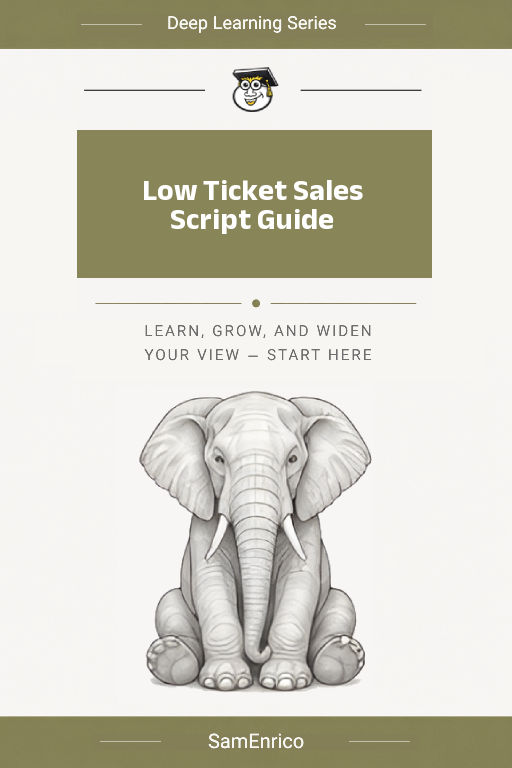
Low Ticket Sales Script Guide eBook
Close quick sales under $50 using scarcity and soc
Close quick sales under $50 using scarcity and social proof.
Formats
Free sample
Chapter 1: The Wallet Check...--When you ask someone to spend 47onaproduct,theirbraindoessomethingremarkable.Itactivatestheinsula—thesameregionthatlightsupwhenyoutouchahotstoveorstubyourtoe.Thisisthe"painofpaying,"andneuroscientistshavemappeditwithstunningprecision.Themomentapriceexceeds47 on a product, their brain does something remarkable. It activates the insula—the same region that lights up when you touch a hot stove or stub your toe. This is the "pain of paying," and neuroscientists have mapped it with stunning precision. The moment a price exceeds 47onaproduct,theirbraindoessomethingremarkable.Itactivatestheinsula—thesameregionthatlightsupwhenyoutouchahotstoveorstubyourtoe.Thisisthe"painofpaying,"andneuroscientistshavemappeditwithstunningprecision.Themomentapriceexceeds50, this pain becomes acute. The customer hesitates.
They tab away. They say "I'll think about it."But drop the price to 49?Theinsulabarelyregistersablip.Thepurchasefeelslikearoundingerror,asmalltreat,alow−stakesexperiment.Thisisnotamatterofaffordability.Acustomerwith49? The insula barely registers a blip. The purchase feels like a rounding error, a small treat, a low-stakes experiment. This is not a matter of affordability.
A customer with 49?Theinsulabarelyregistersablip.Thepurchasefeelslikearoundingerror,asmalltreat,alow−stakesexperiment.Thisisnotamatterofaffordability.Acustomerwith5,000 in their bank account will agonize over a 52purchasewhilespending52 purchase while spending 52purchasewhilespending9 on a latte without thinking twice. The difference is psychological, not financial.This chapter is about understanding that difference—and exploiting it ethically. You will learn why $50 is the magic threshold for impulse purchases, how to reframe your price so it feels like a rounding error, and why you don't need authority or deep rapport to close low-ticket sales. You will also receive your first complete script: "The Wallet Check" opener, designed to bypass the logical brain and trigger an emotional, low-risk "yes."Let's start with the science, because once you understand the hardware, the software (the scripts) become obvious.The Neuroscience of the $50 Line In 2007, researchers at Stanford published a landmark study using functional MRI scans. Participants were shown products with different prices while their brains were being scanned.
When prices exceeded a certain threshold—which varied by individual but averaged around $50—the insula activated. When prices fell below that threshold, the insula remained quiet.Here's what this means in practice. The insula is the brain's "pain matrix." It processes physical pain, social rejection, and financial loss through the same neural pathways. When you ask for 52,thecustomerliterallyfeelsasmallshock.Whenyouaskfor52, the customer literally feels a small shock. When you ask for 52,thecustomerliterallyfeelsasmallshock.Whenyouaskfor47, they feel nothing.
The logical part of their brain (the prefrontal cortex) might know that $5 is trivial, but the insula doesn't care about logic. It reacts to the number itself.This is why low-ticket sales operate on a completely different psychology than high-ticket closes. For a 2,000product,thecustomerneedsweeksofnurturing,casestudies,authoritysignals,andrelationshipbuilding.Fora2,000 product, the customer needs weeks of nurturing, case studies, authority signals, and relationship building. For a 2,000product,thecustomerneedsweeksofnurturing,casestudies,authoritysignals,andrelationshipbuilding.Fora47 product, they need 47 seconds of social proof and a gentle nudge. They are not buying a solution to a complex problem.
They are buying a gamble—a small bet that this thing might work.And because it's a small bet, the rules change entirely.The Zero-Risk Barrier When a purchase is under $50, the customer's primary fear shifts. They are no longer afraid of financial loss. They are afraid of two things: time waste and social embarrassment.Time waste: "What if I buy this and it's useless? I'll have wasted 20 minutes trying to figure it out."Social embarrassment: "What if my spouse or friends see this charge and think I'm an idiot for buying something stupid?"Notice what is missing from this list: fear of poverty. The customer is not worried that $47 will bankrupt them.
They spend that much on takeout without blinking. The real barrier is not the price. The real barrier is the fear of feeling stupid—either to themselves (time waste) or to others (social embarrassment).This is why your script must address these specific fears. You cannot simply say "it's only $47." That doesn't solve the time waste problem. You must say "this will save you 3 hours this week"—and then back it up with a refund policy that eliminates the embarrassment.The Zero-Risk Refund Script addresses both fears simultaneously:"Try this for 30 days.
If it doesn't save you at least 3 hours, I'll refund you before you finish typing the email. No forms. No 'processing.' No questions. You don't even have to tell me why. Just say 'refund' and it's done.
That's how confident I am that this will work for you."Notice what this script does. It promises a specific outcome (saving 3 hours). It makes the refund process frictionless. It removes the social embarrassment by eliminating the need to justify the return. And it does all of this in four sentences.The Trust Distinction (Critical Clarification)Before we go further, we need to address a distinction that will save you from confusion later in this book.
In the original draft of this chapter, we said "you don't need authority or deep rapport for low-ticket sales." That statement is true—but only for certain channels.Here is the clarification:Low-intimacy channels (landing pages, pop-ups, display ads, social media posts): the customer does not need to trust you personally. Social proof substitutes for trust. If 14 people bought in the last hour, the customer trusts the crowd, not you.High-intimacy channels (SMS, email, voice notes, DMs): the customer does need to trust you, because the channel feels personal. You cannot hide behind social proof in someone's text messages.This distinction will become important in Chapter 10 (SMS scripts) and Chapter 12 (ethics). For now, understand that the scripts in this chapter are designed for low-intimacy channels.
You are writing for a landing page, a pop-up, or an ad. The customer has never heard of you. They don't trust you. But they trust the crowd—and you are about to show them the crowd.The Latte Factor (Reversed)You have probably heard of the Latte Factor: the idea that small daily expenses add up to large annual sums. Financial advisors use it to shame people into saving money.
"If you skip your 5latteeveryday,you′llsave5 latte every day, you'll save 5latteeveryday,you′llsave1,800 a year."We are going to reverse this logic.Instead of saying "this 47productisexpensivecomparedtootherthings,"yousay"this47 product is expensive compared to other things," you say "this 47productisexpensivecomparedtootherthings,"yousay"this47 product is cheaper than the things you already waste money on without thinking.""This costs less than takeout for two.""This is cheaper than filling your gas tank.""This is less than your weekly coffee run."The goal is to reframe the price from "a purchase" to "a rounding error." The customer already spends $47 on things they forget about by next Tuesday. You are asking them to redirect that rounding error to something that might actually help them.The Wallet Check Script (Complete)Here is the complete "Wallet Check" opener. This script is designed for low-intimacy channels: landing pages, pop-ups, and short-form video captions. It assumes the customer has never heard of you and does not trust you yet."Look, this costs $47. That's less than takeout for two.
And here's the deal: if this doesn't save you at least 3 hours this week, you've lost the cost of a burger. That's it. A burger. But if it works? You get your nights back.
You stop doing [painful task] manually. You finally have the system you've been putting off.I'm so confident this will work that I'll refund you before you finish typing the email. No forms.…
This is the end of the free sample. Get the eBook to keep going. Buy now
About this book
Details
- Author
- Chen Casandra
- Publisher
- SamEnrico
- Language
- English
- Genre
- Non-Fiction, First 30 Days
- Released
- 2026-06-01
- Pages (approx.)
- 128
- Available as
- eBook, Audiobook

Read better in the ZLOADR app
Your eBooks on your phone or tablet. Sign in with your SamEnrico account and start reading.
More by Chen Casandra
 Assertive Email Communication GuideChen Casandra$11.99
 DoorDash Shopping List EfficiencyChen Casandra$11.99
 LGBTQ Child Star IdentityChen Casandra$11.99
 Depression Treatment HandbookChen Casandra$11.99
 Citation Rules for Sacred Texts GuideChen Casandra$11.99
 Failure Reframe WorkbookChen Casandra$11.99
 Steel Beasts of the Eastern FrontChen Casandra$11.99
 Resentment After DivorceChen Casandra$11.99
 Gripen Pilot MemoirChen Casandra$11.99
 The Last Queen of Egypt: Cleopatra's Final GambitChen Casandra$11.99
 The Clockwork Phoenix: How a Victorian Girl Invented the First Steam-Powered WingsChen Casandra$11.99
 The Battle of Leyte Gulf: The Last Stand of the Imperial FleetChen Casandra$11.99
You may also like
 Website Launch For New LLCStrunk Tracee$12.99
 Shopify Market Expansion GuideGaffney Jude$12.99
 Power Backup Solutions for Philippine VAsPearce Eldon$12.99
 Feedback License Clause TemplateCrum Ashli$12.99Feedback License Clause TemplateCrum Ashli$12.99Feedback License Clause TemplateCrum Ashli$12.99Feedback License Clause TemplateCrum Ashli$12.99Feedback License Clause TemplateCrum Ashli$12.99Feedback License Clause TemplateCrum Ashli$12.99Feedback License Clause TemplateCrum Ashli$12.99Feedback License Clause TemplateCrum Ashli$12.99
 Channel Distribution On One PagePetersen Narcisa$12.99