
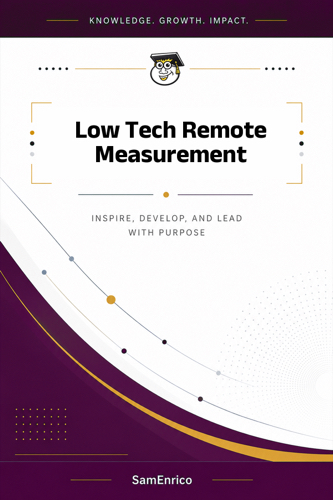
Non-FictionBusiness BriefLow Tech
Low Tech Remote Measurement eBook
Track productivity without expensive software.
Track productivity without expensive software.
Formats
Free sample
Chapter 1: The Trust Diagnostic--–- In 2019, a mid-sized marketing agency did something that most managers would consider insane. They deleted their employee monitoring software. Not because it was expensive—though it was—but because their best designer quit with a two-line resignation email that read, “I don’t feel like an adult. I feel like a surveillance target. Good luck with your screenshots.” That designer took a 20 percent pay cut to work somewhere that didn’t track her keystrokes.
The agency’s founder called me three weeks later, confused and angry. “I had all the data,” he said. “I knew exactly how many hours she worked. I knew when she was at her desk. I knew everything except the one thing that mattered: whether she was going to stay.”This is the dashboard delusion.
It is the seductive, expensive, and ultimately self-defeating belief that more data equals better management. And in the age of remote work, it has become a multi-billion dollar industry built on the back of managerial anxiety.This book is not about rejecting measurement. It is about measuring what actually matters—and learning to see the rest as noise.Let me be clear from the outset: I am not a Luddite. I am not telling you to throw away your laptop or communicate by carrier pigeon. I am telling you that the most expensive, most invasive, most distracting tools on the market today are also the least effective at predicting what you actually care about.
You care about output. You care about quality. You care about your team’s wellbeing and retention. You do not care, or should not care, about how many times someone moved their mouse between 2:00 and 2:15 PM.Yet the surveillance software industry has convinced thousands of managers that mouse movements are a proxy for productivity. This is a lie.
It is a lie supported by confirmation bias, fear, and the natural human desire for control in an uncontrollable world. This chapter will dismantle that lie, diagnose whether your team is ready to abandon it, and give you a clear path forward—whether that path leads into this book’s methods or away from them.The Birth of Bossware and the Death of Trust To understand where we are, we need to understand how we got here. Remote work did not invent managerial anxiety. That anxiety is as old as work itself. What remote work did was remove the visual cues that managers had grown to rely on: the sight of someone at a desk, the sound of typing, the appearance of busyness.
Without these cues, many managers felt blind.Enter the surveillance software industry. Companies like Teramind, Hubstaff, Time Doctor, and Activ Trak promised to restore visibility. For a monthly fee per user, you could see screenshots, keystroke logs, mouse movement patterns, application usage, and even webcam captures. The pitch was irresistible to the anxious manager: “Now you can see exactly what your remote employees are doing, all the time, without leaving your desk.”The problem is that what you see is not what you get.The core flaw in bossware is not ethical—though the ethical problems are substantial. The core flaw is epistemological.
These tools measure motion, not action. Motion is activity without direction: toggling between browser tabs, moving the mouse in circles, typing random characters. Action is activity that produces value: writing a proposal, solving a customer problem, designing a feature. Bossware cannot distinguish between the two. A worker who spends six hours deeply focused on a complex spreadsheet with minimal mouse movement appears “inactive.” A worker who frantically toggles between twenty tabs while accomplishing nothing appears “productive.”This is not a bug.
It is a structural limitation of surveillance-based measurement. Software cannot read intent. It cannot measure quality. It cannot tell you whether the email being typed is a million-dollar contract or a complaint about the office coffee machine. All it can tell you is that typing is happening.The Hawthorne Effect: Why Being Watched Changes What You See There is another problem with surveillance, one that has been known to industrial psychologists for nearly a century.
In the late 1920s and early 1930s, a series of experiments at the Hawthorne Works factory in Cicero, Illinois, produced a surprising finding. When researchers changed lighting conditions—making them brighter or dimmer—worker productivity went up. When they changed break times, productivity went up. When they changed almost any variable, productivity went up.The conclusion was not that lighting or breaks caused productivity gains. The conclusion was that workers changed their behavior simply because they knew they were being studied.
This is the Hawthorne Effect: the act of observation changes the thing being observed.Bossware triggers the Hawthorne Effect in the worst possible way. Workers do not become more productive. They become more performative. They learn to game the system. They jiggle their mouse.
They open and close applications in a pattern that looks busy. They save their real work for hours when the monitoring software is less active, or they use secondary devices for deep work while keeping the monitored machine in a state of simulated busyness.This is what I call productivity theater. It is the performance of work rather than the execution of work. And it is a direct, predictable consequence of surveillance-based measurement. You are not paying for productivity data.
You are paying for a performance.Motion vs. Action: The Distinction That Changes Everything If surveillance tools measure motion, what should we measure instead? The answer is action. But defining action requires a shift in how we think about work.Motion is any activity that can be performed without generating external value. You can move your mouse for an hour and produce nothing.
You can toggle between applications for a day and deliver nothing. Motion is the raw material of busyness, not the output of productivity.Action is any activity that produces a verifiable, valuable outcome. Action has a beginning and an end. Action leaves a trace that can be reviewed, evaluated, and improved. Action answers the question: “What changed because this person worked?”Consider two remote workers.
Worker A spends eight hours at their desk, moving their mouse constantly, toggling between email, Slack, and a dozen browser tabs. Their bossware dashboard shows 100 percent activity. But at the end of the day, they have not completed a single deliverable. Worker B spends four hours at their desk, takes a two-hour break to hike with their dog, and returns for two more hours of focused work. Their bossware dashboard shows 60 percent activity.
But at the end of the day, they have completed three client deliverables, resolved a support ticket, and drafted a proposal.Which worker is more productive? The answer is obvious. But the bossware dashboard would tell you the opposite. This is the dashboard delusion in action: mistaking the appearance of activity for the reality of output.The Hawthorne Effect in Remote Work: A Modern Cautionary Tale Let me tell you about a company I worked with in 2021. Let’s call them Fin Corp.
Fin Corp had sixty remote customer support agents. Management installed bossware to track keystrokes, screenshots, and application usage. Within two weeks, the data…
This is the end of the free sample. Get the eBook to keep going. Buy now
About this book
Details
- Author
- Koontz Johnsie
- Publisher
- SamEnrico
- Language
- English
- Genre
- Non-Fiction, Business Brief, Low Tech
- Released
- 2026-06-11
- Pages (approx.)
- 129
- Available as
- eBook, Audiobook

Read better in the ZLOADR app
Your eBooks on your phone or tablet. Sign in with your SamEnrico account and start reading.
More by Koontz Johnsie
 The Sleep Debt Nap RepaymentKoontz Johnsie$11.99
 Alibaba After-Sales SupportKoontz Johnsie$11.99
 Parental Suicide Grief GuideKoontz Johnsie$11.99
 Manic Episode RecognitionKoontz Johnsie$11.99
 Quit Smoking For SurgeryKoontz Johnsie$11.99
 RAIN Meditation PainKoontz Johnsie$11.99
 Navigating Child Loss GriefKoontz Johnsie$11.99
 Assertiveness For New ManagersKoontz Johnsie$11.99
 The Celestial Scribes of the Nile: Egypt's Forgotten AstronomersKoontz Johnsie$11.99
 The Silk and the Sword: A Princess’s Secret WarKoontz Johnsie$11.99
 Hashtag Justice: The Viral Trial That Changed the InternetKoontz Johnsie$11.99
 Growing GlycyrrhizaKoontz Johnsie$11.99
You may also like
 Hong Kong Handover 1997Dunn Johnnie$11.99
 Zumba For Postnatal Recovery CourseNeal Christian$11.99
 Zumba for BeginnersLadner Nikia$11.99
 YouTube Comment Mining GuideHumes Pandora$12.99
 Worry Box MeditationCarlin Rudy$11.99
 Workplace Stress MeditationNguyen Lynn$11.99
 Workplace Stress and Sleep RepairHawley Ivory$11.99
 Workplace Perfectionism CureDelaney Jeffry$11.99
 Workplace Injustice Anger GuideWallen Isabelle$11.99
 Work Addiction and Burnout LinkGreenwood Ester$11.99
 Women in Yoga and WellnessBeattie Galina$11.99
 Women in Stand Up ComedyChun Evangeline$11.99