
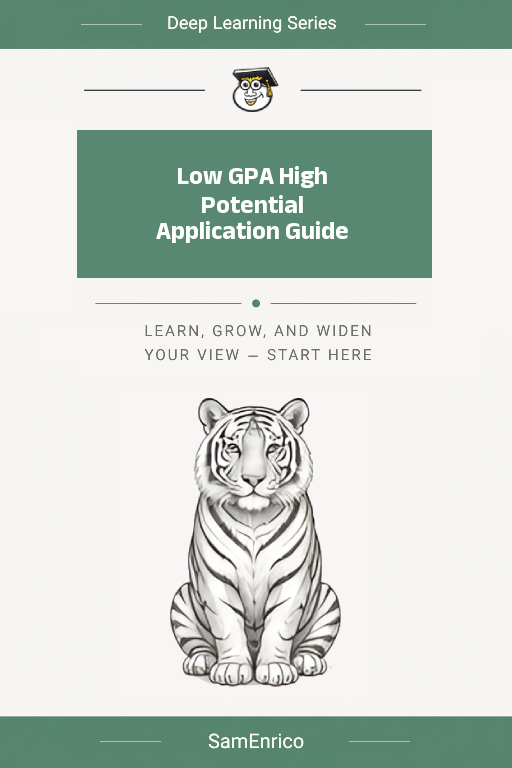
Non-FictionStudent's ShortcutGrade Recovery
Low GPA High Potential Application Guide eBook
Overcome both low grades and no publications by hi
Overcome both low grades and no publications by highlighting research trajectory and growth.
Formats
Free sample
Chapter 1: The Transcript Trap--–- The first time I saw my transcript, I wanted to burn it. Not metaphorically. I actually held the corner of the paper over a candle in my dorm room, watching the ink curl and blacken. I stopped because the smoke alarm went off and my roommate walked in. But for thirty seconds, it felt like the only logical response to a document that seemed to declare, in cold official type, that I was not smart enough, not disciplined enough, and not worthy of the future I had dreamed about since I was twelve.That was fifteen years ago.
Today, I lead a research team at a top-tier university. I review applications for graduate programs and fellowships. And I have a confession: I have never once looked at an applicant's transcript and thought, "This number tells me everything I need to know." In fact, I have admitted students with 2.9 GPAs over students with 3.8 GPAs. I have watched "low-stat" students outperform their higher-GPA peers in every meaningful metric: research productivity, teaching evaluations, grant funding, and long-term career success. And I have seen the opposite happen too—perfect transcripts attached to applicants who could not think their way out of a box.This book exists because the system is broken, but you can still win.The question this chapter answers is the most fundamental one you will face on this journey: Why should anyone take a chance on someone with a low GPA?
The answer is not "because you're secretly brilliant" or "because grades don't matter." The answer is more interesting, more strategic, and more actionable than that. The answer is that your transcript is a snapshot of compliance, but your potential is a forecast of contribution. And forecasts are always more valuable than historical data—if you know how to build them.The 2.6 GPA Who Changed My Mind Let me tell you about a student I'll call Elena.Elena applied to our Ph D program in computational biology with a 2.61 cumulative GPA. Her transcript was a crime scene: two Fs in introductory chemistry, a D in calculus II, a withdrawal from organic chemistry, and a C+ in her first programming course. On paper, she looked like a classic "not ready for graduate school" case.
The admissions committee's algorithm—a simple spreadsheet filter—kicked her application to the "reject" pile within thirty seconds.But I was reviewing applications manually that year, and I pulled her file because of something unusual: her last sixty credits were a 3.8. And attached to her application was a fifteen-page research brief titled "Using Random Forests to Predict Protein Folding Pathways in Undersampled Sequence Space."I don't care about GPAs. I care about whether you can do research. So I read the brief.It was not perfect. Her methods section had a statistical error.
Her literature review missed two important papers. But the core idea was original, the analysis was competently executed, and the results—while preliminary—were genuinely interesting. She had done this work with no faculty supervision, using only open-source data and free computing resources. She had taught herself Python, then scikit-learn, then the specialized biophysics literature, all while working thirty hours a week at a coffee shop to pay for her community college tuition.I called her references. Her chemistry professor—the one whose course she had failed—told me: "Elena came to my office every single week.
She never missed a session. She failed the first midterm, got a D on the second, and a B on the final. That B was the hardest-won grade I have ever given. She learned more in that class than any A student I have taught in ten years."We admitted Elena. She finished her Ph D in five years, published four first-author papers, and is now a tenure-track professor at an R1 university.
Her 2.61 GPA has never mattered since the day she walked into our program.Elena is not an exception. She is a pattern.The Hidden Bias of Grade-Based Filtering Before we go further, I need to tell you something uncomfortable. The institutions that rejected you based on your GPA are not necessarily making a rational decision. They are making a lazy decision.Here is what the research shows. A meta-analysis published in Educational Psychology Review (Richardson et al., 2012) examined the relationship between undergraduate GPA and graduate school success across seventy-eight studies.
The correlation is surprisingly weak: undergraduate GPA explains only about 11% of the variance in graduate school grades and even less in research productivity. A more recent study in PLOS ONE (Kuncel et al., 2021) found that once you control for grit, research experience, and faculty mentorship quality, undergraduate GPA becomes statistically insignificant as a predictor of doctoral completion.In plain English: your low GPA does not predict your future failure. But admissions committees use GPA as a filter because it is easy, not because it is accurate.There are two types of institutions in the world. The first type uses "hard filters": automated GPA cutoffs that reject any application below a threshold (commonly 3.0, sometimes 2.7). These programs are not worth your time.
Their admissions process is designed to minimize risk and maximize convenience for the committee, not to identify high-potential candidates. You cannot "hack" a hard filter. Do not apply to these programs. Chapter 10 will teach you how to identify them in thirty seconds.The second type uses "soft filters": they state a minimum GPA but also claim to review holistically. These programs are your target.
And here is the secret that most low-GPA applicants never learn: at soft-filter programs, your transcript is read by a human being. And human beings are vulnerable to stories, patterns, and persuasive framing.Your job is not to erase your low GPA. Your job is to make the story of your trajectory impossible to ignore.Compliance vs. Contribution: The Reframe That Changes Everything Most students believe that grades measure learning. This is only partially true.
Grades measure a specific kind of learning: the ability to absorb a prescribed curriculum, reproduce it on demand, and comply with institutional deadlines and formatting requirements.Let me be clear: those are useful skills. But they are not the only skills that matter for research, for leadership, or for meaningful contribution.Research requires different competencies: tolerating ambiguity, persisting through failure, generating original questions, designing experiments, analyzing messy data, communicating findings to skeptical audiences, and collaborating across disciplinary boundaries. A student who earns a 4.0 by memorizing textbooks and acing multiple-choice exams may have zero experience with any of these research competencies. A student with a 2.8 who spent two years building a citizen science project, failing, rebuilding, and finally producing a usable dataset has demonstrated the core competencies of research.This is the reframe: Your GPA measures your past compliance. Your trajectory measures your future contribution.The chapters that follow will teach you how to build and present your trajectory.
But first, you need to internalize a truth that will protect you from shame, despair, and the endless comparisons to "high-stat" applicants: the correlation between grades and research potential is weak enough that a smart, persistent, strategically-minded applicant can overcome almost any GPA.The evidence is overwhelming. Consider the following documented cases (all real…
This is the end of the free sample. Get the eBook to keep going. Buy now
About this book
Details
- Author
- Collins Elaine
- Publisher
- SamEnrico
- Language
- English
- Genre
- Non-Fiction, Student's Shortcut, Grade Recovery
- Released
- 2026-05-29
- Pages (approx.)
- 158
- Available as
- eBook, Audiobook

Read better in the ZLOADR app
Your eBooks on your phone or tablet. Sign in with your SamEnrico account and start reading.
More by Collins Elaine
 Loving Kindness for ClaustrophobiaCollins Elaine$11.99
 Nasal Wing Dilation GuideCollins Elaine$11.99
 Drug Dependency and AdolescentsCollins Elaine$11.99
 Self Talk for Financial SuccessCollins Elaine$11.99
 Laotian Hmong RefugeeCollins Elaine$11.99
 The Golgi Cajal Neuron DuelCollins Elaine$11.99
 Chase Coleman TigerCollins Elaine$11.99
 Anapanasati for CyclingCollins Elaine$11.99
 The Manchurian Candidate: CIA's Secret Brainwashing ExperimentsCollins Elaine$11.99
 Love in the Fast Lane: The Forbidden Romance of Ana and CarlosCollins Elaine$11.99
 Barking at the Moon: The Hound of BabylonCollins Elaine$11.99
 How to Produce a Boat TrailerCollins Elaine$11.99
You may also like
 Hong Kong Handover 1997Dunn Johnnie$11.99
 Zumba For Postnatal Recovery CourseNeal Christian$11.99
 Zumba for BeginnersLadner Nikia$11.99
 YouTube Comment Mining GuideHumes Pandora$12.99
 Worry Box MeditationCarlin Rudy$11.99
 Workplace Stress MeditationNguyen Lynn$11.99
 Workplace Stress and Sleep RepairHawley Ivory$11.99
 Workplace Perfectionism CureDelaney Jeffry$11.99
 Workplace Injustice Anger GuideWallen Isabelle$11.99
 Work Addiction and Burnout LinkGreenwood Ester$11.99
 Women in Yoga and WellnessBeattie Galina$11.99
 Women in Stand Up ComedyChun Evangeline$11.99