
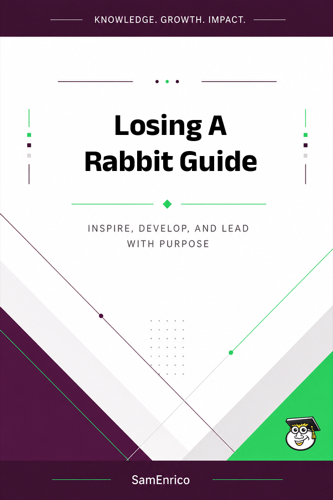
Losing A Rabbit Guide
Addresses unique bond with lagomorphs and grief af
Addresses unique bond with lagomorphs and grief after losing a house rabbit.
Formats
About this book
Free sample
Chapter 1: The Silent Language...--–- The first time a house rabbit flops against your leg, you are witnessing an act of radical trust. This is not hyperbole. In the wild, a rabbit that collapses onto its side—fully exposing its vulnerable belly, its delicate spine, its blind spot—is a rabbit that has decided, against every evolutionary instinct screaming in its hindbrain, that it is safe. The flop is not a sign of exhaustion. It is not a stretch before sleep.
The flop is a statement. It says: I have scanned this environment. I have listened for predators. I have watched your hands. And I have concluded, against all evidence available to my ancient prey-animal nervous system, that you will not kill me.What makes the bond between a human and a house rabbit so uniquely devastating to lose is that it is built entirely on this foundation of earned trust.
A dog may love you because you feed it. A cat may tolerate you because you provide warmth. But a rabbit? A rabbit has no biological imperative to love you. Rabbits are not pack animals.
They do not have an innate drive to please a dominant figure. They are, in the most literal sense, dinner. Everything about their neurology, their senses, their fight-or-flight wiring, is calibrated to assume that anything larger than themselves is a predator. So when a rabbit chooses to love you—when it nudges your ankle for pets, when it grooms your sleeve, when it flops inches from your feet—that love is not instinct. It is a conscious, daily, renewable decision.Losing that love, therefore, is not like losing a pet.
It is like losing a conversation you didn't know you were having until the silence arrived.The Prey Animal Paradox To understand why rabbit grief feels different, you must first understand the prey animal paradox. Rabbits are exquisitely evolved to hide pain. In the wild, any sign of weakness—a limp, a lethargic posture, a refusal to eat—is a death sentence. Predators do not hunt the strong; they hunt the slow, the sick, the vulnerable.…
This is the end of the free sample. Get the eBook to keep going. Buy now
Contents
- Chapter 1
- Chapter 2
- Chapter 3
- Chapter 4
- Chapter 5
- Chapter 6
- Chapter 7
- Chapter 8
- Chapter 9
- Chapter 10
- Chapter 11
- Chapter 12
Details
- Author
- Wiseman Erasmo
- Publisher
- SamEnrico
- Language
- English
- Genre
- Non-Fiction, Self-Help, Small Pet Grief
- Released
- 2026-06-10
- Pages (approx.)
- 146
- Available as
- eBook, Audiobook

Read better in the ZLOADR app
Your eBooks on your phone or tablet. Sign in with your SamEnrico account and start reading.
More by Wiseman Erasmo
 The Complicated Grief for NursesWiseman Erasmo$11.99
 Mindful Email Checking PracticeWiseman Erasmo$11.99
 The Managing Remote Teams GuideWiseman Erasmo$11.99
 Aimee Semple McPherson StoryWiseman Erasmo$11.99
 Silent Skies: The Drone War That Never WasWiseman Erasmo$11.99
 How to Become a Shearing-machine FeederWiseman Erasmo$11.99
 Rainforest Alliance CoffeeWiseman Erasmo$12.99
 Brand Valuation Methodology HandbookWiseman Erasmo$12.99
 Understanding Subacute Sclerosing LeucoencephalitisWiseman Erasmo$17.99
 Data ScienceWiseman Erasmo$11.99