
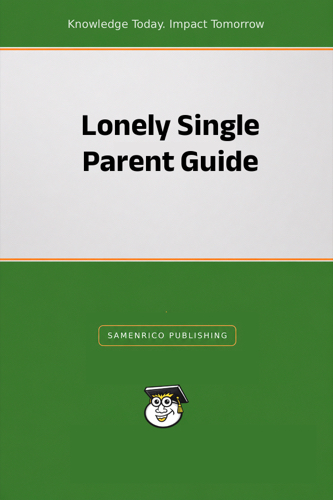
Non-FictionSelf-HelpSingle Parenting
Lonely Single Parent Guide eBook
Find adult connection while raising children alone
by Watt Jovita
Find adult connection while raising children alone.
Formats
Free sample
Chapter 1: The Silent Scream...--–- The alarm blares at 6:15 AM. You silence it with one hand while the other is already pinned beneath a sleeping toddler who crawled into your bed at 2 AM. Before your feet hit the floor, your brain is running: pack lunches, find the missing library book, sign the permission slip you forgot about, schedule the dentist appointment you have been putting off for three months, answer three work emails that came in overnight, and somehow locate a clean pair of socks that match. By 7:45 AM, you have broken up two fights, wiped three surfaces, poured cereal that no one wants to eat, and said the words “put your shoes on” eleven times. You buckle the last car seat strap, close the minivan door, and collapse into the driver’s seat.
For exactly twelve seconds, you sit in silence. And in that silence, you realize something that will not leave you for the rest of the day: you have not spoken a single word to another adult in over fourteen hours.This is the opening scene of a thousand variations, lived out every morning by millions of single parents who are never alone yet profoundly lonely. The paradox lands like a punch to the gut precisely because it makes no logical sense. How can someone who is constantly touched, talked at, tugged on, and needed feel so utterly and completely isolated? How can the chaos of raising tiny humans coexist with the crushing silence of an empty adult social life?
These two realities should cancel each other out. They do not. They amplify each other. The more you give to your children, the less you have left for yourself. And the less you have for yourself, the further you drift from the adult connections that once made you feel like a person rather than just a parent.This chapter is about naming that specific, rarely articulated pain.
It is about understanding the difference between being alone and feeling lonely, two states that look identical from the outside but could not be more different on the inside. It is about recognizing that the billion-dollar self-care industry has sold you a lie: bubble baths and scented candles will not cure social isolation. And most importantly, it is about giving you permission to stop apologizing for wanting adult connection. You are not desperate. You are not needy.
You are not broken. You are a human being who was never designed to raise children in a silo, and the fact that you are starving for conversation, eye contact, and the simple experience of being seen as something other than a delivery system for chicken nuggets is not a weakness. It is a biological imperative.Let us begin by understanding exactly what loneliness is, how it differs from the restorative solitude you actually need, and why the single parent experiences a version of loneliness that couples and child-free friends will never fully understand.The Loneliness Paradox: Never Alone, Yet Completely Isolated The term “loneliness paradox” was first used in academic literature to describe elderly individuals who lived in crowded nursing homes yet reported profound social isolation. Single parents experience an almost identical phenomenon. Your home is loud.
Your children demand constant attention. Your phone buzzes with school updates, pediatrician reminders, and ex-spouse logistics. By any objective measure, you are immersed in human interaction. But the quality of that interaction is what matters, and the quality for most single parents is devastatingly low.Interaction with children, especially young children, is fundamentally one-sided. You give instructions, provide comfort, wipe tears, negotiate bedtimes, and answer the same question (“why?”) forty-seven times before lunch.
This is caregiving, not connection. Caregiving is essential and meaningful, but it does not feed the part of your brain that craves peer-level reciprocity. That part requires someone who can hold up their end of a conversation, someone who remembers the same cultural references, someone who can say “I hear you” without needing you to define the words.The paradox deepens when you consider the logistics of single parenthood. Every errand must include children. Every meal must be planned around picky eaters.
Every bathroom break is accompanied by small fingers wiggling under the door. You are never alone in the physical sense, but the mental and emotional distance between you and the adults who used to know you grows wider by the day. Your coupled friends stop calling because they assume you are busy. Your child-free friends stop calling because they assume you have nothing in common anymore. Your own family offers help that feels more like judgment (“you should really get out more”) than actual assistance.
And so you retreat further into the only role that still makes sense: the parent.Alone-Ness Versus Loneliness: Two States That Look Alike But Feel Completely Different Before we go any further, we must untangle two concepts that most people use interchangeably but that could not be more different in their impact on your mental health. The English language does us no favors here. We have one word, “lonely,” to describe two radically different experiences. Let me give them distinct names.Alone-ness is a chosen, restorative, temporary state of solitude that recharges your batteries and deepens your relationship with yourself. It is the feeling of sitting on your porch with a cup of coffee after the kids are asleep, watching the sunset, and thinking absolutely nothing.
It is the pleasure of reading a novel for an uninterrupted hour while the laundry waits. It is the quiet hum of a long shower where the only voice in your head is your own, and it is kind to you. Alone-ness is a gift you give yourself. It does not hurt. It heals.Loneliness is an involuntary, painful, chronic state of disconnection that drains your energy and warps your self-perception.
It is the feeling of being surrounded by people at a birthday party yet having no one to talk to. It is the ache of watching other adults laugh together while you stand at the edge of the room holding a sleeping toddler. It is the silence of your phone, which buzzes only for logistics and never for “how are you, really?” Loneliness is not chosen. It is inflicted, often by circumstances beyond your control. And it harms you.Here is a quick self-assessment to help you distinguish which state you are experiencing most often.
Do not overthink it. Just answer honestly.The Alone-Ness vs. Loneliness Inventory Ask yourself these three questions:Do you feel energized or drained after a period of being by yourself? (Energized suggests alone-ness. Drained suggests loneliness.)Did you choose to be alone, or did it happen because no one was available?
(Choice points to alone-ness. Default points to loneliness.)When you imagine spending the evening by yourself, do you feel anticipation or dread? (Anticipation suggests alone-ness. Dread suggests loneliness.)If you answered “drained,” “default,” and “dread,” you are not experiencing healthy solitude. You are experiencing painful isolation.
And the first step toward fixing that is admitting that the problem is real, that it is not your fault, and that it will not go away by pretending you are fine.Why Traditional Self-Care Fails…
This is the end of the free sample. Get the eBook to keep going. Buy now
About this book
Details
- Author
- Watt Jovita
- Publisher
- SamEnrico
- Language
- English
- Genre
- Non-Fiction, Self-Help, Single Parenting
- Released
- 2026-06-06
- Pages (approx.)
- 127
- Available as
- eBook, Audiobook

Read better in the ZLOADR app
Your eBooks on your phone or tablet. Sign in with your SamEnrico account and start reading.
More by Watt Jovita
 Stress Reduction For Brain ProtectionWatt Jovita$11.99
 Sahara Camel Convoy GuideWatt Jovita$11.99
 Remote Pet Owner GuideWatt Jovita$11.99
 The Email Batching Focus GuideWatt Jovita$11.99
 Desert Mercy: The Medics of El AlameinWatt Jovita$11.99
 SXSW Pitch GuideWatt Jovita$12.99
 EE Post ITA Application GuideWatt Jovita$12.99
 Learn to Play the BlulWatt Jovita$11.99
 Auto Glass TechnicianWatt Jovita$11.99
 How to Start a Carbon Paper In Large Sheets Business (Beginners Guide)Watt Jovita$11.99
You may also like
 Hong Kong Handover 1997Dunn Johnnie$11.99
 Zumba For Postnatal Recovery CourseNeal Christian$11.99
 Zumba for BeginnersLadner Nikia$11.99
 YouTube Comment Mining GuideHumes Pandora$12.99
 Worry Box MeditationCarlin Rudy$11.99
 Workplace Stress MeditationNguyen Lynn$11.99
 Workplace Stress and Sleep RepairHawley Ivory$11.99
 Workplace Perfectionism CureDelaney Jeffry$11.99
 Workplace Injustice Anger GuideWallen Isabelle$11.99
 Work Addiction and Burnout LinkGreenwood Ester$11.99
 Women in Yoga and WellnessBeattie Galina$11.99
 Women in Stand Up ComedyChun Evangeline$11.99