
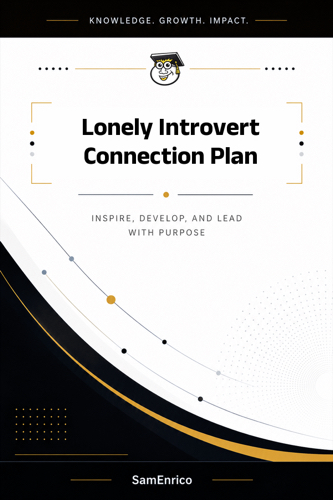
Non-FictionSelf-HelpIntroversion
Lonely Introvert Connection Plan eBook
Honor your need for solitude while avoiding harmfu
by Hartman Son
Honor your need for solitude while avoiding harmful isolation.
Formats
Free sample
Chapter 1: The Quiet Cage...--–- The first time someone told me to “come out of my shell,” I was seven years old. I didn’t know I had a shell. I thought I was just thinking. My second-grade teacher, Mrs. Alvarez, had asked the class what we wanted to be when we grew up.
The other children shouted answers—firefighter, astronaut, veterinarian, president. I sat quietly, turning the question over in my mind like a smooth stone. I wanted to be a writer. But I wanted to be a writer who lived in a house with a big library and a dog who slept under my desk while I worked. I was imagining the smell of old books and the sound of rain on the roof when Mrs.
Alvarez’s voice cut through: “And what about you, sweetheart? Don’t be shy. Come out of your shell.”I wasn’t shy. I was thinking. But I didn’t know how to say that.
So I mumbled “writer” and spent the rest of the day feeling like I had done something wrong simply by being quiet.That was the first lesson I learned about being an introvert in an extrovert’s world: silence is not neutral. Silence is read as fear, rudeness, sadness, or arrogance. Never as thoughtfulness. Never as depth. Never as a perfectly valid way of being alive.This chapter is about unlearning that first lesson.
It is about recognizing that your need for solitude is not a flaw to be fixed but a feature to be understood. And it is about drawing the most important distinction you will ever make as an introvert: the difference between solitude that heals and isolation that harms.The Extrovert Default: How the World Got It Wrong Before we can build a better relationship with solitude, we have to understand the system that taught us to fear it. I call this system the Extrovert Default—the unspoken cultural rule that says more people, more noise, more talking, and more social activity equal better living.The Extrovert Default is everywhere. Open any self-help book from the last fifty years, and you will find the same prescription: network more, speak up, put yourself out there, say yes to every invitation, build your brand through constant visibility. These books are not wrong for extroverts.
For a person who gains energy from social interaction, “say yes to everything” is excellent advice. But for the estimated thirty to fifty percent of the population who are introverts, that advice is not just unhelpful—it is actively dangerous.Consider the workplace. Open office plans, mandatory team-building retreats, brainstorming sessions that reward the loudest voice, performance reviews that penalize the quiet employee. Consider school. Graded participation, group projects that favor the dominant personality, teachers who mistake thinking time for disengagement.
Consider social life. The assumption that a Friday night spent alone is sad, that a wedding reception you leave early is a failure, that declining an invitation requires a detailed excuse rather than a simple “no thank you.”We have built a world that rewards extroversion and punishes introversion. And then we tell introverts that they are broken.You are not broken.The Extrovert Default is not a law of nature. It is a cultural preference that has been mistaken for universal truth. And the first step toward honoring your need for solitude is recognizing that you have been playing a game whose rules were written by and for people who are not like you.The Biology of Quiet: Why Your Brain Is Wired Differently The Extrovert Default would have you believe that your need for solitude is a psychological weakness—something you could overcome if you just tried harder, went to more parties, smiled more, talked more.
This is not only wrong; it is biologically illiterate.Drawing from the foundational research of Susan Cain’s Quiet and Marti Olsen Laney’s The Introvert Advantage, let me explain what is actually happening inside your brain. The difference between introverts and extroverts is not about shyness, social anxiety, or a preference for people. It is about how your nervous system responds to stimulation.Extroverts have a relatively low baseline of cortical arousal. This means their brains are naturally under-stimulated. To reach an optimal state of alertness, they seek out external stimulation—loud music, fast conversation, crowded rooms, multiple inputs at once.
This is why extroverts feel energized by parties and drained by silence. They need the noise to wake up their brains.Introverts have the opposite biology. Your baseline of cortical arousal is higher. Your brain is already processing a significant amount of information even when you are sitting still in a quiet room. This means you reach an optimal state of alertness with much less external input.
In fact, too much input—a crowded party, a long meeting, back-to-back calls—pushes you past your optimal zone into overstimulation. Your brain becomes overloaded. You feel tired, irritable, foggy, desperate to escape. This is not a personality flaw. This is neurology.There is more.
Research using f MRI scans has shown that introverts have more blood flow to the frontal lobes—the parts of the brain associated with planning, problem-solving, and deep thought. Extroverts have more blood flow to the areas associated with sensory processing. In other words, introverts are literally built for reflection. Extroverts are built for action.Neither is better. They are different.
But only one of them has been told their whole life that they need to change.The Critical Distinction: Solitude vs. Isolation Now we arrive at the most important concept in this book. Most people use the words “solitude” and “isolation” interchangeably. They do not mean the same thing. And confusing the two is how introverts end up either burning out from forced socializing or disappearing entirely from human connection.Let me give you a tool that will serve you for the rest of your life.
I call it the Solitude-Isolation Matrix. It has two axes:Choice: Did you choose this state, or was it forced upon you?Feeling: Does this state feel good (restorative, peaceful, meaningful) or bad (painful, empty, shameful)?When you combine these axes, you get four distinct states:1. HEALTHY SOLITUDE (Chosen + Feels Good)This is the gold standard. You have chosen to be alone. You are reading a book, taking a walk, writing in a journal, working on a creative project, or simply resting.
You feel peaceful, recharged, and content. There is no loneliness. There is only the quiet pleasure of your own company. Examples: saying no to a party because you want to stay home and paint; taking a solo camping trip; spending a Sunday morning with coffee and a novel.2. SELF-SABOTAGE (Chosen + Feels Bad)This is the danger zone that looks like solitude but feels like loneliness.
You have chosen to be alone, but instead of feeling peaceful, you feel empty, restless, or ashamed. You decline invitations not because you need rest but because you are afraid of being seen. You scroll social media for hours, comparing yourself to others and feeling worse. You tell yourself you are “recharging,” but you are actually hiding. This is not solitude.
This is self-sabotage. It feels chosen, but it does not feel good—and that is the signal that something is wrong.3.…
This is the end of the free sample. Get the eBook to keep going. Buy now
About this book
Details
- Author
- Hartman Son
- Publisher
- SamEnrico
- Language
- English
- Genre
- Non-Fiction, Self-Help, Introversion
- Released
- 2026-06-07
- Pages (approx.)
- 132
- Available as
- eBook, Audiobook

Read better in the ZLOADR app
Your eBooks on your phone or tablet. Sign in with your SamEnrico account and start reading.
More by Hartman Son
 Remote Procrastination FixHartman Son$11.99
 Five Senses MindfulnessHartman Son$11.99
 Teresa's Ecstasy DescriptionHartman Son$11.99
 The Hypnosis Audio Equipment GuideHartman Son$11.99
 Black Gold and Broken Chains: The Untold Saga of Queen Zingha of NdongoHartman Son$11.99
 Referral Program Pre LaunchHartman Son$12.99
 Portfolio Projects from MOOCsHartman Son$12.99
 Learn to Play the Steirische HarmonikaHartman Son$11.99
 Area Vice PresidentHartman Son$11.99
 How to Become a Garde MangerHartman Son$11.99
You may also like
 Hong Kong Handover 1997Dunn Johnnie$11.99
 Zumba For Postnatal Recovery CourseNeal Christian$11.99
 Zumba for BeginnersLadner Nikia$11.99
 YouTube Comment Mining GuideHumes Pandora$12.99
 Worry Box MeditationCarlin Rudy$11.99
 Workplace Stress MeditationNguyen Lynn$11.99
 Workplace Stress and Sleep RepairHawley Ivory$11.99
 Workplace Perfectionism CureDelaney Jeffry$11.99
 Workplace Injustice Anger GuideWallen Isabelle$11.99
 Work Addiction and Burnout LinkGreenwood Ester$11.99
 Women in Yoga and WellnessBeattie Galina$11.99
 Women in Stand Up ComedyChun Evangeline$11.99