
Non-FictionSelf-HelpVulnerability
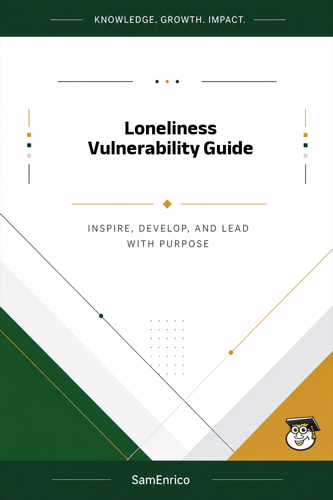
Loneliness Vulnerability Guide eBook
Share authentic feelings with others as a bridge t
Share authentic feelings with others as a bridge to genuine connection.
Formats
Free sample
Chapter 1: The Hunger You’ve Been Ignoring...--–- You feel it most often in the quiet moments. After you close the laptop. When the last notification fades. In the car, engine off, hands still on the wheel, no reason to get out. Or worse—in a crowded room where everyone seems to be speaking a language of easy connection that you never learned.
That ache behind your ribs. That low hum of “something is missing” that you’ve learned to live with, like a radiator that hisses all winter. You’ve named it many things: shyness. Social awkwardness. Being an introvert.
Being “just fine.” Being busy. Being tired. Being “not a people person.” But you have never called it by its real name, because its real name feels like an admission of failure.That name is loneliness.And this book begins with a radical claim: loneliness is not your fault, not a character flaw, and not a problem to be solved. It is a signal. Like thirst.
Like hunger. Like the pain that makes you pull your hand from a hot stove. Your body is trying to save your life.Let me prove it to you.The Biology of Broken Connection In 2003, a neuroscientist named Naomi Eisenberger conducted a study that would change how we understand loneliness. She asked participants to play a simple ball-tossing video game while inside an f MRI scanner—a machine that measures blood flow in the brain. The game, called Cyberball, was rigged.
After a few tosses, the other two players (who were actually computers) stopped throwing the ball to the participant. They excluded her. For no reason. The participant sat inside the scanner, watching a screen, being ignored by pixels.What Eisenberger saw in the scans was astonishing. The same regions of the brain that activate when you burn your hand or stub your toe—the dorsal anterior cingulate cortex and the anterior insula—lit up when a person was socially excluded.
Social pain and physical pain share the same neural real estate. Your brain does not distinguish between a broken bone and a broken heart.This is not metaphor. This is biology.Evolutionary psychologists believe this circuitry developed because for our ancestors, social exclusion was a death sentence. A human alone on the savannah could not hunt, could not defend against predators, could not care for offspring. The tribe was survival.
So the brain evolved an alarm system: when you are disconnected from others, you hurt. The hurt is not a punishment. It is a warning. A signal. A hunger.Think about hunger for a moment.
When you are hungry, you do not sit around thinking, “What a failure I am for needing food.” You eat. You do not blame yourself for the growling in your stomach. You recognize it as information: your body requires fuel. Loneliness is the same kind of information, but we have been taught to treat it differently. We have been taught that loneliness is shameful.
That it means we are unlikeable. Broken. Needy. Weak.What if none of that is true?What if loneliness is simply your authentic self starving for expression?The Two Lonelinesses You Didn’t Know You Had Before we go any further, we need to get precise about what we are feeling. Most people use the word “loneliness” to describe two very different experiences.
Confusing them is like confusing hunger with thirst—both make you uncomfortable, but drinking water will not satisfy starvation.Emotional loneliness is the absence of one person with whom you can share your innermost feelings. It is the specific ache of having no confidant. No one who knows your shame stories. No one who has seen you cry in the last year. No one you would call at 2 a.m.
if your world fell apart. You could have a hundred acquaintances, a bustling social calendar, a loving family—and still suffer from emotional loneliness. Because emotional loneliness is not about the number of people in your life. It is about the depth of the one or two who truly know you.Social loneliness is the absence of a broader social network. It is the ache of having no tribe.
No book club, no Sunday night dinner crew, no pickup basketball group, no colleagues who grab drinks after work. Social loneliness is about belonging to a community, feeling part of something larger than yourself. You could have a wonderful partner who knows everything about you—and still suffer from social loneliness if you have no wider circle.Most self-help books and well-meaning friends confuse these two. They tell the emotionally lonely person to “join a club” (which addresses social loneliness, not emotional). They tell the socially lonely person to “open up more” (which addresses emotional intimacy, not community).
It is like telling a starving person to drink water.Here is why this distinction matters for your life right now. Take out a piece of paper—or open a note on your phone—and answer these two questions:In the past month, have you had a conversation with anyone in which you shared something you were genuinely afraid or ashamed to share? (Yes/No)In the past month, have you participated in any group activity (not including work or family obligations) where you felt a sense of shared purpose or belonging? (Yes/No)If you answered No to question 1, your primary struggle is likely emotional loneliness. If you answered No to question 2, your primary struggle is likely social loneliness.
If you answered No to both, you are experiencing what researchers call “profound loneliness”—a double deficit that requires addressing both types.If you answered Yes to both, you may be surprised to find yourself reading a book about loneliness. But many people with rich connections still feel lonely. We will explore why in Chapter 3, when we discuss the Authenticity Gap—the space between the self you perform and the self you actually are.For now, simply hold the distinction. Emotional loneliness. Social loneliness.
Two hungers. Two different meals.The Loneliness Paradox (This Will Make You Angry)Here is where things get counterintuitive. Almost painful in their irony.The more lonely you feel, the more your brain goes into threat-detection mode. That same anterior cingulate cortex that registers social pain also primes you to look for rejection, criticism, and exclusion. You become hypervigilant.
You scan faces for signs of disgust. You interpret neutral texts as cold. You assume the person who didn’t say hello was avoiding you, not simply distracted.This is a survival mechanism. If you were exiled from the tribe once, your brain wants to make sure it never happens again. So it looks for danger everywhere.But here is the paradox: that hypervigilance changes your behavior in ways that repel the very connection you crave.
You become guarded. You hold back. You wait for the other person to prove they are safe before you reveal anything real. You answer “How are you?” with “Fine” because saying anything else feels like handing a weapon to someone who might hurt you. You laugh at jokes that don’t amuse you.
You agree with opinions you don’t hold. You perform a version of yourself that is pleasant, agreeable, and utterly unknowable.And…
This is the end of the free sample. Get the eBook to keep going. Buy now
About this book
Details
- Author
- Langford Diego
- Publisher
- SamEnrico
- Language
- English
- Genre
- Non-Fiction, Self-Help, Vulnerability
- Released
- 2026-06-10
- Pages (approx.)
- 146
- Available as
- eBook, Audiobook

Read better in the ZLOADR app
Your eBooks on your phone or tablet. Sign in with your SamEnrico account and start reading.
More by Langford Diego
 CrossFit Competition Prep ManualLangford Diego$11.99
 Antwerp Diamond Heist Forged DocumentsLangford Diego$11.99
 Teen Mistakes Growth GuideLangford Diego$11.99
 Stalking Healthcare Professional CasesLangford Diego$11.99
 The Last Broadcast of Radio Free AlaskaLangford Diego$11.99
 The Day the Internet Almost Died: The Great DDoS of 2016Langford Diego$11.99
 Understanding Double Tachycardia Induced By CatecholaminesLangford Diego$17.99
 How to Start a Secondary Schools BusinessLangford Diego$11.99
 Collective Bargaining BasicsLangford Diego$12.99
 AI Expense Management GuideLangford Diego$12.99
 Car DealerLangford Diego$11.99
You may also like
 Hong Kong Handover 1997Dunn Johnnie$11.99
 Zumba For Postnatal Recovery CourseNeal Christian$11.99
 Zumba for BeginnersLadner Nikia$11.99
 YouTube Comment Mining GuideHumes Pandora$12.99
 Worry Box MeditationCarlin Rudy$11.99
 Workplace Stress MeditationNguyen Lynn$11.99
 Workplace Stress and Sleep RepairHawley Ivory$11.99
 Workplace Perfectionism CureDelaney Jeffry$11.99
 Workplace Injustice Anger GuideWallen Isabelle$11.99
 Work Addiction and Burnout LinkGreenwood Ester$11.99
 Women in Yoga and WellnessBeattie Galina$11.99
 Women in Stand Up ComedyChun Evangeline$11.99