
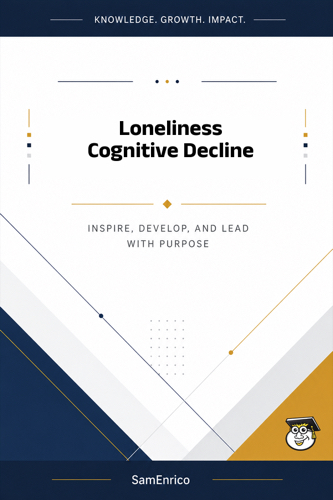
Non-FictionSelf-HelpLoneliness
Loneliness Cognitive Decline
Social isolation and brain health risks.
Social isolation and brain health risks.
Formats
About this book
Free sample
Chapter 1: The Quiet Epidemic...--For most of human history, loneliness was a temporary condition. You felt it after a migration, a death, or an exile, and then you要么 found a new tribe要么 died trying. The brain evolved to treat isolation as an acute emergency, not a chronic condition. That is why your heart races when you are left out of a conversation. That is why rejection hurts like physical pain—because to your ancient limbic system, social exclusion truly was a matter of life and death.But something has changed in the last forty years, something unprecedented in the history of our species.
We have become the most connected generation in human history, measured by data transfer, social media accounts, and messages sent per day. And we have also become the loneliest. The two facts are not contradictory. They are causally linked. The very technologies that allow us to broadcast our lives to thousands of strangers have, paradoxically, eroded the skills and structures that produce genuine intimacy with a handful of people who actually know us.Consider the numbers, because they are not abstract statistics.
They are your neighbors, your coworkers, your parents, and possibly you.In 1980, when the first personal computers were appearing in homes and the concept of "social media" was still science fiction, roughly 11 percent of American adults reported having no close friends. By 2021, that number had risen to 27 percent among adults under sixty and 35 percent among those over sixty. A 2023 Harvard study, the most comprehensive survey of American loneliness ever conducted, found that 36 percent of all adults—approximately ninety million people—reported feeling "seriously lonely" at least once a week. Among young adults aged eighteen to twenty-five, the number was 61 percent. Among single parents, it was 65 percent.
Among those with chronic illness, it was 72 percent.These are not trivial numbers. They are not the background noise of a changing society. They are a public health emergency hiding in plain sight, because loneliness is not merely an emotional state. It is a biological signal with biological consequences. And those consequences, as this book will show you in…
This is the end of the free sample. Get the eBook to keep going. Buy now
Contents
- Chapter 1
- Chapter 2
- Chapter 3
- Chapter 4
- Chapter 5
- Chapter 6
- Chapter 7
- Chapter 8
- Chapter 9
- Chapter 10
- Chapter 11
- Chapter 12
Details
- Author
- Arevalo Albina
- Publisher
- SamEnrico
- Language
- English
- Genre
- Non-Fiction, Self-Help, Loneliness
- Released
- 2026-06-11
- Pages (approx.)
- 114
- Available as
- eBook, Audiobook

Read better in the ZLOADR app
Your eBooks on your phone or tablet. Sign in with your SamEnrico account and start reading.
More by Arevalo Albina
 Physical Abuse Self Worth RepairArevalo Albina$11.99
 Nightmare Processing For OCDArevalo Albina$11.99
 Pregnancy Loss PodcastsArevalo Albina$11.99
 Low Carb Bodybuilding BlueprintArevalo Albina$11.99
 Unmet Expectation TriggersArevalo Albina$11.99
 Memory Conformity PressureArevalo Albina$11.99
 The Tsar's Imperial Falcons: Russia's Feathered AmbassadorsArevalo Albina$11.99
 The Raven's Prophecy: How a Trickster Shaped the WorldArevalo Albina$11.99
 Understanding Thomsen DiseaseArevalo Albina$11.99
 How to Produce Spice GrindersArevalo Albina$11.99
 A Collector's Handbook to the Daimler De36Arevalo Albina$11.99
 Succession Tax Advisor SelectionArevalo Albina$12.99
You may also like
 Hong Kong Handover 1997Dunn Johnnie$11.99
 Zumba For Postnatal Recovery CourseNeal Christian$11.99
 Zumba for BeginnersLadner Nikia$11.99
 YouTube Comment Mining GuideHumes Pandora$12.99
 Worry Box MeditationCarlin Rudy$11.99
 Workplace Stress MeditationNguyen Lynn$11.99
 Workplace Stress and Sleep RepairHawley Ivory$11.99
 Workplace Perfectionism CureDelaney Jeffry$11.99
 Workplace Injustice Anger GuideWallen Isabelle$11.99
 Work Addiction and Burnout LinkGreenwood Ester$11.99
 Women in Yoga and WellnessBeattie Galina$11.99
 Women in Stand Up ComedyChun Evangeline$11.99