
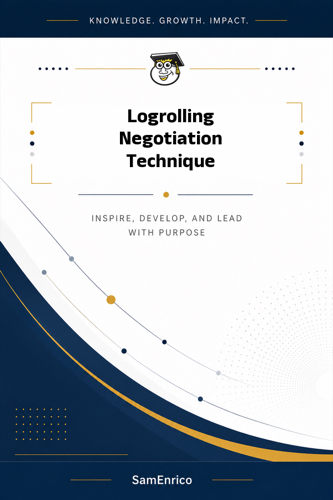
Logrolling Negotiation Technique eBook
Trade issues where value differs to create win win
by Gurley Orval
Trade issues where value differs to create win win outcomes.
Formats
Free sample
Chapter 1: The Half‑Loaf Trap--–- Most negotiators believe that a fair outcome is a 50/50 split. They enter rooms carrying a mental calculator, ready to meet the other side in the middle. It feels reasonable. It feels balanced. It feels like justice.
And it is almost always wrong.Imagine you are negotiating your salary for a new job. The employer offers $100,000. You ask for $120,000. After twenty minutes of polite back-and-forth, you land on $110,000. You shake hands.
You feel like you won half the battle. The employer feels like they saved $10,000 from your initial demand. Everyone leaves satisfied—or so they tell themselves.But here is the question this book will force you to ask: Was that the best possible outcome?What if you valued flexible hours more than an extra $10,000? What if the employer valued a longer probation period more than saving $5,000? What if you could have traded a later start date for a professional development budget?
What if the employer could have given you an extra week of vacation at zero cost to them while you gave up a signing bonus that mattered little to you?The $110,000 compromise answered none of those questions. It split the difference on one issue—salary—while ignoring every other dimension of value. That is not negotiation. That is arithmetic pretending to be strategy.This chapter will dismantle the most common, most intuitive, and most destructive fallacy in negotiation: the belief that splitting the difference creates value. In its place, we will build the foundation for logrolling—the sophisticated practice of trading across issues to create outcomes where both parties get more of what they truly care about.
By the end of this chapter, you will understand why compromise is often a lose-lose outcome in disguise, and you will be ready to abandon the half-loaf trap forever.The Seduction of the Middle Why do we love splitting the difference? The answer lies deep in our psychology. The fairness heuristic—the cognitive shortcut that tells us “equal is fair”—is one of the most powerful forces in human decision-making. Behavioral economists have documented the “ultimatum game” effect for decades: when one person proposes a split of $10 and the other can either accept or reject it (receiving nothing if they reject), offers below $3 are routinely turned down—not because $3 is worthless, but because the split feels unfair. People will sacrifice their own gain to punish inequity.This instinct serves us well in many contexts.
Splitting a restaurant bill equally among friends is efficient. Dividing an inheritance equally among siblings prevents resentment. But in negotiation, the fairness heuristic becomes a trap. Why? Because negotiation is not about dividing a known, fixed pie.
It is about discovering and reconfiguring a pie whose boundaries are invisible until you map them.Consider the salary negotiation again. When you split $100,000 and $120,000 down the middle, you are making a hidden assumption: that salary is the only thing that matters. In reality, the typical employment negotiation involves at least six distinct issues: base salary, performance bonus, vacation days, remote work flexibility, professional development budget, and start date. Each of these has different value to you and to the employer.What if you value remote work flexibility at $15,000 per year (because it saves you commuting costs and childcare expenses) but it costs the employer nothing? What if the employer values a longer probation period at $10,000 (because it reduces their hiring risk) but it costs you nothing?
By splitting the difference on salary alone, you and the employer left $25,000 of untapped value on the table.That is the half-loaf trap. You walked away with a loaf that was cut in half. But with the right trade, you could have walked away with a full loaf and given the other side a full loaf of their own.The Anatomy of a Lose‑Lose Compromise Let me be precise about what makes compromise destructive. A compromise is an agreement in which both parties give up something they wanted in order to meet in the middle. The logic is symmetric: I give up $10,000 of my ask; you give up $10,000 of your offer.
We each lose something. We each gain something. We call it fair.But here is the problem: compromise assumes that all issues are equally important to both parties. That assumption is almost never true.In any multi-issue negotiation, each party has a hierarchy of priorities. Some issues matter a great deal.
Some matter very little. Some are deal-breakers. Some are throwaways. When you compromise—when you split the difference on each issue individually—you are treating every issue as if it were equally important to both sides. You are ignoring the very differences that make value creation possible.A true lose-lose compromise occurs when both parties give up something they valued highly in exchange for something they valued little.
This happens constantly in real-world negotiations. Consider these examples:Example One: The Vendor Contract A software company negotiates with a vendor on price and delivery timeline. The vendor offers $50,000 and 30 days. The software company asks for $40,000 and 45 days. They compromise: $45,000 and 37.5 days.
The software company values the lower price (they are cash-constrained) but does not care much about delivery timeline (they have inventory). The vendor values the longer timeline (they have production capacity issues) but does not care much about price (they have high margins). Under the compromise, the software company got a price that is still too high and a timeline that is irrelevant. The vendor got a timeline that is still too tight and a price that is irrelevant. Both lost.
A trade—$40,000 for 45 days in exchange for the vendor keeping timeline at 30 days—would have given each exactly what they valued.Example Two: The Divorce Settlement A divorcing couple negotiates over the family home and custody of the dog. One spouse wants the home (emotional attachment) but doesn't care about the dog. The other spouse wants the dog (emotional attachment) but doesn't care about the home. They compromise: sell the home and split the proceeds, share custody of the dog every other week. Both are miserable.
The first spouse lost the home they loved and now has to manage shared dog custody they didn't want. The second spouse lost the dog they loved and now has to deal with selling a home they didn't care about. A trade—home to first spouse, dog to second spouse—would have given each 100% of what they valued.Example Three: The Merger Integration Two companies merging disagree on two issues: which IT platform to adopt and which brand name to keep. Company A cares deeply about keeping their IT platform (it is customized to their processes) but doesn't care about the brand name (their brand is weak). Company B cares deeply about keeping their brand name (it has market recognition) but doesn't care about the IT platform (their system is outdated).
They compromise: adopt a third, new IT platform and create a new combined brand name. Both spend millions on migration and rebranding. Both are unhappy. A trade—keep Company A's IT platform and Company B's brand name—would have given each exactly what they valued at zero additional cost.In each case, the compromise was symmetrical but stupid. The trade…
This is the end of the free sample. Get the eBook to keep going. Buy now
About this book
Details
- Author
- Gurley Orval
- Publisher
- SamEnrico
- Language
- English
- Genre
- Non-Fiction, Business Brief, Trade offs
- Released
- 2026-06-10
- Pages (approx.)
- 148
- Available as
- eBook, Audiobook

Read better in the ZLOADR app
Your eBooks on your phone or tablet. Sign in with your SamEnrico account and start reading.
More by Gurley Orval
 Digital Legacy GuideGurley Orval$11.99
 Gambling Addiction and Employment SearchGurley Orval$11.99
 WhatsApp Group ComparisonGurley Orval$11.99
 Notion Gantt Chart Timeline ViewGurley Orval$11.99
 The Attention and Memory LinkGurley Orval$11.99
 Interruption Success StoriesGurley Orval$11.99
 Gray Divorce RecoveryGurley Orval$11.99
 The Bloodhound and the Ballot: How Dogs Sniffed Out Voter Fraud in 2000Gurley Orval$11.99
 The Quantum Leap: How a Forgotten Genius Almost Changed the WorldGurley Orval$11.99
 Growing BartlettinaGurley Orval$11.99
 Generative AI Brand Voice GuideGurley Orval$12.99
 Co Founder Green Flags GuideGurley Orval$12.99