
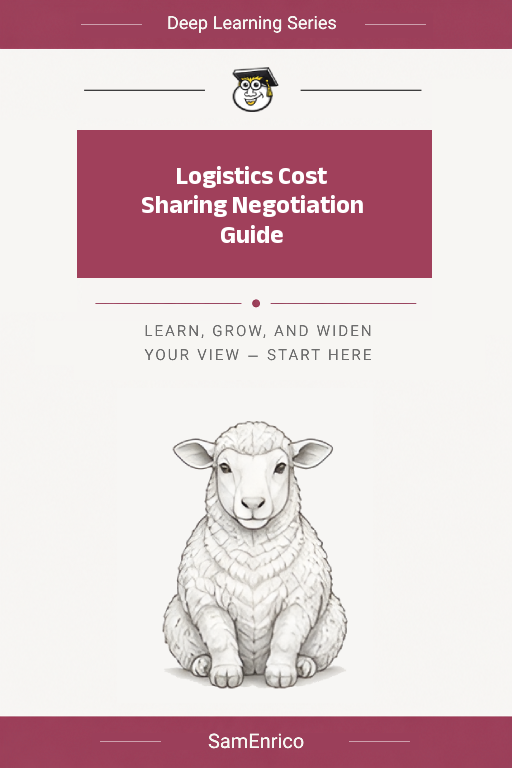
Logistics Cost Sharing Negotiation Guide eBook
Split freight costs or negotiate delivered duty pa
by Person Jeane
Split freight costs or negotiate delivered duty paid terms that transfer risk and simplify budgeting.
Formats
Free sample
Chapter 1: The Free Freight Fantasy--–- In a conference room overlooking a sprawling distribution center in Ohio, a procurement director named Sarah had just done something she thought was brilliant. She had negotiated a deal where her largest supplier agreed to absorb all freight costs. “Free shipping,” she announced to her team, expecting applause. Instead, six months later, she was sitting across from her CFO, explaining why her division had overspent its logistics budget by $4.2 million. The freight wasn’t free.
It had never been free. And the “savings” she had celebrated were, in fact, a financial trap that had been hiding in plain sight.The Most Expensive Word in Logistics Let’s get one thing straight from the opening pages of this book: There is no such thing as free freight.If you are a procurement professional, supply chain manager, or business owner who has ever celebrated a “supplier-paid freight” agreement, you have likely been misled—not by malice, but by the seductive simplicity of a single word. Free. It sounds like victory. It sounds like you have beaten the system.
But in the world of logistics cost sharing, “free” is the most expensive word you will ever encounter.Why? Because every cost in a supply chain gets paid by someone. When a supplier agrees to “cover freight,” they do not magically absorb that expense out of goodwill or operational efficiency. They hide it. They shift it.
They bury it in your unit price, your minimum order quantities, your less favorable payment terms, or—most dangerously—in the quality of service you receive. The freight bill disappears from your ledger, but the cost never leaves the system. It simply becomes invisible.And invisible costs are the hardest to control.This chapter will dismantle the illusion that has cost companies billions of dollars in unplanned logistics expenses. We will explore why traditional freight negotiation models are fundamentally broken, how ambiguous shipping language creates budget disasters, and why the question you should be asking is not “who pays the bill?” but rather “who controls the risk?”By the end of this chapter, you will never again celebrate a “free freight” agreement without first looking under the hood. And you will understand the central thesis that drives every subsequent chapter of this book: Control is more valuable than payment.The FOB Origin Trap: How Buyers Get Hooked To understand why “free freight” is a fantasy, we first need to understand the most common trap that buyers fall into: FOB Origin.
Under standard Incoterms (which we will explore in depth in Chapter 2), FOB Origin means that the buyer takes ownership and risk of the goods the moment they are loaded onto the carrier’s truck at the supplier’s dock. From that point forward, the buyer is responsible for everything—the main carriage, the insurance, the customs clearance (if cross-border), and all associated costs.Here is where the trap springs shut. Many buyers believe that if they negotiate “supplier pays freight,” they have avoided the risks of FOB Origin. But the terms “FOB Origin” and “supplier pays freight” are not mutually exclusive. A supplier can absolutely agree to pay the freight bill while still transferring risk to the buyer at the point of origin.
In that scenario, the buyer is paying for the freight—just indirectly, through a higher product price or a separate line item that has been rebranded as something else.Consider a typical example. A buyer in Chicago purchases electronics from a supplier in Shenzhen. The supplier quotes 100perunit FOBShenzhen.Thebuyernegotiates“freefreight”andthesupplieragrees.Whatactuallyhappens?Thesupplierraisestheunitpriceto100 per unit FOB Shenzhen. The buyer negotiates “free freight” and the supplier agrees. What actually happens?
The supplier raises the unit price to 100perunit FOBShenzhen.Thebuyernegotiates“freefreight”andthesupplieragrees.Whatactuallyhappens?Thesupplierraisestheunitpriceto115, adds a “logistics coordination fee” of $3 per unit, and lengthens the payment terms from net 30 to net 10. The buyer’s landed cost has not decreased. It may have increased. But because the freight line item has disappeared from the invoice, the buyer feels a false sense of victory.This is not an edge case. It is the norm.The Real Cost of FOB Origin The hidden dangers of FOB Origin extend far beyond opaque pricing.
When the buyer takes risk at the supplier’s dock, they also take responsibility for:Carrier selection and contracting. If the buyer does not control the carrier, they cannot optimize routes, consolidate shipments, or negotiate volume discounts.Damage claims. Under FOB Origin, the buyer must file claims directly with the carrier—a process that can take months and often recovers pennies on the dollar.Demurrage and detention. If the shipment is delayed at the port or warehouse, the buyer is on the hook for daily storage fees that can quickly escalate into five-figure charges.Routing changes. If a disruption occurs (a port strike, a canal closure, a weather event), the buyer bears the cost of rerouting or expediting.These are not theoretical risks.
They are line items on real invoices that have crushed real budgets.The $500 Million Mistake: A Case Study in Ambiguity Let me tell you about a company I will call Retail Corp —a major American retailer with over 2,000 stores and annual revenue exceeding $40 billion. In 2019, Retail Corp’s procurement team negotiated what they believed was a masterstroke: a three-year contract with a Southeast Asian apparel manufacturer that included “supplier-paid freight to Retail Corp’s regional distribution centers.”The language seemed clear. The price was competitive. The deal was signed.What followed was a logistics nightmare.The contract had one fatal flaw: it did not specify which Incoterm governed the shipment. The phrase “supplier-paid freight” was not defined.
Was it FOB Origin with the supplier paying the bill? Was it DDP (Delivered Duty Paid)? Was it something in between? No one knew. And when the first container arrived at the Port of Los Angeles, the ambiguity metastasized into crisis.The shipment was held in customs for three weeks because no one had been designated as the Importer of Record.
Demurrage fees accrued at 450perdaypercontainer.Bythetimethegoodswerereleased,Retail Corphadaccumulatedover450 per day per container. By the time the goods were released, Retail Corp had accumulated over 450perdaypercontainer.Bythetimethegoodswerereleased,Retail Corphadaccumulatedover800,000 in charges. But who was responsible? The supplier argued that “supplier-paid freight” meant they would pay the ocean carrier, not port fees. Retail Corp argued that “freight” included all transportation costs.
The contract was silent.Over the next 18 months, similar disputes arose at every stage of the supply chain: detention fees at the distribution center (whose truck driver waited too long?), fuel surcharges (were they part of freight or separate?), and even insurance claims for water-damaged goods (did the damage occur before or after the undefined “freight” handover?).The Final Toll By the time the contract was terminated, Retail Corp had absorbed over $500 million in unplanned logistics costs across its entire supplier base—not just this one manufacturer. The ambiguity in one contract had set a precedent that rippled across dozens of others. Procurement had celebrated “free freight” while finance was hemorrhaging cash.The post-mortem revealed a painful truth: Retail Corp had never negotiated freight at all. They had negotiated an invoice reallocation. The costs still existed.
The risks still existed. The only thing that had changed was which line item the bill appeared on.This case study…
This is the end of the free sample. Get the eBook to keep going. Buy now
About this book
Details
- Author
- Person Jeane
- Publisher
- SamEnrico
- Language
- English
- Genre
- Non-Fiction, Business Brief
- Released
- 2026-06-02
- Pages (approx.)
- 144
- Available as
- eBook, Audiobook

Read better in the ZLOADR app
Your eBooks on your phone or tablet. Sign in with your SamEnrico account and start reading.
More by Person Jeane
 Meth Voice Recovery GuidePerson Jeane$11.99
 Imposter Syndrome for Sales ProfessionalsPerson Jeane$11.99
 Weekend Catch Up MemoryPerson Jeane$11.99
 Four Way Stop Etiquette GuidePerson Jeane$11.99
 Retirement Estate Planning GuidePerson Jeane$11.99
 Fourth Quarter Comeback CodePerson Jeane$11.99
 Cold Bath RLS ReliefPerson Jeane$11.99
 Bokassa Central AfricanPerson Jeane$11.99
 The Queen Who Outplayed the Crown: The Untold Story of Queen Anne’s Political MasteryPerson Jeane$11.99
 Huldra’s Hollow: The Enchantress of the Nordic WoodsPerson Jeane$11.99
 Longwang's Lost Pearl: The Dragon King's Last GambitPerson Jeane$11.99
 How to Become a ArrowsmithPerson Jeane$11.99
You may also like
 Hong Kong Handover 1997Dunn Johnnie$11.99
 Zumba For Postnatal Recovery CourseNeal Christian$11.99
 Zumba for BeginnersLadner Nikia$11.99
 YouTube Comment Mining GuideHumes Pandora$12.99
 Worry Box MeditationCarlin Rudy$11.99
 Workplace Stress MeditationNguyen Lynn$11.99
 Workplace Stress and Sleep RepairHawley Ivory$11.99
 Workplace Perfectionism CureDelaney Jeffry$11.99
 Workplace Injustice Anger GuideWallen Isabelle$11.99
 Work Addiction and Burnout LinkGreenwood Ester$11.99
 Women in Yoga and WellnessBeattie Galina$11.99
 Women in Stand Up ComedyChun Evangeline$11.99