
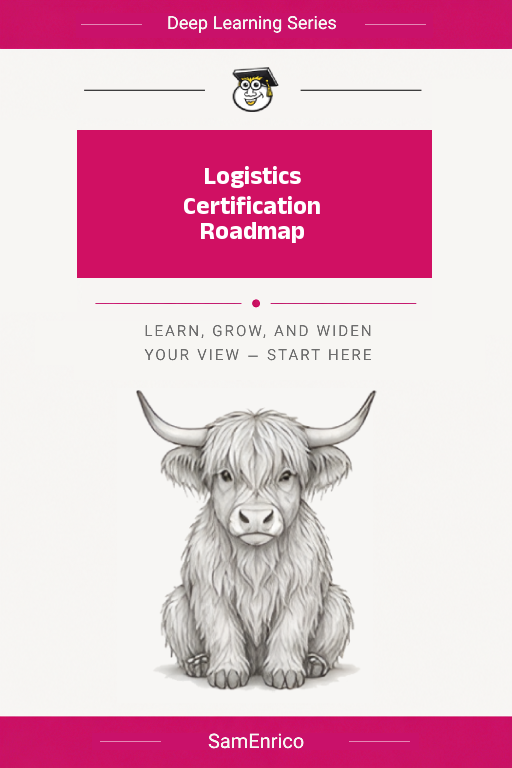
Logistics Certification Roadmap eBook
Earn APICS, CSCP, CLTD, and Six Sigma credentials
by Kopp Suzann
Earn APICS, CSCP, CLTD, and Six Sigma credentials without a traditional degree.
Formats
Free sample
Chapter 1: The $86,000 Lie--The first thing you need to know is that someone has been lying to you. It wasn't malicious, probably. It was likely delivered with good intentions by parents, teachers, guidance counselors, and well-meaning bosses who genuinely believed they were giving you the right advice. But it was a lie nonetheless, and that lie has cost you years of higher wages, better job titles, and the professional respect you have earned through hard work.The lie sounds something like this: "You need a four-year degree to build a successful career."Maybe you heard it in high school when you were filling out college applications you couldn't afford. Maybe you heard it from a hiring manager who glanced at your resume, saw no bachelor's degree, and slid it into the rejection pile without reading about your ten years of warehouse experience.
Maybe you hear it every time you scroll through Linked In job postings that list "Bachelor's degree required" as the very first line, before describing a job you know you could do in your sleep.Here is the truth that the data reveals: Professional certifications have become the new currency of credibility in logistics and supply chain management. And for non-degree holders, they represent the single fastest path from the warehouse floor to the corner office.The 2025 ASCM Supply Chain Salary Report delivers a number that should stop you cold. Supply chain professionals with APICS certifications earn a median salary of 103,000.Thosewithoutcertificationearnamedianof103,000. Those without certification earn a median of 103,000.Thosewithoutcertificationearnamedianof86,000. That is a 20 percent premium.
Twenty percent just for holding a credential that takes most people six to nine months to earn and costs less than $3,000.Let me put that in terms that matter to someone working a warehouse shift right now. If you are earning 50,000asashiftsupervisororinventorycoordinator,a20percentincreasetakesyouto50,000 as a shift supervisor or inventory coordinator, a 20 percent increase takes you to 50,000asashiftsupervisororinventorycoordinator,a20percentincreasetakesyouto60,000. That is an extra 10,000peryear–nearly10,000 per year – nearly 10,000peryear–nearly1,000 per month before taxes. If you are earning 60,000asalogisticsspecialist,youjumpto60,000 as a logistics specialist, you jump to 60,000asalogisticsspecialist,youjumpto72,000. Over five years, that certification could generate an additional 50,000to50,000 to 50,000to100,000 in lifetime earnings.
The return on investment is staggering: spend $3,000 and six months of evenings to earn an extra half-million dollars over your career.And that is just for holding one certification. The same report found that professionals with two or more certifications earn 14 percent more than those with just one. At the 75th percentile, professionals with multiple certifications earn $143,000 annually. That is not Silicon Valley money – that is supply chain money, earned by people who understand inventory turns, transportation modes, and warehouse optimization.The Death of the Degree Requirement Something fundamental has shifted in American hiring practices over the past five years. The labor market has experienced shocks that no economist fully predicted: the Great Resignation, the pandemic-induced supply chain crisis, the rapid acceleration of e-commerce, and now the integration of artificial intelligence into logistics operations.
Throughout all of this, one constant has emerged – employers cannot find enough qualified workers.The talent shortage in logistics and supply chain management has become so severe that companies have been forced to abandon the degree requirements that once served as automatic filters. According to the 2024 ASCM Talent Report, 68 percent of supply chain employers have eliminated bachelor's degree requirements for mid-level logistics roles in the past three years. Another 22 percent are actively reviewing their degree requirements with plans to revise them.Why the sudden change? Because degrees stopped predicting job performance. A study of logistics hiring data found that a candidate's college major had virtually no correlation with on-the-job success in supply chain roles after the first two years of employment.
What did predict success? Certifications. Previous logistics experience. Demonstrated problem-solving ability. And the specific technical skills tested by certifying bodies like ASCM and IASSC.The shift is most visible in job postings themselves.
Go to Linked In or Indeed right now and search for "Logistics Manager" in any major city. Count how many postings still say "Bachelor's degree required." Then count how many say "Bachelor's degree preferred" or "Equivalent experience accepted." The trend is unmistakable. Employers are desperate, and desperation has made them flexible.But flexibility alone is not enough. You need leverage. You need something that proves to an employer that you know what you are doing, that you have invested in yourself, and that you bring current, relevant knowledge to the table.
That something is certification.What Certifications Actually Tell Employers Let me be direct about what a certification does and does not prove. A certification does not prove that you are smart. It does not prove that you came from a good family or that you can write a ten-page research paper about 19th-century literature. Those things matter in some professions. They do not matter in logistics.What a certification proves is narrower, more practical, and ultimately more valuable to an employer.
A certification proves that you have mastered a specific body of knowledge that is directly relevant to the work you will be asked to do. It proves that you can learn technical material, retain it, and apply it to pass a rigorous examination. It proves that you have taken initiative – that you did not wait for someone to hand you a promotion but instead invested your own time and money to become more valuable.Consider the difference between a degree and a certification from the employer's perspective. A bachelor's degree in business administration might include one course on supply chain management, tucked into the junior year alongside marketing, finance, and organizational behavior. That course was taught by a professor who may never have set foot in a warehouse.
The textbook was published three years ago, which in supply chain terms is practically ancient history. And the student took that class once, passed the final, and promptly forgot most of it.A certification, by contrast, requires ongoing, focused study of nothing but supply chain topics. The exam tests current best practices, not theories from a textbook written before the pandemic disrupted every assumption about global logistics. And because certifications require recertification every three to five years, the certified professional has a built-in incentive to stay current with industry changes. The employer does not have to wonder whether your knowledge is stale – the recertification clock guarantees freshness.This is why certifications have become the new college degree for logistics.
They are more current, more relevant, more rigorous in the specific ways that matter, and far more affordable. They also level the playing field for people who could not afford the traditional path.The People This Book Is For I want to be specific about who I am writing for, because this book is not for everyone. If you have a bachelor's degree in supply chain management and ten years of experience at Amazon, you probably do not need this book. You are doing fine. This book is for everyone else.This book is for the warehouse worker who has spent eight years stacking pallets, operating forklifts, and training new hires, but cannot get promoted to supervisor because the posting requires a degree.
You know more about how that warehouse actually runs than any recent college graduate ever will. You know which dock…
This is the end of the free sample. Get the eBook to keep going. Buy now
About this book
Details
- Author
- Kopp Suzann
- Publisher
- SamEnrico
- Language
- English
- Genre
- Non-Fiction, Non Obvious Career, Certification
- Released
- 2026-05-29
- Pages (approx.)
- 137
- Available as
- eBook, Audiobook

Read better in the ZLOADR app
Your eBooks on your phone or tablet. Sign in with your SamEnrico account and start reading.
More by Kopp Suzann
 Remote Work Weekly PlanningKopp Suzann$11.99
 Retirement Housing Property Tax TransferKopp Suzann$11.99
 Assertive Meeting CommunicationKopp Suzann$11.99
 Sunscreen Chemical FiltersKopp Suzann$11.99
 Parent Loss Books ListKopp Suzann$11.99
 Running Away from Foster CareKopp Suzann$11.99
 Remote Work New Hire GuideKopp Suzann$11.99
 Success Without Burnout for NursesKopp Suzann$11.99
 Rhythm of the Sphinx: The Forgotten Composer of Ancient EgyptKopp Suzann$11.99
 The Great Formula Heist: The Cold War Race for DuPont’s SecretKopp Suzann$11.99
 A Collector's Handbook to the Mg 18Kopp Suzann$11.99
 Service Providers Guide to MusicKopp Suzann$11.99