
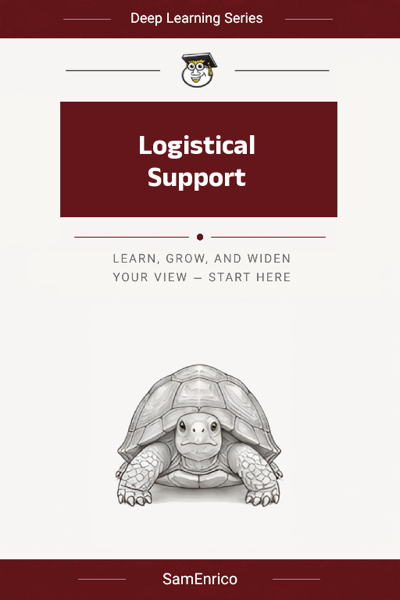
Non-FictionInformativeEducational
Logistical Support eBook
A Coursebook on Logistical Support
by Higgs Billye
A Coursebook on Logistical Support
Formats
Free sample
Chapter 1: The Invisible Giant...–- On a Tuesday morning in March, a container ship the length of the Empire State Building tilted sideways in the Suez Canal. Within six hours, $9 billion in global trade had stopped moving. Within one week, factories in Ohio had halted production because a single type of resin—used to make dashboard components—was sitting in a container on the wrong side of that stuck ship. Within one month, the price of bathroom fixtures in Iowa had risen 17 percent. No war had been declared.
No natural disaster had struck. A single piece of steel, caught in mud, had reached across the globe and rearranged the lives of millions of people who had never heard of the Suez Canal, who did not know what a shipping container looked like, and who certainly did not wake up that Tuesday morning thinking about logistics.And yet, logistics was all they were thinking about. They just did not know it yet.This is the central paradox of logistical support: when it works, absolutely no one notices. The strawberry arrives at the grocery store in February. The emergency room has the right blood type.
The part you ordered online arrives at your door within thirty-six hours. None of these events register as remarkable. They are simply the background hum of a functioning society. But when logistical support fails, it becomes the only story. The empty shelf.
The grounded aircraft. The delayed surgery. The stalled factory. Suddenly, everyone is an expert on supply chains. Suddenly, everyone wants to know why the system broke.The answer, almost always, is not that the system broke.
It is that the system was never designed to be supported in the first place.This book is about that distinction. It is about the difference between moving things and keeping things moving. It is about the difference between buying an asset and owning an asset over its entire life. It is about the difference between a product that works on the first day and a product that still works on the thousandth day. And it is about you—not as a passive observer of logistical failures, but as someone who will be responsible for preventing them.Let us begin with a story.
Not the Suez Canal story—that one is already famous. A smaller story, one that never made the news, but one that illustrates everything you need to understand about why logistical support matters and why most organizations get it catastrophically wrong.The Ten-Million-Dollar Bolt In 2016, a defense contractor delivered a new generation of military communication terminals to the United States Army. The terminals were extraordinary pieces of engineering. They could transmit encrypted data across thousands of miles, resist electronic jamming, and operate in temperatures ranging from forty degrees below zero to one hundred and twenty degrees above. They had been tested in wind tunnels, in anechoic chambers, in desert simulations, and in Arctic simulations.
They passed every test with flying colors.The terminals were deployed to forward operating bases in Afghanistan. Within ninety days, 40 percent of them had stopped working.The problem was not the sophisticated electronics. The problem was not the encryption software. The problem was not the power supply or the antenna or any of the components that had been carefully tested and certified. The problem was a single bolt—a small, unassuming, utterly unremarkable fastener that held the terminal's casing closed.Here is what happened.
The bolt was a custom design, manufactured specifically for this terminal by a single supplier in Wisconsin. When a technician in the field needed to open the casing for routine maintenance or minor repairs, they removed the bolt. And then, in a surprising number of cases, they dropped the bolt. Sand, gravel, mud, snow, darkness, fatigue, enemy fire, the chaos of a forward operating base—the bolt would roll off the workbench, fall into the dirt, and vanish.No problem, you might think. Order a replacement.But the bolt was a custom design, manufactured specifically for this terminal by a single supplier in Wisconsin.
The supplier had a minimum order quantity of one thousand bolts and a lead time of ninety days. The Army could not order one bolt. It could not order fifty bolts. It could order one thousand bolts at a cost of forty-seven thousand dollars, and it could wait three months for delivery.In the meantime, the terminals sat idle. Soldiers carried paper maps instead of using the digital mapping capability of the terminals.
Radio silence was broken because the encrypted communication link was unavailable. The operational impact was measured not in dollars but in mission degradation and, in a few documented cases, in lives lost.The bolt itself cost less than two dollars to manufacture. The cost of the terminal was two hundred fifty thousand dollars. The cost of its unavailability over ninety days was estimated at over ten million dollars in operational impact, wasted soldier time, and expedited logistics to airlift functional terminals from other locations.All of this—the ten million dollars, the degraded missions, the three-month wait, the custom bolt, the single supplier, the ninety-day lead time, the minimum order quantity of one thousand—all of this was determined before the first terminal was ever built. It was determined by a design decision, made by an engineer who almost certainly never thought about bolts at all.
The engineer was focused on performance, on reliability, on signal processing and encryption algorithms. The engineer was not thinking about what would happen when a twenty-two-year-old technician, exhausted after a twelve-hour patrol and working by flashlight, dropped a bolt in the dirt.But that is exactly what logistical support is: the sum total of everything that happens after the engineer has stopped thinking.A Working Definition Before we go any further, we need to be precise about what we are talking about. The term "logistics" is used so broadly and so loosely that it has come to mean almost nothing and everything at once. In common usage, logistics is whatever happens between a product being ordered and it arriving. In military contexts, logistics is the art and science of moving and sustaining forces.
In business contexts, logistics is often reduced to transportation and warehousing.None of these definitions are wrong. But none of them are sufficient for what this book intends to teach.Here is the definition we will use throughout this book: Logistical support is the disciplined application of resources, processes, and information to ensure that a system remains operationally ready throughout its intended life, at an acceptable cost, across all anticipated operating environments.Let us pull that apart.First, disciplined application. Logistical support is not improvisation. It is not heroic last-minute efforts to expedite a critical part. It is not the miracle shipment that arrives just in time.
Those are the exceptions that prove the rule. Real logistical support is boring, methodical, and predictable. It is the opposite of drama. If you are constantly putting out fires, you do not have a logistical support system. You have a fire department.Second, system remains operationally ready.
Notice that the unit of analysis is the system, not the part. A warehouse full of spare parts is not…
This is the end of the free sample. Get the eBook to keep going. Buy now
About this book
Details
- Author
- Higgs Billye
- Publisher
- SamEnrico
- Language
- English
- Genre
- Non-Fiction, Informative, Educational
- Released
- 2026-05-09
- Pages (approx.)
- 158
- Available as
- eBook, Audiobook

Read better in the ZLOADR app
Your eBooks on your phone or tablet. Sign in with your SamEnrico account and start reading.
More by Higgs Billye
 The Emotional Agility WorkbookHiggs Billye$11.99
 Senior Dance Movement Self Esteem GuideHiggs Billye$11.99
 The EQ for Parents HandbookHiggs Billye$11.99The EQ for Parents HandbookHiggs Billye$11.99
 Anger After Partner's Phone UseHiggs Billye$11.99
 Media Literacy Body Image GuideHiggs Billye$11.99
 The Spice Kings of Lisbon: How Portugal Built a Culinary EmpireHiggs Billye$11.99
 Understanding Madokoro–ohdo–sonoda SyndromeHiggs Billye$17.99
 Contract Lifecycle Efficiency HandbookHiggs Billye$12.99
 Data Presentation Emergency KitHiggs Billye$12.99
 How to Start a Hobby in Start A BandHiggs Billye$11.99
You may also like
 Hong Kong Handover 1997Dunn Johnnie$11.99
 Zumba For Postnatal Recovery CourseNeal Christian$11.99
 Zumba for BeginnersLadner Nikia$11.99
 YouTube Comment Mining GuideHumes Pandora$12.99
 Worry Box MeditationCarlin Rudy$11.99
 Workplace Stress MeditationNguyen Lynn$11.99
 Workplace Stress and Sleep RepairHawley Ivory$11.99
 Workplace Perfectionism CureDelaney Jeffry$11.99
 Workplace Injustice Anger GuideWallen Isabelle$11.99
 Work Addiction and Burnout LinkGreenwood Ester$11.99
 Women in Yoga and WellnessBeattie Galina$11.99
 Women in Stand Up ComedyChun Evangeline$11.99