
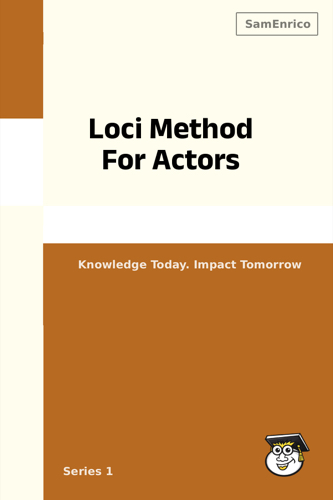
Loci Method For Actors eBook
Remembers script lines spatially.
by Burrell Kacy
Remembers script lines spatially.
Formats
Free sample
Chapter 1: The Empty Chair…--–- The first time Peter forgot his lines on stage, he was playing Mercutio in a community theatre production of Romeo and Juliet. It was the Queen Mab speech—a rambling, gorgeous, terrifying monologue that he had rehearsed two hundred times. He had said the words in his car, in the shower, while brushing his teeth, while falling asleep. He had written them on index cards. He had recorded himself and listened back on headphones during his commute.
By opening night, Peter knew those lines the way he knew his own phone number.And then, three minutes into the speech, standing center stage under the hot breath of the follow spot, the words vanished.Not faded. Not blurred. Vanished. One moment he was describing the wheels of a chariot made of spider's legs. The next moment there was nothing—just a white, buzzing emptiness where the next line was supposed to be.
He opened his mouth. Nothing came out. He heard the audience shift in their seats. He saw the actor playing Benvolio blink at him with wide, terrified eyes. The silence stretched for four seconds that felt like four years.
Finally, Peter made a sound that was not a word—a kind of strangled hum—and then blurted the wrong line from the wrong scene, stumbled through the rest of the speech in a sweat-soaked daze, and walked off stage at intermission with the certain knowledge that he would never, ever forget that moment for the rest of his life.Here is what Peter learned that night, and what every actor learns sooner or later: rote repetition does not create reliable memory. It creates the illusion of memory. It builds a house of cards that looks solid until someone opens a window. And in live performance—with its shifting variables, its unexpected interruptions, its adrenaline and exhaustion and the thousand small catastrophes that can happen between curtain rise and curtain fall—that house of cards will collapse.This book exists because that collapse is not inevitable. It is not a measure of your talent, your intelligence, or your dedication.
It is a measure of a flawed method. And the Method of Loci—a 2,500-year-old technique that uses your brain's ancient, powerful spatial processing systems—offers a different way. Not a harder way. Not a more complicated way. A way that works with your brain instead of against it.But before we get to the solution, we need to understand the problem.
Because you cannot fix what you do not see.The Myth of Rote Repetition Let us name the beast. Rote repetition is the practice of saying your lines over and over—alone, with a partner, into a recording device—until they feel automatic. It is the most common memorization method in actor training. It is also, by almost every cognitive metric, the least efficient and least reliable.Why? Because repetition does not create deep memory.
It creates familiarity. And familiarity is not the same thing as recall.Here is a simple experiment you can run in your own mind. Think of a song you have heard a hundred times on the radio. You know the chorus. You can hum along.
Now, without singing it out loud, try to recite the third line of the second verse. Can you do it? Probably not. You are familiar with the song, but you have never needed to retrieve that specific line on demand. Your brain stored the song as a fuzzy, holistic pattern—good for recognition, terrible for precision recall.Now think of a different kind of memory: your childhood address.
You can probably recite it instantly, without hesitation, even if you have not thought about it in years. That address is stored differently in your brain. It is tied to spatial location, to emotional context, to the physical experience of walking through that front door. It is not just familiar. It is embedded.Rote repetition trains the first kind of memory—the fuzzy, recognition-based kind.
It convinces you that you know the lines because they feel familiar. But familiarity is a trap. When the pressure of performance hits—when the lights are hot, the director is watching, the audience is waiting—your brain's stress response kicks in. Cortisol floods your system. And suddenly, that familiar-but-fragile memory trace shatters like glass.The research backs this up.
A 2016 study published in the journal Memory & Cognition found that participants who used repeated rehearsal to memorize word lists showed significantly higher rates of retrieval failure under stress compared to participants who used spatial mnemonics. The reason is straightforward: stress impairs the hippocampus's ability to retrieve declarative memories—the "what" memories of facts and words. But spatial navigation uses different neural pathways. When you mentally walk a path, you are engaging brain systems that are less vulnerable to cortisol.In plain English: Your brain remembers where you put something better than it remembers what you said. That is not a design flaw.
That is an evolutionary feature. Your ancestors did not need to memorize the chemical formula for water. They needed to remember which cave had the safe berries and which cave had the bear. And so your brain evolved to prioritize spatial and visual information above almost everything else.Rote repetition ignores this evolutionary reality. It treats your brain like a blank hard drive waiting to be filled with data.
But your brain is not a hard drive. It is a living, ancient, deeply patterned organ with its own preferences and shortcuts. The Method of Loci works with those preferences. Rote repetition fights them.The Two Systems of Your Acting Brain To understand why the Loci Method works and rote repetition fails, we need to take a brief detour into cognitive psychology. Do not worry—there will be no jargon dump.
But there is a distinction that every actor needs to understand, because it explains almost everything about why memorization feels hard.The Nobel Prize-winning psychologist Daniel Kahneman popularized the idea of two cognitive systems: System 1 and System 2. Here is what they are and why they matter to you.System 1 is fast, automatic, unconscious, and effortless. It is the part of your brain that catches a falling glass before you consciously decide to move your hand. It is the part that recognizes your mother's face in a crowd. It is the part that drives a familiar route home while you think about something else entirely.
System 1 does not feel like thinking. It feels like knowing.System 2 is slow, deliberate, conscious, and effortful. It is the part of your brain that solves a math problem, follows a complex recipe, or remembers a new phone number long enough to dial it. System 2 feels like work.Here is the crucial insight for actors: Great acting happens when your lines live in System 1. When you are truly present in a scene—listening, reacting, improvising within the text—you are not thinking about your next line.
Your next line simply arrives, the way a catchphrase arrives in conversation. It is automatic. It is effortless. It is alive.Rote repetition tries to force your lines into System 1 through brute force. The theory is that if…
This is the end of the free sample. Get the eBook to keep going. Buy now
About this book
Details
- Author
- Burrell Kacy
- Publisher
- SamEnrico
- Language
- English
- Genre
- Non-Fiction, Self-Help, Acting
- Released
- 2026-06-05
- Pages (approx.)
- 151
- Available as
- eBook, Audiobook

Read better in the ZLOADR app
Your eBooks on your phone or tablet. Sign in with your SamEnrico account and start reading.
More by Burrell Kacy
 Body Scan Scripts for TeachersBurrell Kacy$11.99
 Musician Conductor NonverbalBurrell Kacy$11.99
 Facebook Marketplace HoardingBurrell Kacy$11.99
 Overcoming Speech AnxietyBurrell Kacy$11.99
 Belgian Police ReformBurrell Kacy$11.99
 Lose It App GuideBurrell Kacy$11.99
 Homicide Victim Family LiaisonBurrell Kacy$11.99
 The Trial of the Century in the Andes: The Case That Redefined Insanity in Latin AmericaBurrell Kacy$11.99
 From the Cosmic Egg: The Birth of the World in Polynesian LoreBurrell Kacy$11.99
 How to Produce Nativity SetsBurrell Kacy$11.99
 A Collector's Handbook to the Simca 1500Burrell Kacy$11.99
 How to Produce Advertising InflatablesBurrell Kacy$11.99
You may also like
 Hong Kong Handover 1997Dunn Johnnie$11.99
 Zumba For Postnatal Recovery CourseNeal Christian$11.99
 Zumba for BeginnersLadner Nikia$11.99
 YouTube Comment Mining GuideHumes Pandora$12.99
 Worry Box MeditationCarlin Rudy$11.99
 Workplace Stress MeditationNguyen Lynn$11.99
 Workplace Stress and Sleep RepairHawley Ivory$11.99
 Workplace Perfectionism CureDelaney Jeffry$11.99
 Workplace Injustice Anger GuideWallen Isabelle$11.99
 Work Addiction and Burnout LinkGreenwood Ester$11.99
 Women in Yoga and WellnessBeattie Galina$11.99
 Women in Stand Up ComedyChun Evangeline$11.99