
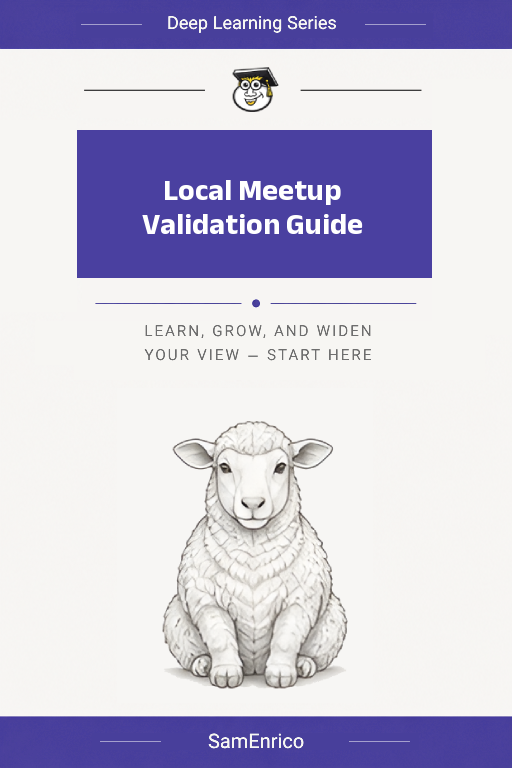
Local Meetup Validation Guide eBook
Host free local meetup about your idea topic to ga
Host free local meetup about your idea topic to gauge interest and collect in person feedback from attendees.
Formats
Free sample
Chapter 1: The $0 Lab Coat--–- The most dangerous place for an aspiring entrepreneur is not a competitor’s office or a venture capitalist’s rejection letter. It is their own living room, sitting on a comfortable couch, surrounded by people who love them too much to tell them the truth.You have an idea. It keeps you awake at night. You have sketched it on napkins, built spreadsheets, named it something clever, and told your partner, your best friend, and your mother. They all said the same thing: “That sounds interesting.” Some of them even said, “You should totally do that.”And here is the terrifying reality that will either save you or sink you: those people are lying to you.Not because they are bad people.
Not because they want you to fail. But because they have something far more valuable to protect than your business idea—they have your relationship. Your mother will never say, “That’s the dumbest thing I have ever heard.” Your best friend will never say, “I wouldn’t pay five dollars for that.” Your spouse will never say, “I think you’re wasting your time.” They have invested years, decades, or a lifetime of emotional currency into you. They will not risk that investment to give you the one thing you actually need: the brutal, unfiltered, uncomfortable truth.This chapter is about why your couch is the enemy, why your friends are useless for validation, and why a room full of strangers who owe you nothing is the only laboratory that matters. By the end of this chapter, you will understand the philosophy of the $0 Lab Coat—a mindset that turns you from a hopeful dreamer into a dispassionate researcher who can kill a bad idea in seven days instead of seven months.The Couch Fallacy: Why Comfort is the Enemy of Truth Let us name the first dangerous assumption.
Call it The Couch Fallacy.The Couch Fallacy is the belief that your own enthusiasm for an idea is a reliable signal of market demand. When you are sitting alone, thinking about your idea, your brain does something remarkable—it fills in all the missing pieces with optimistic guesses. You imagine customers nodding along. You imagine them pulling out their wallets. You imagine the press writing about your genius.
Your brain is not trying to deceive you; it is trying to protect you from the anxiety of uncertainty. But in doing so, it becomes the worst business partner you will ever have.Consider the data. The Startup Genome Report—one of the largest longitudinal studies of early-stage startups—found that founders who conduct “event smoke tests” (free, low-commitment gatherings to gauge interest) before building anything are 34% less likely to fail than those who do not. Why? Because they replace their own internal optimism with external behavioral data.
They stop asking “Do I like this idea?” and start asking “Did a stranger show up to talk about it?”The Couch Fallacy kills ideas in two ways. First, it makes you fall in love with your own assumptions. You spend weeks, months, or years refining a product that nobody asked for. Second, it delays the moment of truth so long that by the time you finally talk to customers, you are financially and emotionally committed to a direction that you cannot abandon—even when the evidence says you should.The antidote to the Couch Fallacy is simple, uncomfortable, and free: you must step into a room with strangers before you write a single line of code, build a single prototype, or spend a single dollar on inventory. You must become a researcher, not a believer.
You must put on the $0 Lab Coat.The $0 Lab Coat: A New Identity for Entrepreneurs The $0 Lab Coat is a metaphor, but it is also an instruction manual for a new identity.A scientist does not fall in love with a hypothesis. A scientist designs an experiment specifically to prove the hypothesis wrong. When the data contradicts the hypothesis, the scientist does not cry or double down—the scientist updates their understanding of the world and moves on. That is the mindset you need to adopt.The “$0” part of the name is not a gimmick; it is a constraint that forces creativity. You are not allowed to spend money on validation.
No paid surveys. No focus group agencies. No rented conference rooms. No expensive software. Why?
Because if you cannot validate your idea for free, you have not actually validated your idea—you have just proven that you can throw money at a problem. Real demand does not require a budget. Real demand shows up on a Tuesday night because the topic matters to them.The $0 Lab Coat mindset has three rules:You are not a founder during validation. You are a researcher. Your job is to collect data, not to sell.You must be willing to be proven wrong in public.
The worst outcome is not a half-empty room. The worst outcome is a full room of polite liars.You do not get to argue with the data. If two people show up, you do not say “they must have been busy.” You say “my hypothesis was falsified” and you move on.This identity shift is the single most difficult thing you will do as an entrepreneur. It requires swallowing your ego, abandoning your need for validation from loved ones, and seeking out the discomfort of strangers who might tell you that your baby is ugly. But it is also the most liberating shift you will ever make.
Because once you realize that a failed event is just a data point—not a judgment on your worth—you become free to fail fast, learn cheaply, and pivot without pain.The Problem with Friends & Family: Why Love is a Liar Let us be precise about why friends and family cannot give you useful feedback. This is not a theory; it is behavioral economics.Every relationship contains social debt. Social debt is the accumulated emotional currency you have invested in someone—the favors you have done, the secrets you have shared, the years of friendship, the blood relation. The longer you have known someone, the higher the social debt. And here is the critical insight: people will not risk social debt to give you honest feedback.Think about what you are asking a friend to do when you say “Tell me honestly, is this a good idea?” You are asking them to potentially hurt your feelings, damage the relationship, and create awkwardness—all for zero personal gain.
The rational response for your friend is to say something neutral or mildly positive. “That’s interesting.” “I could see that working.” “You should look into it.” These are not lies in the malicious sense. They are polite lies—social lubricant designed to keep the relationship intact.Your mother is the worst offender. A mother’s entire evolutionary purpose is to support her offspring. She is biologically incapable of telling you your idea is terrible.
She will say “that’s nice, dear” while secretly wondering if you should just get a stable job. Her kindness is her curse, and it is your trap.Real-world example: A…
This is the end of the free sample. Get the eBook to keep going. Buy now
About this book
Details
- Author
- Townsend Sadie
- Publisher
- SamEnrico
- Language
- English
- Genre
- Non-Fiction, Startup Guide, Local Meetup, In Person
- Released
- 2026-06-01
- Pages (approx.)
- 152
- Available as
- eBook, Audiobook

Read better in the ZLOADR app
Your eBooks on your phone or tablet. Sign in with your SamEnrico account and start reading.
More by Townsend Sadie
 Group Creative Risk Taking CourseTownsend Sadie$11.99
 Chinese Student Return TrendsTownsend Sadie$11.99
 Gambling Withdrawal HelpTownsend Sadie$11.99
 Intuitive Eating Weight GuideTownsend Sadie$11.99
 Core Beliefs That Fuel AngerTownsend Sadie$11.99
 The Siege of the Grand Hotel: The Day a Terrorist Took a City HostageTownsend Sadie$11.99
 The Phantom of the Dark WebTownsend Sadie$11.99
 Industrial Manufacturing BuyersTownsend Sadie$12.99
 Programmatic Media Buying and OptimizationTownsend Sadie$11.99
 Understanding Chromosome 6, Monosomy 6q1Townsend Sadie$17.99
 How to Start a Farm Supplies Merchant Wholesaler BusinessTownsend Sadie$11.99