
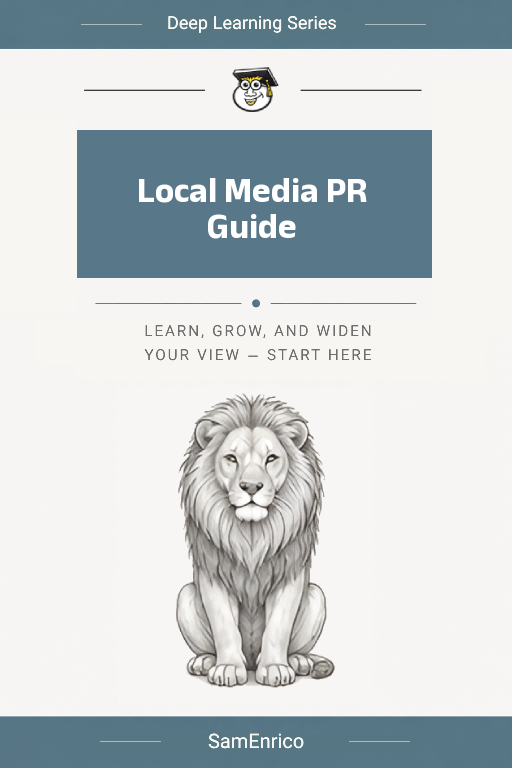
Non-FictionStartup GuideMedia Outreach
Local Media PR Guide eBook
Get local media coverage for your startup. City ne
Get local media coverage for your startup. City newspapers and regional journalists.
Formats
Free sample
Chapter 1: The Forbes Delusion--–- I once spent six months trying to get into Tech Crunch. Six months of carefully crafted pitches, follow-up emails, introductions from mutual connections, and even a desperate attempt to become friends with a junior editor on Linked In. The result? Zero customers. Zero job applicants.
Zero investors knocking on my door. Then, after admitting defeat and swallowing my pride, I spent six hours preparing for a local television segment on a sleepy morning show that aired between weather updates and a story about a cat stuck in a tree. The next morning, I sold out my entire inventory by 9:15 AM. The local story generated more revenue in fifteen minutes than six months of national pitching had produced in total. This is not a humble brag.
This is a warning. If you are a startup founder chasing national media coverage while ignoring the newspaper that lands on your neighbor's doorstep every morning, you are leaving money on the table. Worse, you are actively deceiving yourself about what actually builds a business.The Myth That Keeps Startups Poor Let me name the enemy explicitly. It is not the journalists who ignore your emails. It is not the crowded inboxes or the algorithmic feeds or the death of traditional media.
The enemy is the Forbes Delusion—the widespread, almost religious belief among startup founders that national media coverage is the only "real" validation of success. This delusion has been carefully cultivated by the startup industrial complex: the accelerator programs that brag about their alumni being featured in Wired, the VC firms that list Tech Crunch mentions as a portfolio metric, and the Linked In influencers who post screenshots of their bylines as proof of relevance.Here is the truth that no one in those circles will tell you. National coverage builds your ego. Local coverage builds your business. One makes you feel important at cocktail parties.
The other makes your cash register ring. And yet, I cannot count how many founders I have met who would rather spend twenty hours crafting the perfect pitch to a New York-based reporter who has never visited their city than spend two hours building a relationship with the journalist who lives three blocks from their office.The data backs up my frustration. A feature in a major national tech publication generates, on average, a spike in website traffic that lasts approximately forty-eight hours. After that, the traffic drops to baseline or below. Why?
Because the audience is scattered across the country, the world, the solar system. They are not your neighbors. They cannot walk into your store. They will not hire your local team. They will not attend your community event.
They click, they forget, they move on.Compare that to a feature in a local newspaper like the Tampa Bay Times, the Cleveland Plain Dealer, or the Seattle Times. The audience is concentrated within a twenty-mile radius. They share the same weather, the same traffic jams, the same school board controversies, the same potholes. When they read about your startup, they are not browsing for entertainment. They are looking for solutions to problems they experience every day.
The conversion rate is not measured in fractions of a percent. It is measured in real foot traffic, real job applications, and real B2B sales calls from other local business owners who read the same paper over their morning coffee.The Geography of Attention To understand why local media outperforms national media for most startups, you need to understand a concept I call the Geography of Attention. Here is how it works. Human beings have a finite capacity for caring about things outside their immediate experience. Psychologists call this the "identifiable victim effect"—we are far more moved by the story of one specific person in our community than by statistics about millions of strangers.
But the effect extends beyond charity. It applies to everything we read, watch, and consume.The average person cares about things in the following order of priority. First, themselves and their immediate family. Second, their street and neighborhood. Third, their city and surrounding region.
Fourth, their state. Fifth, their country. Sixth, everything else. National media lives at level five and six. Local media lives at level two, three, and four.
When you pitch a national outlet, you are asking a reader to care about something that has no obvious connection to their daily life. When you pitch a local outlet, you are speaking directly to the geography where their attention already lives.I learned this lesson the hard way after my Tech Crunch failure. I had convinced myself that national coverage would be the "breakthrough" my startup needed—the signal to investors that we were legitimate, the badge of honor that would attract top talent, the SEO boost that would drive endless organic traffic. None of it happened. The traffic spike was real but empty.
The bounce rate was catastrophic. The only emails I received were from other founders asking how I had gotten the coverage. Not a single customer. Not a single lead. Not a single dollar.The local television segment, by contrast, was not glamorous.
It aired at 6:45 AM on a Tuesday. The anchor mispronounced my company's name twice. The camera angle made me look like I was leaning away from the host to avoid bad breath. But within four hours of the segment airing, my phone would not stop ringing. Customers came to the store.
They mentioned the segment by name. They asked questions I had answered on air, which told me they had actually watched it. By the end of the week, we had hired two new employees to handle the volume. The local story changed the trajectory of my business. The national story changed nothing.Why Local Readers Are Different Animals Let me break down exactly why local readers behave differently than national readers.
This is not speculation. This is based on data from hundreds of startups that have tested both approaches.First, proximity creates accountability. When a national reader sees your story, they have no way to verify it. They cannot visit your store. They cannot talk to your customers.
They cannot shake your hand. The story is abstract, theoretical, easy to dismiss or forget. But when a local reader sees your story, they know where you are. They have driven past your building. They might know someone who works for you.
The story is anchored in physical reality. It feels real because it is real. And because it feels real, they act on it.Second, local journalists understand their audience in a way national journalists cannot. The national reporter covering startups has probably never started a business. They live in a coastal media bubble.
They measure success by page views and social shares. They do not know what it is like to wake up at 4 AM worried about making payroll. The local journalist, by contrast, covers the chamber of commerce meetings. They interview the owners of the diner and the hardware store and the plumbing supply company. They understand the local economy because they are part of it.
When they write about your startup, they frame it in terms that matter to their readers: jobs, taxes, traffic, schools…
This is the end of the free sample. Get the eBook to keep going. Buy now
About this book
Details
- Author
- Tomlin Lizeth
- Publisher
- SamEnrico
- Language
- English
- Genre
- Non-Fiction, Startup Guide, Media Outreach
- Released
- 2026-05-30
- Pages (approx.)
- 132
- Available as
- eBook, Audiobook

Read better in the ZLOADR app
Your eBooks on your phone or tablet. Sign in with your SamEnrico account and start reading.
More by Tomlin Lizeth
 Validation For Medical TraumaTomlin Lizeth$11.99
 ED Myths DebunkedTomlin Lizeth$11.99
 The Parent Anger Medication GuideTomlin Lizeth$11.99
 Twelve Step for Late BloomersTomlin Lizeth$11.99
 The Dual N Back Training GuideTomlin Lizeth$11.99
 The Sea Beggars' Defiance: How a Band of Outcasts Defied the Spanish ArmadaTomlin Lizeth$11.99
 Modern ReenactmentTomlin Lizeth$11.99
 The Breeder's Guide to Ossabaw Island PigsTomlin Lizeth$11.99
 Week One Domain Name SearchTomlin Lizeth$12.99
 10 Ways to Use Food Colouring (Recipe Book)Tomlin Lizeth$11.99
You may also like
 Hong Kong Handover 1997Dunn Johnnie$11.99
 Zumba For Postnatal Recovery CourseNeal Christian$11.99
 Zumba for BeginnersLadner Nikia$11.99
 YouTube Comment Mining GuideHumes Pandora$12.99
 Worry Box MeditationCarlin Rudy$11.99
 Workplace Stress MeditationNguyen Lynn$11.99
 Workplace Stress and Sleep RepairHawley Ivory$11.99
 Workplace Perfectionism CureDelaney Jeffry$11.99
 Workplace Injustice Anger GuideWallen Isabelle$11.99
 Work Addiction and Burnout LinkGreenwood Ester$11.99
 Women in Yoga and WellnessBeattie Galina$11.99
 Women in Stand Up ComedyChun Evangeline$11.99