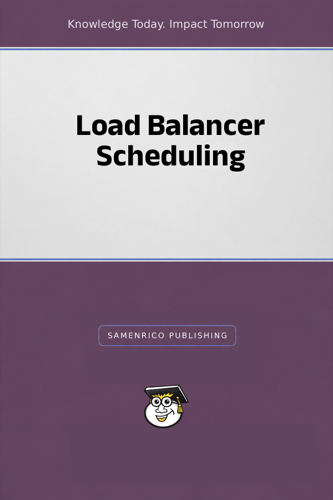
Load Balancer Scheduling eBook
Teaches evening out daily review counts with add o
by Haas Makeda
Teaches evening out daily review counts with add on tools.
Formats
Free sample
Chapter 1: The Uneven Inbox--Every morning, somewhere in the world, a manager opens their dashboard and sees the same red alert: fourteen reviewers are drowning while three are idle. The 9 AM dump of fresh reviews has arrived, and the system—if it can even be called a system—has done what it always does. It has blasted every new task to every reviewer simultaneously, creating a stampede of notifications, a cascade of “I’ll get to it later” replies, and the quiet, accumulating dread of another day spent firefighting rather than reviewing.This book is written for that manager. It is also written for the engineer who built that dashboard, the team lead who inherited the chaos, and the reviewer who has given up on ever seeing an empty queue again. The problem we are about to solve is deceptively simple: how do you distribute daily review tasks so that every person gets a fair, manageable share, no one burns out, and nothing falls through the cracks?
The answer, as we will discover over the next twelve chapters, is not a single silver bullet. It is a set of patterns, algorithms, and add-on tools that, when combined, turn chaos into rhythm.But before we build anything, we must first understand why this problem is so much harder than it looks. And to understand that, we need to talk about fairness.The Productivity Killer No One Names Uneven distribution of work is not merely an annoyance. It is a measurable productivity killer with cascading consequences that most organizations tolerate because they do not know how to fix them. Let us name the symptoms so we recognize them in our own teams.The first symptom is the morning spike and afternoon lull.
At 9 AM, after the nightly batch of reviews has accumulated, the system releases everything at once. Reviewers spend the first two hours of their day in a state of triage, not deep work. By 11 AM, the most aggressive reviewers have cleared their queues, while the methodical ones are still buried. At 4 PM, the cycle repeats as the last submissions of the day trigger another burst. The result is a sawtooth pattern of utilization: spikes of panic followed by valleys of guilt.The second symptom is invisible idleness.
While some reviewers are overloaded, others are genuinely idle—but the system does not surface this fact because tasks are not flowing to them. An idle reviewer is not necessarily lazy; they may be faster, or they may simply be the last person in a broken round-robin rotation. The manager sees the overloaded team members complaining and assumes the team is understaffed, when in fact the existing capacity is simply misallocated.The third symptom is the comparison spiral. When reviewers can see each other’s queue sizes—and in many tools, they can—the imbalance becomes a source of social friction. “Why does Alex have five reviews when I have twenty?” The answer, nine times out of ten, is not favoritism but a scheduling algorithm that has no concept of fairness.
The tool simply delivers work in the order it arrives to the first available person, which is mathematically guaranteed to create imbalance over time.These symptoms are not inevitable. They are the predictable outputs of a system designed without load balancing in mind. Most review platforms were built to answer a single question: “How do I get this task to someone, anyone, as fast as possible?” They were not built to answer the much harder question: “How do I distribute these tasks so that everyone ends the day with roughly the same amount of work, adjusted for their capacity and speed?” That second question is the domain of load balancer scheduling.Why Web Traffic Is Not Review Traffic If you have any background in system architecture, you have encountered load balancing before. A typical web load balancer sits between users and servers, distributing incoming requests so that no single server is overwhelmed. The goal is speed, uptime, and efficient use of compute resources.
The algorithms are well understood: round robin, least connections, IP hash, weighted distributions. Entire books have been written on the subject, and some of them are excellent.But here is the trap that catches almost everyone who tries to apply web load balancing to human review workflows. Web traffic treats all requests as interchangeable units of compute. A request to load a homepage and a request to process a payment are different in duration, but the load balancer does not care about fairness between servers. It cares about not dropping connections.
A server that gets ten requests while another gets one is not a moral failing; it is just a statistical fluctuation that will average out over the next ten milliseconds.Human reviewers are not servers. They have feelings, schedules, attention spans, and varying levels of expertise. A reviewer who receives ten complex legal documents while a colleague reviews ten typo fixes will not average out tomorrow. They will burn out next month. More importantly, the cost of imbalance is not dropped packets or slow response times.
It is quiet quitting, missed deadlines, and the slow erosion of quality as exhausted reviewers rush through their work.This book therefore takes a different starting point. We will borrow heavily from network load balancing—the algorithms are elegant and proven—but we will adapt them to a new optimization target. That target is equity, not speed. Equity means that over the course of a day or a week, each reviewer receives a share of work proportional to their capacity, and the distribution of work across the team has a low standard deviation. In plain language: everyone gets about the same amount, relative to how fast they work.Equity is harder to achieve than speed because it requires statefulness.
A web load balancer can forget a request the moment it is routed. An equity-focused balancer must remember who got what, how long it took them, and whether they are currently overloaded. This memory requirement is the reason most review platforms do not even attempt fairness. But as we will see, a small amount of state—tracked in lightweight add-ons—is enough to transform the system.The Two Failure Modes: 9 AM Dump and 5 PM Scramble Every unbalanced review system eventually settles into one of two failure patterns. Understanding these patterns is the first step toward breaking them.The 9 AM Dump occurs when the system collects reviews overnight and releases them in a single batch at the start of the business day.
This pattern is common in platforms that use daily batch processing or that rely on a human manager to manually assign tasks each morning. The result is a wall of work that hits every reviewer simultaneously. Notifications flood inboxes. The urgent and the trivial are indistinguishable. Reviewers begin the day already behind, and the psychological weight of a full queue reduces deep work for hours.
The 9 AM Dump rewards the fastest clicker, not the most careful reviewer. It punishes methodical workers and guarantees that the first tasks of the day receive less attention than they deserve.The 5 PM Scramble is the mirror image. In this pattern, the system holds reviews until late…
This is the end of the free sample. Get the eBook to keep going. Buy now
About this book
Details
- Author
- Haas Makeda
- Publisher
- SamEnrico
- Language
- English
- Genre
- Non-Fiction, Self-Help, Workload Management
- Released
- 2026-06-06
- Pages (approx.)
- 128
- Available as
- eBook, Audiobook

Read better in the ZLOADR app
Your eBooks on your phone or tablet. Sign in with your SamEnrico account and start reading.
More by Haas Makeda
 Burnout Prevention for MidwivesHaas Makeda$11.99
 Nairobi Mau Mau MemorialHaas Makeda$11.99
 Choking Prevention Self HypnosisHaas Makeda$11.99
 Headlight Glass ForensicsHaas Makeda$11.99
 The Sleep Micronutrient GuideHaas Makeda$11.99
 Child Death And MarriageHaas Makeda$11.99
 Preterm Birth Grief WorkbookHaas Makeda$11.99
 The Silk Road Rebels: How Nomadic Weavers and Imperial Painters Redefined FashionHaas Makeda$11.99
 The Forgotten Dominion: How the British Commonwealth Shaped the Modern WorldHaas Makeda$11.99
 How to Produce Fleas (Control Products)Haas Makeda$11.99
 How to Become a Safety-pin-assembling-machine OperatorHaas Makeda$11.99
 Teaching English Grammar to Chinese StudentsHaas Makeda$12.99