
Non-FictionInformativeEducational
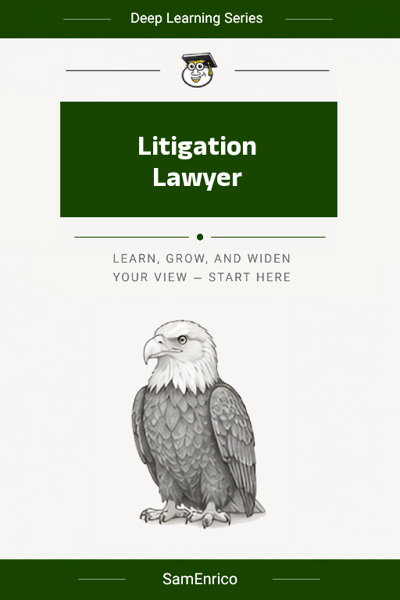
Litigation Lawyer eBook
A Coursebook on Litigation Lawyer
A Coursebook on Litigation Lawyer
Formats
Free sample
Chapter 1: The First Phone Call...--The phone rang at 4:47 on a Tuesday afternoon—the kind of call that comes right when you are thinking about packing up, right when you have convinced yourself that nothing urgent will happen before tomorrow. Sarah Chen, a third-year associate at Liu & Associates in Chicago, had just clicked save on a discovery motion and was reaching for her coat when the glow of her desk phone caught her eye. Caller ID showed the firm's main switchboard, which meant either a partner looking for something or a new client. Both were dangerous.She picked up. "Sarah Chen.""Ms.
Chen, this is Marcus Webb in reception. I have a gentleman here asking to speak with a litigator. He says he was referred by Judge Patterson. He seems... agitated."Judge Patterson.
That name landed like a stone in still water. The judge had been Sarah's mentor during her clerkship two years ago, a woman who did not give referrals lightly and certainly did not send clients to junior associates unless she believed they were ready. Sarah felt her pulse quicken. "I'll be right down."The lobby of Liu & Associates was designed to impress—floor-to-ceiling windows overlooking the Chicago River, leather chairs that cost more than Sarah's first car, abstract art that she still did not understand after three years. Marcus Webb stood behind the reception desk, his face a mask of professional neutrality, nodding toward a man in the corner.The man was fiftyish, wearing a navy blue suit jacket that did not quite match his gray trousers.
His tie was loosened. His hands gripped a worn leather satchel like it was the only thing keeping him from flying apart. He stood when Sarah approached and extended a hand that trembled slightly."Mr. Webb said you were referred by Judge Patterson," Sarah said, shaking his hand."Frank Delgado. And yes.
The judge said you were the one to talk to. She said—" He paused, swallowing. "She said you would listen."That was the first lesson Sarah had learned from Judge Patterson, long before she ever drafted a complaint or argued a motion: listening is not waiting for your turn to speak. Listening is the practice of silence. It is the deliberate suspension of your own thoughts so that another person's story can enter.
It is, in litigation, the single most underrated skill."Sit down, Mr. Delgado," Sarah said, gesturing to a quieter seating area away from the reception desk. "Tell me everything."The Ecosystem of a Lawsuit: Where You Are Standing Before Sarah could understand Frank Delgado's problem, she had to understand where his problem could be solved. This is the first strategic question every litigator must answer: What type of decision-maker will hear this case?Most new lawyers think a lawsuit is a lawsuit—you file a complaint, you go to court, a judge or jury decides. But this is like saying all vehicles are cars.
The litigation ecosystem contains three fundamentally different species of decision-makers, each with its own rules, its own culture, and its own strategic logic.Trial Courts: The Fact-Finding Engines The trial court is where stories are tested against evidence. Its primary function is fact-finding—determining what actually happened. Trial judges (and juries) hear witnesses, examine documents, and decide which version of events is more likely true. The federal district courts and state trial courts operate under civil procedure rules designed to surface facts: discovery, depositions, interrogatories, and ultimately the crucible of trial.For Sarah's potential client, the trial court was the first stop. Whatever dispute had driven Frank Delgado to her office, the trial court would be where it began—and possibly where it ended.
But not every dispute belongs in trial court, and not every trial court decision is final.Appellate Courts: The Error-Correcting Machines Appellate courts do not find facts. They do not hear witnesses. They do not re-evaluate credibility. What appellate courts do is review legal errors—they ask whether the trial court applied the right law, whether the jury received proper instructions, whether the judge admitted or excluded evidence correctly. The United States Courts of Appeals and state appellate courts are error-correcting machines, not second trials.Sarah remembered Judge Patterson's most memorable lecture on this topic: "If you lose on the facts at trial, you lose.
Period. The appellate court will not save you. They will read the cold transcript, see that the jury heard both sides, and affirm. You win at trial or you do not win at all."Administrative Bodies: The Specialized Forums Not every dispute belongs in an Article III court. The National Labor Relations Board, the Equal Employment Opportunity Commission, the Securities and Exchange Commission—these administrative bodies have their own procedures, their own judges (often called administrative law judges), and their own appeal paths.
Some cases must be exhausted in administrative forums before they ever see a courthouse.As Sarah sat down with Frank Delgado, she kept these three forums in her mind. The question was not whether he had a grievance. The question was which of these three doors he had to knock on first—and whether he had already missed his chance.The Three Questions Every Case Must Answer Judge Patterson had drilled into Sarah a simple framework for evaluating any potential case. Before she drafted a single word, before she accepted a retainer, before she even told a client whether they had a case, she had to answer three questions:Does the court have power over this dispute? (Jurisdiction)Is this dispute ready for court right now?
(Ripeness)Is this the right person bringing the claim? (Standing and Real Party in Interest)These questions are not procedural trivia. They are the gateways to justice. Miss one, and your case is dismissed before you ever argue the merits.Standing: The Right Person Standing is the constitutional requirement that the person suing must have suffered a concrete, particularized injury that is traceable to the defendant and redressable by the court. You cannot sue because you are offended by something that happened to someone else.
You cannot sue because you disagree with a law that has not harmed you. You cannot sue as a concerned citizen unless the law specifically allows it.Sarah asked Frank Delgado the standing question directly: "Mr. Delgado, who was harmed here? Was it you personally, or someone else?""It was me," he said. "My business.
My money."That was standing. A concrete injury, traceable to someone's conduct, capable of being fixed by a court order or money judgment. But standing alone was not enough.Ripeness: The Right Time Ripeness prevents courts from issuing advisory opinions on hypothetical disputes. A case is not ripe if the harm has not yet occurred or if it depends on future events that may never happen. You cannot sue because someone might breach a contract next year.
You cannot seek an injunction against a law that has not yet been enforced against you."Has the harm already happened?" Sarah asked. "Or are you trying to stop something from happening?""It's happened," Delgado said. "They already took the money."That was ripeness. A concrete dispute, not a hypothetical fear. But there was one more question.Real Party in…
This is the end of the free sample. Get the eBook to keep going. Buy now
About this book
Details
- Author
- Ritter Vannesa
- Publisher
- SamEnrico
- Language
- English
- Genre
- Non-Fiction, Informative, Educational
- Released
- 2026-06-02
- Pages (approx.)
- 153
- Available as
- eBook, Audiobook

Read better in the ZLOADR app
Your eBooks on your phone or tablet. Sign in with your SamEnrico account and start reading.
More by Ritter Vannesa
 The Empathy Development HandbookRitter Vannesa$11.99
 Active Listening CourseRitter Vannesa$11.99
 Senior Mentoring Self Esteem CourseRitter Vannesa$11.99
 Adolescent Body Image RescueRitter Vannesa$11.99
 Polish Secret State StructuresRitter Vannesa$11.99
 Orpheus and the Lyre That Conquered DeathRitter Vannesa$11.99
 Understanding Macular Degeneration, Age-relatedRitter Vannesa$17.99
 Data Presentation Mistakes GalleryRitter Vannesa$12.99
 A Beginners Guide to Drum and bugle corps (modern) (Volume 1)Ritter Vannesa$11.99
You may also like
 Hong Kong Handover 1997Dunn Johnnie$11.99
 Zumba For Postnatal Recovery CourseNeal Christian$11.99
 Zumba for BeginnersLadner Nikia$11.99
 YouTube Comment Mining GuideHumes Pandora$12.99
 Worry Box MeditationCarlin Rudy$11.99
 Workplace Stress MeditationNguyen Lynn$11.99
 Workplace Stress and Sleep RepairHawley Ivory$11.99
 Workplace Perfectionism CureDelaney Jeffry$11.99
 Workplace Injustice Anger GuideWallen Isabelle$11.99
 Work Addiction and Burnout LinkGreenwood Ester$11.99
 Women in Yoga and WellnessBeattie Galina$11.99
 Women in Stand Up ComedyChun Evangeline$11.99