
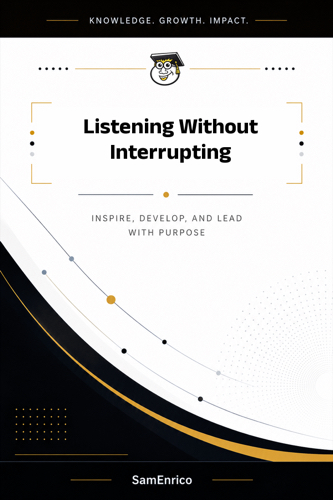
Non-FictionSelf-HelpInterruptingPatience
Listening Without Interrupting eBook
Break the habit of cutting people off and let spea
Break the habit of cutting people off and let speakers finish completely.
Formats
Free sample
Chapter 1: The Waiting Disease--You are not listening right now.I don't mean that as an insult. I mean it as a neurological fact. As you read these words, your brain is already doing something else. It is categorizing. It is judging.
It is preparing a rebuttal to something I haven't even said yet. It is remembering a story from your own life that this paragraph reminds you of, and it is itching to tell that story to someone—preferably soon, preferably before they finish talking.This is not a character flaw. It is not a moral failure. It is a wiring problem.Every human being on the planet suffers from what I call the Waiting Disease. Here is the symptom: when someone else is speaking, you are not actually listening to them.
You are waiting. You are waiting for a pause, any pause, so you can jump in. You are waiting for the moment when you can say the thing that is already fully formed in your mind. You are waiting for your turn.And here is the terrifying truth that most communication books will not tell you: the person who is waiting is not in a conversation. They are in a hostage situation, holding themselves hostage until the other person finally stops making noise.I know this because I was the worst offender.
For thirty-seven years, I was a world-class waiter. I interrupted my wife during our second date. I cut off my boss in my first week of work. I finished my children's sentences so often that my oldest son, at age six, looked at me and said, "Daddy, why do you always think you know what I'm going to say before I say it?" That question stopped me cold. Because he was right.
I did think I knew. And I was almost always wrong.This book is the result of the decade I spent trying to answer my son's question. It is the result of recording hundreds of conversations, interviewing neuroscientists and hostage negotiators, and failing repeatedly at the simple act of keeping my mouth shut while someone else was talking. The good news is that the Waiting Disease is curable. The bad news is that the cure requires you to admit something uncomfortable: you are not nearly as good at listening as you think you are.Let me prove it to you right now.The Three-Question Test That Nobody Passes Think back to the last argument you had with someone you love.
Not a fight—just a disagreement. Maybe about money, or chores, or politics, or whose family you were visiting for the holidays. Got it in your mind? Good.Now answer these three questions without looking ahead:What were the last three complete sentences the other person said before you responded?What emotion was underneath their words? Not the surface emotion like "anger" or "frustration"—the deeper one.
Were they scared? Lonely? Exhausted? Feeling invisible?If you had to repeat their position back to them in a way that would make them say, "Yes, that's exactly what I meant," could you do it?I have administered this test to over two thousand people in workshops, executive coaching sessions, and couples counseling. Fewer than five percent can answer all three questions correctly.
Most people cannot answer the first question at all. They remember the gist—"She was mad about the dishes"—but not the actual words. They remember their own rebuttal perfectly. They remember the clever point they made, the evidence they cited, the rhetorical kill shot they delivered. The other person's actual words?
Gone. Never recorded.This is the Waiting Disease in action. While the other person was speaking, you were not encoding their words into memory. You were using your brain's limited processing power to rehearse your response, to find the flaw in their logic, to prepare the counterexample from your own life. Their words entered your ears and then left your brain almost immediately because your brain had already decided they weren't important.Your brain, it turns out, is a terrible multitasker.The 200-Millisecond Lie Neuroscience has a dirty secret that most self-help books ignore: the human brain cannot perform two verbal processing tasks simultaneously.
It cannot listen and prepare a response at the same time. What feels like multitasking is actually rapid toggling—your brain switching back and forth between "receive mode" and "speak mode" at speeds you cannot consciously perceive.Here is the mechanical problem. Human beings speak at approximately 125 to 150 words per minute. That is the speed of a moderately paced audiobook. Human beings think at approximately 600 to 800 words per minute.
That is the speed of a panicked inner monologue. The gap between speaking speed and thinking speed is roughly 200 milliseconds per word. In other words, for every word someone says to you, your brain has 200 milliseconds of spare processing capacity.Two hundred milliseconds does not sound like much. But over the course of a thirty-second turn in a conversation, those milliseconds add up to several seconds of mental downtime. And the brain abhors downtime.
So it fills the void. It fills the void with rehearsal. It starts preparing what you are going to say next. It starts constructing counterarguments. It starts searching your memory for a relevant story from your own life.
By the time the speaker has finished their third sentence, your brain is no longer listening to them at all. It is listening to itself.This is not a bug. It is a feature—an evolutionary feature that was perfectly adapted for a world that no longer exists. Ten thousand years ago, if you were in a tribe of fifty people and someone was speaking to you, the stakes were simple: are they a threat or an opportunity? If they were a threat, you needed to prepare your defense.
If they were an opportunity, you needed to prepare your alliance pitch. Either way, you needed to be ready to speak back quickly, because the tribe did not have time for long pauses. Silence meant danger.But we do not live in tribes anymore. We live in a world of complex relationships, nuanced emotions, and problems that cannot be solved with a quick retort. The brain's ancient wiring is now actively sabotaging our connections.
The feature has become a bug.The Shift Response: How You Accidentally Steal Every Conversation There is one conversational reflex that accounts for more than half of all interruptions, and it is so common that most people do not even recognize it as an interruption. I call it the Shift Response.Here is how it works. Someone tells you a story. They share something meaningful—a frustration at work, a victory with their child, a memory that still stings. And you respond by shifting the focus from their experience to your own.
"That reminds me of when I..." "Oh, that's exactly what happened to me last week..." "I know exactly how you feel; let me tell you about my situation..."On the surface, the Shift Response feels like empathy. You are trying to connect. You are saying, "I understand because I have been through something similar." But here is what the Shift Response actually communicates…
This is the end of the free sample. Get the eBook to keep going. Buy now
About this book
Details
- Author
- Joyner Cammie
- Publisher
- SamEnrico
- Language
- English
- Genre
- Non-Fiction, Self-Help, Interrupting, Patience
- Released
- 2026-06-10
- Pages (approx.)
- 146
- Available as
- eBook, Audiobook

Read better in the ZLOADR app
Your eBooks on your phone or tablet. Sign in with your SamEnrico account and start reading.
More by Joyner Cammie
 TM for Screen AddictionJoyner Cammie$11.99
 Remote Worker Imposter GuideJoyner Cammie$11.99
 Affirmations for ComparisonJoyner Cammie$11.99
 The Sociopath Impulsive CriminalJoyner Cammie$11.99
 The Visionaries of Stone: How Western Architects Shaped DemocracyJoyner Cammie$11.99
 Understanding T-lymphocytopeniaJoyner Cammie$17.99
 How to Become a Dry-house TenderJoyner Cammie$11.99
 Zero Cost Pivot GuideJoyner Cammie$12.99
 Agriculture Invoice FactoringJoyner Cammie$12.99
 SleepingJoyner Cammie$11.99
You may also like
 Hong Kong Handover 1997Dunn Johnnie$11.99
 Zumba For Postnatal Recovery CourseNeal Christian$11.99
 Zumba for BeginnersLadner Nikia$11.99
 YouTube Comment Mining GuideHumes Pandora$12.99
 Worry Box MeditationCarlin Rudy$11.99
 Workplace Stress MeditationNguyen Lynn$11.99
 Workplace Stress and Sleep RepairHawley Ivory$11.99
 Workplace Perfectionism CureDelaney Jeffry$11.99
 Workplace Injustice Anger GuideWallen Isabelle$11.99
 Work Addiction and Burnout LinkGreenwood Ester$11.99
 Women in Yoga and WellnessBeattie Galina$11.99
 Women in Stand Up ComedyChun Evangeline$11.99