
Non-FictionSelf-HelpDifficult Conversations
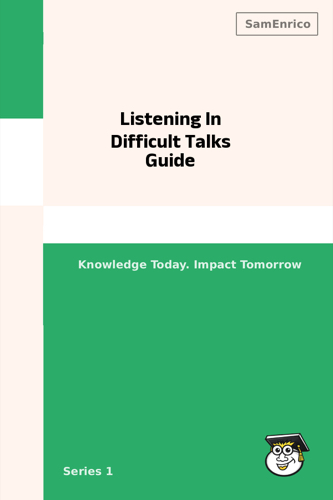
Listening In Difficult Talks Guide eBook
Stay present and curious during high-stakes, emoti
Stay present and curious during high-stakes, emotional, or confrontational conversations.
Formats
Free sample
Chapter 1: The Autopilot Trap--–- Let me tell you about the worst listening moment of my life.I was thirty-two years old, sitting across from my partner in a quiet apartment kitchen. The dishwasher hummed. A pot of coffee had gone cold between us. She had just said the words that no one hears clearly: “I don’t think I can keep doing this.”And I listened to exactly zero percent of what came next.Instead, I was already building my defense. My brain had sprinted past her pain, past her explanation, past every sentence she was saying, and had arrived at a polished counterargument before she even finished her first breath.
I remember nodding at what I thought were the right moments. I remember saying “I hear you” in what I believed was a calm, reasonable voice. I remember the exact shape of her face when she finally stopped talking and looked at me with something worse than anger—with exhaustion.She said, “You’re not even here, are you?”She was right. I wasn’t. I had been gone since the second I felt accused.That conversation did not end well.
In fact, that conversation was the last one we ever had as partners. And the brutal truth—the one I have carried with me through a decade of studying difficult conversations, training managers, and coaching couples—is this: I was not a bad person. I was not a selfish person. I was a person whose brain had done exactly what it evolved to do when faced with a threat.It stopped listening.This chapter is not about making you feel guilty for every conversation you have ever botched. It is about understanding, with surgical precision, why listening fails when you need it most—and how to catch yourself before your autopilot drives the car off the cliff.The Seven-Second Betrayal Let us begin with a number that will haunt you once you understand it: seven seconds.Research in affective neuroscience suggests that within seven seconds of perceiving a conversational threat—criticism, blame, a raised voice, an accusation, or even just the phrase “we need to talk”—the brain initiates a cascade of neurochemical events that fundamentally alter your ability to listen.
This is not a character flaw. This is not a failure of willpower. This is your amygdala, an almond-shaped cluster of neurons deep in the temporal lobe, doing its job.Here is what happens inside your head in those seven seconds.Your amygdala, which functions as the brain’s smoke detector, scans constantly for threats. Most of the time, it remains quiet. But when it detects something that resembles danger—and evolutionarily speaking, social rejection, criticism, and conflict are processed by the brain in the same regions as physical pain—it sounds the alarm.
The amygdala signals the hypothalamus, which activates the sympathetic nervous system. Cortisol and adrenaline flood your system. Your heart rate increases. Your breathing becomes shallow. Blood flows away from your prefrontal cortex—the part of your brain responsible for complex reasoning, perspective-taking, and impulse control—and toward your muscles and limbs.In other words, your brain prepares you to fight, flee, or freeze.What it does not prepare you to do is listen.Listening requires a calm prefrontal cortex.
It requires the ability to process tone, nuance, facial expression, and emotional subtext. It requires working memory to hold the other person’s words while you consider their meaning. Under threat, all of that processing power gets downgraded. You do not choose to become a worse listener. You literally cannot access the neural resources required for good listening.This is what I call the seven-second betrayal.
Your brain, trying to protect you, steals your ears.The Three Default Modes Not everyone reacts the same way to conversational threat, just as not everyone runs from a physical threat. Some people fight. Some people flee. Some people freeze. In difficult conversations, these instincts manifest as three distinct autopilot signatures.The Explainer (Defend Mode)The Explainer feels the threat and immediately begins constructing a defense.
Every sentence the other person says becomes an allegation to be rebutted. The Explainer interrupts not out of rudeness but out of urgency—if they do not correct the record right now, the injustice will stand. Their internal monologue sounds like this: “That’s not fair. Let me explain. You don’t understand.
What about the time when…?”The Explainer often believes they are being reasonable. They are not yelling. They are not name-calling. They are simply providing context, correcting misunderstandings, and offering evidence. But here is the cruel irony: every explanation sounds like an excuse to someone who feels unheard.
The more the Explainer explains, the more the other person feels dismissed.I worked with a senior leader, let us call her Priya, who prided herself on her rationality. In difficult conversations with her team, she would listen just long enough to identify the “misunderstanding,” then launch into a calm, logical explanation of why the employee’s perception was incomplete. She was never wrong on the facts. And she could not understand why her team felt so unheard. Priya was an Explainer.
She was so busy defending her accuracy that she never heard the need beneath the complaint.The Blamer (Attack Mode)The Blamer responds to threat by going on offense. Where the Explainer tries to correct the record, the Blamer tries to shift blame. Their internal monologue: “You’re the one who… Actually, you always… If you hadn’t done X, I wouldn’t have done Y.”The Blamer interrupts with accusations rather than explanations. Their voice may rise. Their posture may become confrontational.
They are not trying to win an argument so much as to neutralize the threat by making the other person the problem. This mode is particularly common in people who grew up in environments where the only way to avoid blame was to assign it elsewhere.I once coached a restaurant owner named Marco who could not keep kitchen staff. Every conflict escalated. When an employee complained about scheduling, Marco would fire back with a list of the employee’s mistakes. When a customer gave negative feedback, Marco would explain why the customer was wrong.
Marco was not a cruel person. He was a Blamer whose autopilot had become so automatic that he no longer noticed when he had shifted from listening to attacking.The Ghost (Withdraw Mode)The Ghost responds to threat by leaving—physically, emotionally, or both. Their internal monologue goes silent. They may nod mechanically, say “okay” or “fine,” or agree superficially just to end the conversation. Inside, they have already checked out.
They are waiting for the talk to be over so they can retreat to safety.Ghosting is not always passive. Some Ghosts become extremely agreeable under pressure, saying whatever they think will de-escalate the situation. This is not listening; it is appeasement. The other person may feel temporarily heard, but nothing has actually been processed, and the Ghost will often feel resentful afterward for having agreed to things they did not truly accept.I remember a software engineer named David who came to coaching because his wife said he never fought…
This is the end of the free sample. Get the eBook to keep going. Buy now
About this book
Details
- Author
- Hubbard Isabel
- Publisher
- SamEnrico
- Language
- English
- Genre
- Non-Fiction, Self-Help, Difficult Conversations
- Released
- 2026-06-09
- Pages (approx.)
- 141
- Available as
- eBook, Audiobook

Read better in the ZLOADR app
Your eBooks on your phone or tablet. Sign in with your SamEnrico account and start reading.
More by Hubbard Isabel
 Social Media Stress and CouplesHubbard Isabel$11.99
 Community Healing CirclesHubbard Isabel$11.99
 Tech Support Distraction GuideHubbard Isabel$11.99
 The Quit Smoking Diabetes GuideHubbard Isabel$11.99
 The Technology DependencyHubbard Isabel$11.99
 Dual Coding MethodHubbard Isabel$11.99
 The Land of My ParentsHubbard Isabel$11.99
 EQ for Grief and LossHubbard Isabel$11.99
 The Siege of Shimbazu: Okinawa's Last Stand (1609)Hubbard Isabel$11.99
 The Man Who Found Adele: Simon Cowell and the Birth of a Global SuperstarHubbard Isabel$11.99
 The Last Wild Frontier: How a Forgotten Expedition Reshaped AmericaHubbard Isabel$11.99
 China Brazil Dropshipping Invoice RequirementsHubbard Isabel$12.99
You may also like
 Hong Kong Handover 1997Dunn Johnnie$11.99
 Zumba For Postnatal Recovery CourseNeal Christian$11.99
 Zumba for BeginnersLadner Nikia$11.99
 YouTube Comment Mining GuideHumes Pandora$12.99
 Worry Box MeditationCarlin Rudy$11.99
 Workplace Stress MeditationNguyen Lynn$11.99
 Workplace Stress and Sleep RepairHawley Ivory$11.99
 Workplace Perfectionism CureDelaney Jeffry$11.99
 Workplace Injustice Anger GuideWallen Isabelle$11.99
 Work Addiction and Burnout LinkGreenwood Ester$11.99
 Women in Yoga and WellnessBeattie Galina$11.99
 Women in Stand Up ComedyChun Evangeline$11.99