
Non-FictionBusiness BriefAlcohol
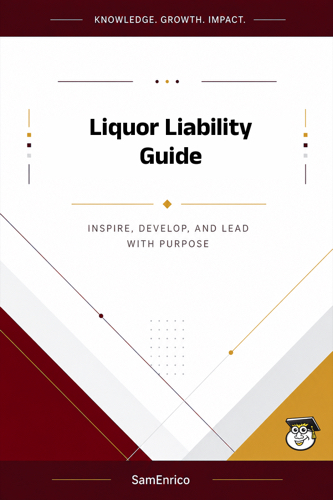
Liquor Liability Guide eBook
Teaches dram shop coverage for bars, restaurants,
Teaches dram shop coverage for bars, restaurants, and event venues.
Formats
Free sample
Chapter 1: The Pouring Problem-- Every time a bartender tips a bottle over a glass, something invisible is transferred along with the liquid. It is not merely alcohol. It is risk. It is liability. It is the potential for a verdict that could strip away everything a business owner has spent decades building.
The act of pouring a drink seems simple, even mundane. But in the eyes of the law, that single pour creates a chain of responsibility that extends far beyond the four walls of the establishment, far beyond the moment of consumption, and far into the night when a patron may be behind the wheel of a car, standing in front of another person's home, or arguing loudly in a parking lot.This book exists because most bar owners, restaurant operators, and event venue managers do not understand the true nature of the risk they carry. They understand that drunk driving is bad. They understand that overserving a patron can lead to trouble. But they do not understand the mechanics of how liability attaches, how insurance responds, and how a single incident can trigger a cascade of legal and financial consequences that no amount of hard work can undo.
The Liquor Liability Guide is designed to close that gap. It is a practical, actionable manual for anyone who serves alcohol to the public for profit, written in plain English but grounded in the real statutes, case law, and insurance policy language that govern this area.Before we dive into the specifics of insurance forms, training protocols, and defense strategies, we must first confront a foundational truth: the law did not always hold servers responsible for the actions of drunk patrons. That change—from complete immunity to significant liability—is the single most important legal development in the history of the hospitality industry. Understanding how and why that change occurred is not an academic exercise. It is the key to understanding why juries today are willing to award millions of dollars against a bar that served a patron one drink too many.The Old Rule: Immunity for Tavern Keepers For centuries, the common law of England and the United States held a simple rule: a tavern keeper could not be held liable for injuries caused by a drunk patron.
The reasoning was straightforward. The proximate cause of any harm was not the sale of alcohol but the voluntary act of the patron in choosing to drink to excess. The tavern keeper did not force the patron to drink. The tavern keeper did not force the patron to drive. The patron was a free agent, and the consequences of his or her choices belonged to that patron alone.This rule made sense in a pre-industrial world where horse-drawn carriages moved slowly and the worst injury from a drunk driving incident might be a broken wheel or a bruised ego.
It also reflected a deeply held moral philosophy about personal responsibility. Courts in the 1800s routinely dismissed dram shop cases with language that sounds shocking to modern ears. A Massachusetts court in 1842 wrote that holding a tavern keeper liable would be "to extend the responsibilities of a vendor of spirituous liquors further than has ever yet been done by any court." A New York court in 1816 stated flatly that "the drunkenness of the plaintiff, and not the sale of the liquor, was the cause of his injury."The term "dram shop" itself comes from this era. A dram was a small unit of measurement—roughly one-eighth of a fluid ounce, or a spoonful of liquid. In 18th-century English taverns, gin was sold by the dram, hence the name.
These establishments were often dirty, crowded, and associated with the poorest classes. They were not the polished gastropubs of modern imagination. They were dangerous places where laboring men spent their wages on cheap spirits, and the law largely left them alone because society had not yet decided that drunk driving was a public health crisis.That indifference would not last. The rise of the automobile changed everything.The Automobile Revolution and the Birth of Dram Shop Acts In 1900, there were approximately eight thousand registered automobiles in the United States. By 1920, there were nine million.
And with millions of cars came millions of crashes. The combination of a drunk driver and a two-ton vehicle traveling at thirty miles per hour produced catastrophic injuries that the horse-and-buggy era had never seen. Families of crash victims began suing the taverns that served the drunk drivers, and juries were sympathetic.The common law immunity that had protected taverns for centuries began to crumble. Between 1920 and 1940, twenty-seven states passed modern dram shop acts. These were not symbolic gestures.
They had real teeth. They lowered the burden of proof, eliminated damage caps in some states, and explicitly rejected the common law immunity. The language of these acts was carefully crafted to shift the focus from the patron's voluntary intoxication to the server's role in contributing to that intoxication.Prohibition (1920 to 1933) temporarily halted this legislative momentum, but when Prohibition ended, the dram shop movement resumed with renewed energy. By 1950, more than half the states had some form of dram shop liability. By 1980, that number had grown to forty states.
Today, forty-three states and the District of Columbia have dram shop acts, and the remaining seven states impose liability under other legal theories. The old common law immunity is effectively dead for commercial servers, even in states without explicit statutes.Why the Law Changed: Four Rationales That Drive Liability Today Understanding why the law shifted from immunity to liability helps explain how juries think today. There are four primary rationales that courts and legislatures have offered for imposing liability on commercial servers, and each of them matters for your business.The Incentive Rationale. If bars and restaurants are not held liable for the consequences of overserving, they have no financial incentive to stop serving intoxicated patrons. A bar makes money on every drink poured.
Without liability, the rational economic choice is to keep serving until the patron passes out or leaves. Liability changes that calculation. When a bar faces potential verdicts in the millions, the cost of cutting off a paying customer becomes trivial by comparison. The law uses liability as a tool to align economic incentives with public safety.The Insurance Rationale. Commercial servers have insurance, or at least they should.
Victims of drunk driving crashes often face a driver who is uninsured or underinsured—the drunk driver may be unemployed, have no assets, and carry only state minimum liability coverage. The bar, by contrast, has deeper pockets. Plaintiffs' attorneys pursue bars not out of malice but out of necessity. If the drunk driver cannot pay, the bar is the only remaining source of compensation for the victim's medical bills, lost wages, and pain and suffering. This rationale is pragmatic rather than moral, but it carries enormous weight in courtrooms.The Deterrence Rationale.
The threat of liability deters bad conduct. When bars know they can be sued for overserving, they train their staff, implement policies, and cut off patrons more aggressively. Studies have shown that states with strong dram shop acts have lower rates of drunk driving fatalities than states with…
This is the end of the free sample. Get the eBook to keep going. Buy now
About this book
Details
- Author
- Williford Lashawna
- Publisher
- SamEnrico
- Language
- English
- Genre
- Non-Fiction, Business Brief, Alcohol
- Released
- 2026-06-05
- Pages (approx.)
- 141
- Available as
- eBook, Audiobook

Read better in the ZLOADR app
Your eBooks on your phone or tablet. Sign in with your SamEnrico account and start reading.
More by Williford Lashawna
 Difficult Conversations EQWilliford Lashawna$11.99
 Self Esteem Emotional NeglectWilliford Lashawna$11.99
 Personal Brand SEO BasicsWilliford Lashawna$11.99
 Lorazepam Alcohol Detox GuideWilliford Lashawna$11.99
 The Remote Work Life SeparationWilliford Lashawna$11.99
 Neurofeedback Trigger TrainingWilliford Lashawna$11.99
 Inhibition And Working MemoryWilliford Lashawna$11.99
 The Timbuktu Scholars: Guardians of Africa's Lost WisdomWilliford Lashawna$11.99
 The Art of the Open Sea: Pythagoras and the Birth of Western NavigationWilliford Lashawna$11.99
 How to Produce Fireproof ProductsWilliford Lashawna$11.99
 Toy American Eskimo Dog: Small But BoldWilliford Lashawna$11.99
 How to Produce Salad Dressing Mixers and ShakersWilliford Lashawna$11.99
You may also like
 Hong Kong Handover 1997Dunn Johnnie$11.99
 Zumba For Postnatal Recovery CourseNeal Christian$11.99
 Zumba for BeginnersLadner Nikia$11.99
 YouTube Comment Mining GuideHumes Pandora$12.99
 Worry Box MeditationCarlin Rudy$11.99
 Workplace Stress MeditationNguyen Lynn$11.99
 Workplace Stress and Sleep RepairHawley Ivory$11.99
 Workplace Perfectionism CureDelaney Jeffry$11.99
 Workplace Injustice Anger GuideWallen Isabelle$11.99
 Work Addiction and Burnout LinkGreenwood Ester$11.99
 Women in Yoga and WellnessBeattie Galina$11.99
 Women in Stand Up ComedyChun Evangeline$11.99