
Non-FictionInformativeEducational
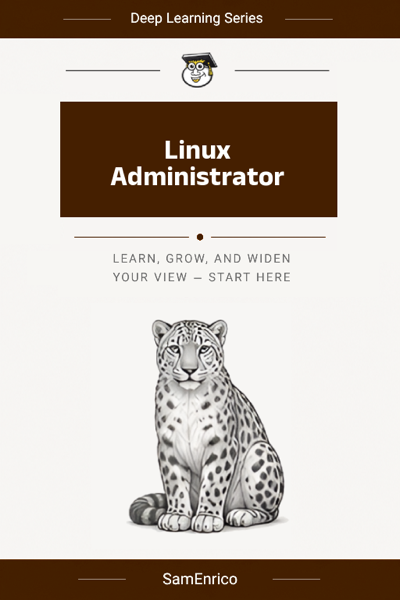
Linux Administrator eBook
A Coursebook on Linux Administrator
by Snow Tisha
A Coursebook on Linux Administrator
Formats
Free sample
Chapter 1: The 3 AM Wake-Up Call--–- The phone rang at 3:14 AM. Not the gentle chirp of an everyday notification, but the sharp, relentless buzz of a monitoring alert — the kind that bypasses your brain and lands directly in your stomach. On the screen: “CRITICAL: 200+ servers unreachable. Payment processing offline.” Your heart rate doubles before you are fully awake. You stumble to a laptop, fingers trembling slightly, and type the first command of your career as a Linux administrator: ssh production-db-01.
It fails. So does the next. Thirty seconds later, you realize the truth: you are the only person on call. The senior admin is on vacation. The documentation was last updated six years ago.
And somewhere — in a data center you cannot see, on a kernel you cannot touch — a system you are responsible for is failing at a rate of $50,000 per minute.This is not a drill. This is not a certification exam. This is the moment that separates people who “know Linux” from people who are Linux administrators.The 3 AM wake-up call is not an exaggeration; it is a rite of passage. Every seasoned administrator has a version of this story — the night when theory collapsed into practice, when a forgotten chmod or an unmonitored disk partition erupted into a full-blown crisis. And yet, those same administrators will tell you that those terrifying nights were also their greatest teachers.
Because a Linux administrator is not defined by the calm, predictable days of applying updates and creating user accounts. An administrator is defined by what happens when the system doesn’t do what it is told — when the boot loader vanishes, when the logs go silent, when the kernel panics at 4 AM and the only thing standing between a working server and a digital brick is your own knowledge, typed one character at a time.This chapter is about why that knowledge matters more now than ever. It is about the role you are stepping into — not as a “server babysitter” or a “command-line typist,” but as a systems engineer, a crisis manager, and a guardian of digital infrastructure. And it begins with a truth that no automation tool can replace, no cloud provider can abstract away, and no AI agent can fully shoulder: you cannot fix what you do not understand.The Myth of the Obsolete Administrator There is a persistent myth in modern technology that system administration is dying. Walk into any startup, listen to any Dev Ops evangelist, and you will hear it: “With Kubernetes, servers manage themselves.” “With serverless, you never touch an operating system.” “With AI, just ask Chat GPT to fix it.”This myth is seductive, comforting, and dangerously wrong.What cloud platforms, container orchestration, and AI assistants actually do is abstract away routine tasks.
They do not — cannot — eliminate the need for deep, foundational understanding. In fact, they increase it. Consider these scenarios, none of which are hypothetical:A managed Kubernetes cluster reports “node not ready.” The control plane is running. The pods are still scheduled. But nothing works.
The cloud provider’s status page is green. Who troubleshoots? A human who understands cgroups, systemd, and network namespaces.An automatic scaling event goes haywire and launches 500 instances instead of five. The billing alarm is screaming. Who stops the bleeding?
A human who knows how to query the cloud API, filter by tag, and terminate instances in bulk — and who understands that terminating an instance that is processing a transaction will corrupt data unless they first drain connections.A cloud provider has a regional outage. The “high availability” configuration failed because you relied on a single availability zone. Who fails over to a secondary region? A human who understands DNS failover, database replication lag, and the difference between synchronous and asynchronous writes.The answer is the same today as it was twenty years ago: a human who understands Linux from the inside out. Not because automation is bad — automation is essential — but because automation is built by humans, configured by humans, and trusted to run without supervision only after humans have verified that it works.The administrator of 2025 is not a relic.
They are an evolved specialist. You still need to know how to read a filesystem superblock, how to interpret a kernel panic, and how to recover a corrupted fstab from a live USB. But you also need to understand virtual networking, container runtimes, cloud-init scripts, and infrastructure-as-code tools. The fundamentals have not disappeared; they have moved up the stack. And without them, you are not an administrator — you are a passenger, hoping that the automation never breaks.Beyond “Server Babysitter”: The Five Pillars The term “Linux administrator” is deceptively simple.
It conjures images of gray-bearded elders in darkened server rooms, wearing noise-canceling headphones and typing arcane commands with the speed of concert pianists. That caricature was never entirely accurate, and today it is obsolete. A modern Linux administrator is responsible for five interconnected domains, each requiring both deep technical knowledge and sharp judgment.Pillar One: Uptime and Reliability At its core, administration is about keeping systems running. But “uptime” is not a number on a dashboard; it is the sum of thousands of small decisions: which kernel version to run, how to configure swap, where to place log files, when to reboot after a security update, and — perhaps most importantly — how to design systems that can survive failures without human intervention.The difference between 99.9% uptime (eight hours of downtime per year) and 99.999% uptime (five minutes per year) is not luck. It is architecture (redundancy, failover, load balancing), monitoring (detecting problems before users do), and recovery (automated failover with manual fallback when automation breaks).
As an administrator, you are the last line of defense. When the automated failover works, no one notices. When it fails, you get the 3 AM phone call.Pillar Two: Security and Compliance Every Linux server is a target. Within minutes of connecting a fresh installation to the internet, bots will scan for open SSH ports, try default passwords, and probe for known vulnerabilities. The administrator’s job is not just to set up a firewall and enable SELinux; it is to understand the threat model, apply the principle of least privilege, and ensure that a breach in one container does not become a breach in the entire cluster.Compliance adds another layer.
Whether your organization must follow PCI (payment card industry), HIPAA (healthcare), GDPR (privacy), or internal security policies, you are responsible for proving that systems are configured correctly. That means audit logs, immutable records, regular patching, and documented procedures. You are not just protecting data; you are protecting the company from lawsuits, fines, and reputational collapse.Pillar Three: Automation and Efficiency Repetition is the enemy of reliability. Every manual step is an opportunity for human error — a typo, a forgotten flag, a command run on the wrong server. The modern administrator writes scripts, creates systemd timers, and uses configuration management tools (such as Ansible, which we will cover in Chapter 10) to turn infrastructure into code.Automation does not replace your job; it elevates it.
Instead of creating fifty user accounts by hand, you write a script that reads a CSV file and creates them flawlessly in three…
This is the end of the free sample. Get the eBook to keep going. Buy now
About this book
Details
- Author
- Snow Tisha
- Publisher
- SamEnrico
- Language
- English
- Genre
- Non-Fiction, Informative, Educational
- Released
- 2026-05-04
- Pages (approx.)
- 157
- Available as
- eBook, Audiobook

Read better in the ZLOADR app
Your eBooks on your phone or tablet. Sign in with your SamEnrico account and start reading.
More by Snow Tisha
 Meditation for Sleep AnxietySnow Tisha$11.99
 Food Addiction Therapist GuideSnow Tisha$11.99
 Burnout Recovery Career Change GuideSnow Tisha$11.99
 Self Worth Religious Trauma GuideSnow Tisha$11.99
 Kurofune Perry Opening GuideSnow Tisha$11.99
 Fenrir's Howl: The Wolf That Swallowed the MoonSnow Tisha$11.99
 Frozen Shadows: The Secret Mapping of Antarctica's Hidden PeaksSnow Tisha$11.99
 Employee Drug Testing TrapSnow Tisha$12.99
 Monte Carlo Econ ExcelSnow Tisha$12.99
 Understanding Glucosephosphate Isomerase DeficiencySnow Tisha$17.99
 How to Start a Cellular Phones Business (Beginners Guide)Snow Tisha$11.99
You may also like
 Hong Kong Handover 1997Dunn Johnnie$11.99
 Zumba For Postnatal Recovery CourseNeal Christian$11.99
 Zumba for BeginnersLadner Nikia$11.99
 YouTube Comment Mining GuideHumes Pandora$12.99
 Worry Box MeditationCarlin Rudy$11.99
 Workplace Stress MeditationNguyen Lynn$11.99
 Workplace Stress and Sleep RepairHawley Ivory$11.99
 Workplace Perfectionism CureDelaney Jeffry$11.99
 Workplace Injustice Anger GuideWallen Isabelle$11.99
 Work Addiction and Burnout LinkGreenwood Ester$11.99
 Women in Yoga and WellnessBeattie Galina$11.99
 Women in Stand Up ComedyChun Evangeline$11.99