
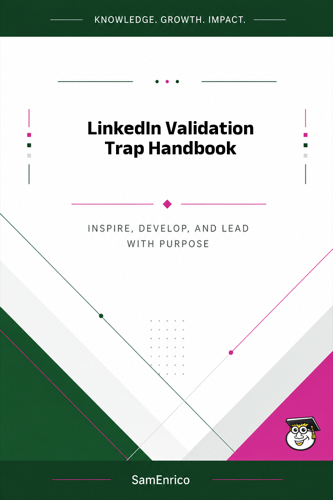
LinkedIn Validation Trap Handbook eBook
Stop comparing career achievements and job titles
by Tyner Shanda
Stop comparing career achievements and job titles on professional networks.
Formats
Free sample
Chapter 1: The Highlight Reel Machine--–- You are about to read something that will make you uncomfortable. That is the point.Every morning, before you have had your first sip of coffee, before you have said a single word to another human being, before you have done anything that actually matters in your real life, you open an app that is designed to make you feel small.You tell yourself you are “networking.” You tell yourself you are “staying informed.” You tell yourself you are “building your personal brand.” But if you are honest—truly, painfully honest—you open it for the same reason millions of other professionals open it every single day.You want to see if you are winning.And within thirty seconds, you will find out that you are not.Someone got promoted. Someone else closed a funding round. A former classmate you barely remember just announced a “dream role” at a company you once applied to and got rejected from. Another connection—the one who always seems to be on a beach or at a “retreat” or “thrilled to announce” something—has done it again.You scroll.
You compare. You feel a tightening in your chest.Then you close the app, put your phone down, and try to start your actual day. But something has already shifted. A small crack has formed in the foundation of your professional self-worth. And tomorrow morning, you will open the app again, and the crack will grow a little wider.This is not a personal failing.
This is not a weakness unique to you. This is a machine, and you have been caught inside it.This chapter is called The Highlight Reel Machine for a reason. Because that is exactly what Linked In has become—not a network, not a tool, not a community, but a machine that takes the messiest, most uncertain, most human parts of your career and grinds them against the most polished, curated, and misleading versions of everyone else’s.By the time you finish this chapter, you will understand exactly how that machine works. You will see the gears. You will name the mechanism.
And most importantly, you will stop blaming yourself for feeling inadequate, because you will finally understand that inadequacy is not a bug in the system.It is the feature.The Invention of a Problem You Didn’t Know You Had Let us go back in time for a moment. Not centuries. Just a few decades.Before Linked In launched in 2003, professionals compared themselves to others in very different ways. You compared yourself to the people in your office. Maybe to a competitor you heard about at an industry conference.
Perhaps to a former classmate whose career update you received in a holiday card once a year.That was it. That was the scope of your comparison universe.Your brain is wired for comparison. This is not a moral failing; it is an evolutionary inheritance. For most of human history, comparing yourself to others in your immediate tribe was essential for survival. Is that person stronger?
Faster? Better at finding food? If so, you needed to know, because your place in the hierarchy determined your access to resources, safety, and mates.Psychologists call this Social Comparison Theory. First developed by Leon Festinger in 1954, the theory argues that humans have an innate drive to evaluate themselves by comparing themselves to others. When objective measures are unavailable—and in careers, they almost always are—we turn to subjective comparisons.There are two types.Downward comparison is when you compare yourself to someone you perceive as worse off.
It makes you feel better. “At least I am not that guy who got laid off.” Downward comparison is comforting, which is why your brain reaches for it when you are feeling vulnerable.Upward comparison is when you compare yourself to someone you perceive as better off. It can be motivational. “She got that promotion. Maybe I can too.” But it can also be destructive.
And on Linked In, upward comparison is not occasional. It is constant, relentless, and optimized.Here is what changed: Linked In expanded your comparison universe from dozens of people to millions.You are no longer comparing yourself to the three colleagues in the cubicles around you. You are comparing yourself to a former classmate in another city, a stranger in another country, a “thought leader” with a blue checkmark who posts from a time zone you have never visited. You are comparing your messy, complicated, often disappointing real career to a feed of carefully curated victories.And your brain cannot tell the difference.Evolution did not prepare you for this. Your neural hardware was designed for a world where you saw perhaps a few hundred faces in your lifetime, not a world where you scroll past a thousand carefully staged success stories before lunch.The machine exploits a mismatch between your ancient brain and your modern screen.
And you are not losing because you are weak.You are losing because the game is rigged.The Architecture of Envy: How Linked In Weaponizes Your Attention Let us talk about what actually happens when you open Linked In. Not what you think happens. What actually happens.Linked In is not a neutral platform. It is a publicly traded company with a fiduciary responsibility to maximize shareholder value. That means it needs you to spend as much time on the platform as possible.
Every feature, every notification, every algorithm is designed with one primary goal: increase engagement.Engagement is not the same as usefulness. Engagement is not the same as connection. Engagement is the total amount of time you spend looking at the screen, clicking, scrolling, and returning.And the single most reliable way to increase engagement is to trigger an emotional response. Positive emotions work—warmth, inspiration, hope. But negative emotions work better.
Anger, outrage, and fear drive more clicks, more scrolling, and more returns.But on a professional network, outright outrage is tricky. People want to feel productive, not enraged. So Linked In optimized for a different negative emotion: inadequacy.Inadequacy is perfect for engagement because it does not make you close the app. It makes you stay. If you feel inadequate, you do not leave.
You scroll more, looking for evidence that you are not as behind as you think. You click on profiles to see how other people structured their career paths. You compare your skills to theirs. You wonder if you should take that certification course. You stay.The machine is built on three specific mechanisms.Mechanism One: The Asymmetric Information Gap When someone posts about a promotion, a new job, or a major achievement, they almost never include the full context.
They do not mention the nine months of rejection emails that preceded the offer. They do not mention the sleepless nights, the imposter syndrome, the near-meltdown in the parking lot before the final interview. They do not mention the luck, the privilege, or the connections that opened the door.They post the victory. Nothing else.You, reading that post, fill in the gaps with your imagination. And your imagination, trained by a lifetime of upward comparison, fills the gaps with…
This is the end of the free sample. Get the eBook to keep going. Buy now
About this book
Details
- Author
- Tyner Shanda
- Publisher
- SamEnrico
- Language
- English
- Genre
- Non-Fiction, Self-Help, Professional Identity, Career
- Released
- 2026-06-08
- Pages (approx.)
- 140
- Available as
- eBook, Audiobook

Read better in the ZLOADR app
Your eBooks on your phone or tablet. Sign in with your SamEnrico account and start reading.
More by Tyner Shanda
 Vince Gill Nashville GentlemanTyner Shanda$11.99
 Remote Company Retreats Accessibility GuideTyner Shanda$11.99
 Burnout Recovery Evening Wind DownTyner Shanda$11.99
 The US Address for Banking GuideTyner Shanda$11.99
 Charlemagne's Legacy: The Carolingian Renaissance RebornTyner Shanda$11.99
 Salesforce Project ManagerTyner Shanda$11.99
 How to Become a License InspectorTyner Shanda$11.99
 Private Scholarships for KoreaTyner Shanda$12.99
 EU Import Tariffs CoffeeTyner Shanda$12.99
 Understanding Sexually Transmitted DiseaseTyner Shanda$17.99