
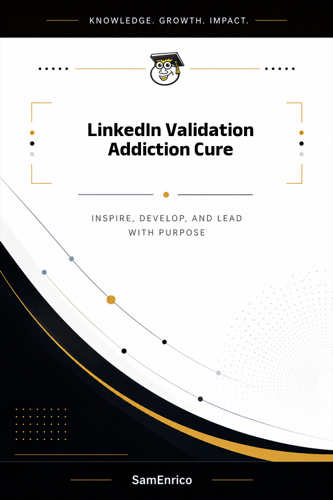
Non-FictionSelf-HelpProfessional Development
LinkedIn Validation Addiction Cure eBook
Reduces compulsive profile checking and engagement
Reduces compulsive profile checking and engagement-seeking behavior on professional networks.
Formats
Free sample
Chapter 1: The Dopamine Resume--–- It begins, as it always does, with a tiny blue dot.Not a dramatic collapse. Not a shouting match with your laptop. Just a small, circular notification icon that appears at the top of your screen, silently insisting that someone, somewhere, has acknowledged your existence. You tell yourself you will ignore it. You have work to do.
A deadline looms. Your coffee is still hot. But your hand moves before your conscious mind can object. The cursor drifts upward. A single click.
And just like that, you are gone.Twenty minutes later, you surface from the feed like a drowning man gasping for air. You cannot remember a single post you read. You have not applied for any jobs, messaged any recruiters, or advanced any professional goal. You have simply... scrolled.
And yet, something in your chest feels momentarily lighter. Someone liked your comment. A connection request was accepted. Three people viewed your profile. None of this has improved your career.
None of this has paid your bills. But the blue dot is gone, and for a few precious seconds, the silence is enough.If you recognize this scene, you are not weak. You are not lazy. You are not undisciplined. You are, however, caught in a neurological trap designed by some of the smartest behavioral engineers in the world, and they built it specifically for people like you: ambitious, driven professionals who have been taught that visibility equals viability, and that being seen is the first step to being valued.Welcome to the dopamine resume.
Your professional self-worth has been hijacked, and this chapter will show you exactly how.The Myth of the Rational Professional Linked In presents itself as a utility. A tool. A digital filing cabinet for your career. The company’s founding narrative is almost boring in its practicality: connect with colleagues, find jobs, display your skills. But this utilitarian framing is precisely what makes the platform so dangerous.
Unlike Instagram, which announces itself as a playground of filtered vanity, or Tik Tok, which screams for your attention with dancing teens and viral challenges, Linked In wears the mask of productivity. It looks like work. It smells like work. It borrows the visual language of work: charts, headlines, recommendations, professional headshots. And because it looks like work, you feel justified spending hours inside it.This is the first and most important deception you must unravel.
Linked In is not a utility. It is a behavioral modification engine disguised as a business tool. Every feature you use, every notification you receive, every email that lands in your inbox has been A/B tested, optimized, and deployed with a single goal: to keep you scrolling, clicking, and returning. The company’s financial model depends on your attention, not your career success. You are not the customer.
You are the product. And the product’s job is to generate engagement metrics that can be sold to recruiters and advertisers.Consider the numbers. The average Linked In user now spends more than seven hours per month on the platform. Seven hours. That is nearly a full working day.
Yet when researchers ask those same users to estimate their time, the average response is ninety minutes. The discrepancy between perceived and actual usage is not accidental. Linked In, like every other social platform, has engineered its interface to eliminate friction, provide variable rewards, and exploit the psychological phenomenon known as the "blissful ignorance effect" – our brain’s tendency to stop tracking time when we are engaged in a loop of unpredictable rewards.You are not scrolling because you lack willpower. You are scrolling because Linked In has spent billions of dollars learning how to make scrolling inevitable.The Three Pillars of Professional Dopamine To understand your addiction, you must first understand the specific rewards Linked In offers – rewards that are more potent for professionals than the likes and hearts of other platforms. While Instagram sells social comparison and Facebook sells belonging, Linked In sells something far more intoxicating to the ambitious mind: professional validation.Pillar One: Endorsements The endorsement feature appears harmless.
A former colleague clicks a button next to "Project Management" or "Public Speaking" and suddenly a number on your profile increments by one. It requires no thought, no effort, no genuine assessment of your abilities. And that is precisely why it is so addictive.Endorsements function as micro-doses of professional approval. They require nothing from the giver and deliver a small, reliable hit of validation to the receiver. Your brain registers each endorsement as a social signal: someone believes I am competent.
Over time, the endorsement count becomes a proxy for professional worth. You check it obsessively. You feel a twinge of anxiety when a week passes without a new one. You may even find yourself silently endorsing others in the hope that they will reciprocate – a behavioral pattern psychologists call "social grooming," adapted for the digital age.The cruelty of the endorsement feature is that it measures frequency, not quality. A hundred endorsements from people who barely know you mean less than a single detailed recommendation from a mentor.
But the recommendation requires effort. The endorsement requires a click. Linked In prioritizes the click because the click keeps you engaged.Pillar Two: Recruiter Profile Views Of all the dopamine triggers on Linked In, the "Who’s viewed your profile" feature is the most potent. Here is why. In the professional world, being noticed by someone with power – a hiring manager, a recruiter, a senior executive – has historically been a rare and valuable event.
Your brain has evolved to treat such attention as significant. A recruiter viewing your profile signals desirability, employability, and social proof. It suggests that you are not just another resume in a pile; you are a person worth noticing.Linked In takes this ancient neurological circuit and turns it into a slot machine. The list of profile viewers refreshes unpredictably. Sometimes it is empty.
Sometimes it contains a single name from a company you have never heard of. And sometimes – gloriously sometimes – it contains a recruiter from Google, or Microsoft, or a fast-growing startup in your industry. The variability is the hook. Your brain releases dopamine not when you receive a reward, but when you anticipate one. The possibility that the next viewer might be someone important keeps you checking, refreshing, and returning.The platform compounds this effect by withholding full information.
If you use Linked In anonymously, you cannot see who viewed you. If you want the full list, you must upgrade to Premium – or accept that you will always wonder. This manufactured information gap creates a low-grade anxiety that only checking can temporarily relieve. You are not using Linked In. Linked In is using you.Pillar Three: Connection Requests from "Impressive" People The third pillar of professional dopamine is the connection request from someone with higher status.
A vice president at a Fortune 500 company requests to connect. A venture capitalist follows you. A thought leader with fifty thousand followers sends an invitation. Each of these requests triggers a surge of validation: I have been accepted by the tribe. I belong among the successful.Connection requests are particularly insidious…
This is the end of the free sample. Get the eBook to keep going. Buy now
About this book
Details
- Author
- Herrera Brittany
- Publisher
- SamEnrico
- Language
- English
- Genre
- Non-Fiction, Self-Help, Professional Development
- Released
- 2026-06-09
- Pages (approx.)
- 140
- Available as
- eBook, Audiobook

Read better in the ZLOADR app
Your eBooks on your phone or tablet. Sign in with your SamEnrico account and start reading.
More by Herrera Brittany
 Trello Archived Cards RecoveryHerrera Brittany$11.99
 Sweating and Blushing CuesHerrera Brittany$11.99
 Atomic Habits For OptimismHerrera Brittany$11.99
 Wound Closure Strip UseHerrera Brittany$11.99
 Shift Work DisorderHerrera Brittany$11.99
 Number Peg System WorkbookHerrera Brittany$11.99
 Remote Work for AnxietyHerrera Brittany$11.99
 The Tulip Mania Mirage: When Flowers Became FortuneHerrera Brittany$11.99
 The Charge at Cowpens: The Cavalry That Saved the RevolutionHerrera Brittany$11.99
 How to Produce 100% Cashmere FabricHerrera Brittany$11.99
 Brazil State ICMS Tax DropshippingHerrera Brittany$12.99
 AI Assisted Cost Allocation ModelsHerrera Brittany$12.99
You may also like
 Hong Kong Handover 1997Dunn Johnnie$11.99
 Zumba For Postnatal Recovery CourseNeal Christian$11.99
 Zumba for BeginnersLadner Nikia$11.99
 YouTube Comment Mining GuideHumes Pandora$12.99
 Worry Box MeditationCarlin Rudy$11.99
 Workplace Stress MeditationNguyen Lynn$11.99
 Workplace Stress and Sleep RepairHawley Ivory$11.99
 Workplace Perfectionism CureDelaney Jeffry$11.99
 Workplace Injustice Anger GuideWallen Isabelle$11.99
 Work Addiction and Burnout LinkGreenwood Ester$11.99
 Women in Yoga and WellnessBeattie Galina$11.99
 Women in Stand Up ComedyChun Evangeline$11.99