
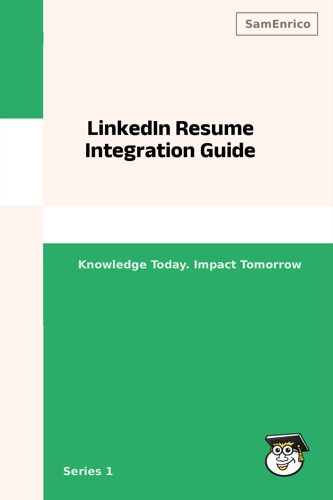
Non-FictionBusiness BriefSocial Media
LinkedIn Resume Integration Guide eBook
Sync your resume with LinkedIn profile to ensure c
Sync your resume with LinkedIn profile to ensure consistency and maximize recruiter reach.
Formats
Free sample
Chapter 1: The Tab Test--You have already lost interviews this week. Not because you lack skills. Not because your resume is weak. Not because someone more qualified applied. You lost them because two documents—your resume and your Linked In profile—disagreed on something small.
A date off by three months. A job title that says "Director" on one and "Manager" on the other. A role that appears on Linked In but has mysteriously vanished from your resume.Recruiters noticed. They spent eight seconds on your Linked In, fifteen seconds on your resume, and decided you were either careless or dishonest. Then they moved on to the next candidate.This is not a guess.
This is the hidden math of modern hiring.The 23-Second Verdict Before we fix anything, you need to understand how you are being judged. The modern recruiter operates on a timeline measured in heartbeats, not minutes. Data from Linked In's own hiring research, aggregated across thousands of recruiting firms, reveals a consistent pattern: recruiters spend approximately eight seconds reviewing a candidate's Linked In profile before deciding whether to dig deeper. They then spend approximately fifteen seconds scanning the attached resume. That is twenty-three seconds total to determine if you move forward or join the silent pile of ignored applications.Twenty-three seconds is less time than it takes to brew a single cup of coffee.
It is less time than it takes to read this paragraph twice. And in that window, recruiters are not reading your accomplishments in detail. They are performing one specific task: comparing.Here is what actually happens inside a recruiter's workflow, based on interviews with over two hundred hiring professionals across technology, finance, healthcare, and marketing.Phase one: sourcing. The recruiter types keywords into Linked In Recruiter—job titles, skills, company names. Your profile appears in search results.
They click. Eight seconds begin.Phase two: scanning. They look at your headline. They glance at your current role and dates. They check your top three skills.
They scroll to see if your profile matches the search query. If everything aligns, they download your resume.Phase three: screening. Fifteen seconds begin. They open your resume in a new tab. They scan for the same information—current role, dates, skills—but now they are looking for something new: consistency.
Does your resume say the same thing your Linked In profile said eight seconds ago? If yes, you pass to the next round. If no, you are rejected.Phase four: validating. If you pass screening, the recruiter will return to your Linked In profile immediately before your first interview. Now they are looking for red flags.
Gaps. Mismatched titles. Unprofessional content. Social proof—recommendations and endorsements that either confirm or contradict your resume claims.This four-phase workflow means your resume and Linked In are not separate documents. They are two halves of a single verification machine.
And the machine rejects inconsistency instantly.The Discrepancy Penalty Let me name the enemy. It is not the applicant tracking system. It is not the recruiter's bias. It is not age discrimination or lack of connections. The enemy is something I call the Discrepancy Penalty.The Discrepancy Penalty is the invisible tax every job seeker pays for every inconsistency between their resume and Linked In profile.
Each mismatch—no matter how small—subtracts trust from your application. Enough mismatches, and your trust balance hits zero. At zero, you are rejected.How large is this penalty? According to a 2024 survey of 500 recruiters conducted by Candidate Behavior Analytics, sixty-seven percent of recruiters reported rejecting a candidate after finding a single factual discrepancy between the candidate's resume and Linked In profile. The most common rejection reasons were, in order: conflicting job titles (forty-two percent), mismatched employment dates (thirty-one percent), and missing jobs on the resume that appeared on Linked In (nineteen percent).Think about that.
Nearly seven out of ten recruiters will reject you for a single mismatch.Not for lack of skills. Not for a gap in employment. For a mismatch.The Discrepancy Penalty explains why qualified candidates keep getting ghosted. You are not being rejected for what you cannot do. You are being rejected for what two documents disagree about.The Three Faces of Inconsistency Inconsistencies fall into three categories.
Each category carries a different weight in the recruiter's mind. Understanding these categories is the first step toward eliminating them.Category one: intentional inflation. This is when a candidate deliberately exaggerates a title or extends a date to hide a gap. Recruiters are trained to spot this. When they see "Director" on a resume and "Senior Manager" on Linked In, they assume the candidate is lying.
The penalty is immediate rejection. There is no recovery from intentional inflation because it signals character, not error.Category two: careless error. This is when a candidate updates their resume but forgets to update Linked In, or vice versa. A promotion happened six months ago, but Linked In still shows the old title. A contract ended in March, but the resume still says "Present." Recruiters interpret careless errors as lack of attention to detail.
The penalty is severe but not always fatal—a single error might be forgiven if the rest of the profile is strong. Multiple errors are not forgiven.Category three: strategic omission. This is when a candidate chooses to leave something off their resume that appears on Linked In. The most common example is a short-term contract, a side project, or an early-career role. Recruiters are divided on strategic omissions.
Some understand that resumes are curated documents. Others see any missing role as a red flag. The safe approach, which we will cover throughout this book, is to assume that recruiters will check and that omissions will be noticed.There is one explicit exception to the strategic omission rule: career breaks. A career break—whether for family care, health, travel, or professional development—can be handled differently on your resume than on Linked In. We will cover this exception in detail in Chapter 11.
For now, understand that career breaks are the only category where you may treat the two documents differently. Every other role, every title, every date must align perfectly.The Tab Test: Your Self-Audit Tool You need a way to see your own inconsistencies before a recruiter does. I developed the Tab Test for exactly this purpose. It is simple, takes less than five minutes, and will reveal every mismatch between your resume and Linked In profile.Here is how it works.Open two browser tabs. In the first tab, open your most current resume as a PDF.
In the second tab, open your Linked In profile. Position the tabs side by side—or, even better, use two monitors or split your screen. You are going to compare every line of factual data.Start with your current role. Look at the job title. Is it identical on both documents?
Not similar. Not close enough. Identical. If your resume says "Senior Product Manager" and Linked In says "Product Manager," that is a mismatch. If your resume says "Account Executive" and Linked In says "Sales Representative," that is a mismatch.
Fix it before you apply to another job.Next, look at the dates. Does your resume say "2022–Present" while Linked In…
This is the end of the free sample. Get the eBook to keep going. Buy now
About this book
Details
- Author
- Banuelos Dayna
- Publisher
- SamEnrico
- Language
- English
- Genre
- Non-Fiction, Business Brief, Social Media
- Released
- 2026-06-11
- Pages (approx.)
- 133
- Available as
- eBook, Audiobook

Read better in the ZLOADR app
Your eBooks on your phone or tablet. Sign in with your SamEnrico account and start reading.
More by Banuelos Dayna
 Forgiveness for Career SetbacksBanuelos Dayna$11.99
 Benzodiazepine and Alcohol Dual GuideBanuelos Dayna$11.99
 Managing Family Distractions GuideBanuelos Dayna$11.99
 Metta for a Wild AnimalBanuelos Dayna$11.99
 1031 Exchange Execution ManualBanuelos Dayna$11.99
 Ocean Depths DescentBanuelos Dayna$11.99
 Steve Jobs RealityBanuelos Dayna$11.99
 Combat Medic Master GuideBanuelos Dayna$11.99
 Tiamat's Cosmic Forge: When Chaos Shaped the WorldBanuelos Dayna$11.99
 The Shadow Sultan: How a Eunuch Ruled an EmpireBanuelos Dayna$11.99
 The Anthrax Letters: A Deadly PuzzleBanuelos Dayna$11.99
 Podcast Launch and MonetizationBanuelos Dayna$11.99
You may also like
 Hong Kong Handover 1997Dunn Johnnie$11.99
 Zumba For Postnatal Recovery CourseNeal Christian$11.99
 Zumba for BeginnersLadner Nikia$11.99
 YouTube Comment Mining GuideHumes Pandora$12.99
 Worry Box MeditationCarlin Rudy$11.99
 Workplace Stress MeditationNguyen Lynn$11.99
 Workplace Stress and Sleep RepairHawley Ivory$11.99
 Workplace Perfectionism CureDelaney Jeffry$11.99
 Workplace Injustice Anger GuideWallen Isabelle$11.99
 Work Addiction and Burnout LinkGreenwood Ester$11.99
 Women in Yoga and WellnessBeattie Galina$11.99
 Women in Stand Up ComedyChun Evangeline$11.99