
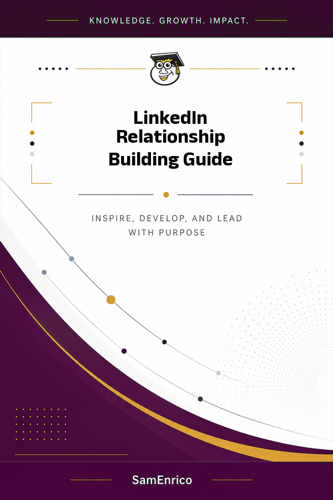
Non-FictionSelf-HelpDigital Networking
LinkedIn Relationship Building Guide eBook
Use social media strategically to connect with ind
Use social media strategically to connect with industry peers and recruiters.
Formats
Free sample
Chapter 1: The Connection Illusion--Imagine waking up tomorrow to find that your Linked In connection count has doubled overnight. Five hundred new people have accepted your requests. Your profile views have tripled. Your feed is filled with congratulatory messages from strangers. You feel popular, influential, and successful.Now imagine that not a single one of those new connections knows your name.
Not one would reply to a message asking for advice. Not one would refer you to a hiring manager. Not one would send you a lead for a client or a job. Your network has grown, but your opportunities have not. Your metrics have improved, but your career has not advanced.This is the Connection Illusion.
It is the most dangerous and pervasive myth in professional networking today. And it is costing you opportunities you do not even know you are missing.The Connection Illusion convinces professionals that networking is a numbers game. Send enough requests. Accept enough invitations. Collect enough badges.
The person with the largest network wins. This belief is seductive because it simplifies a complex process into a single, trackable metric. It replaces the messy, uncomfortable work of genuine relationship building with the clean, satisfying click of a button.But the Connection Illusion is not merely unhelpful. It is actively harmful to your professional future. Every hour you spend chasing connection counts is an hour you could have spent cultivating relationship capital.
Every stranger you add to your network without context or conversation is a distraction from the people who could actually help you reach your goals. Every like you click without genuine engagement is a performance of networking rather than the practice of it.This chapter dismantles the Connection Illusion completely. You will learn why most professionals fail at Linked In networking despite spending hours on the platform. You will discover the concept of relationship capital—the only metric that has ever predicted career success. You will understand the hidden job market and why your resume is probably invisible within it.
And you will define your North Star, the specific destination that will guide every action you take in this book.By the end of this chapter, you will never look at your connection count the same way again.The Numbers That Lie Let us examine a typical week in the life of a professional trapped in the Connection Illusion.Monday morning, they open Linked In and see a red notification badge. Someone has sent a connection request. They click accept without viewing the profile. Why not? More connections are always better, right?Tuesday afternoon, they receive an In Mail from a recruiter.
The message is clearly automated, but they reply anyway. More visibility can't hurt.Wednesday, they scroll through their feed and see a post from a former colleague celebrating a promotion. They click "like" without reading the caption. They don't actually care about the promotion, but they want to stay on the colleague's radar.Thursday, Linked In suggests twenty "People You May Know." They send requests to all twenty without personalizing a single one. It only takes thirty seconds, and maybe one of them will be useful someday.Friday, they check their profile views.
Sixty-three people have viewed their profile this week. That feels good. That feels like progress.Saturday, they wonder why none of this activity has produced a single job lead, client referral, or meaningful conversation.This professional has performed dozens of "networking actions" but has not advanced a single relationship. They have mistaken activity for progress, visibility for trust, and connection counts for relationship capital. They are trapped in the Connection Illusion.The problem is not effort.
The problem is the target of that effort. Linked In's interface is designed to reward behaviors that feel productive but are not. The notification badge, the connection count, the profile view counter—these are all features, not bugs. Linked In wants you to believe that more connections equal more success because that belief keeps you active on the platform.But Linked In's business goals are not your career goals. Linked In profits when you stay on the platform, click buttons, and generate data.
You profit when you build relationships that lead to real-world opportunities. These two objectives are not aligned. In fact, they are often in direct opposition.The Connection Illusion is the gap between what Linked In wants you to measure and what actually matters for your career. Closing that gap is the entire purpose of this book.Relationship Capital: The Currency That Matters Throughout this book, you will encounter a term that deserves careful definition upfront: relationship capital.Relationship capital is the stored goodwill, mutual respect, and willingness to help that exists between two people who have genuinely connected. It is not transactional in the sense of tracking favors.
It is relational in the sense of accumulated trust. Think of it as the balance in a bank account where the currency is not money but confidence.When you meet someone for coffee and listen carefully to their challenges, you make a deposit. When you share a resource that solves a problem they mentioned, you make another deposit. When you introduce them to someone who can help with a project, you make a larger deposit. Each deposit increases the balance of relationship capital.When you ask for advice, you make a small withdrawal.
When you ask for a warm introduction to a hiring manager, you make a larger withdrawal. When you ask for a significant favor, like a letter of recommendation or an investment of time, you make a substantial withdrawal. A healthy relationship has far more deposits than withdrawals. An unhealthy relationship has more withdrawals than deposits. A nonexistent relationship has no deposits at all.The Connection Illusion convinces professionals that they can withdraw before they have deposited.
They connect with a recruiter and immediately ask about open positions. They message a senior executive and request a thirty-minute informational interview. They join a group and start promoting their services. These behaviors fail because they attempt to withdraw from an account with a zero balance.The professionals who succeed on Linked In do the opposite. They spend weeks or months making deposits without asking for anything in return.
They share resources. They make introductions. They offer thoughtful comments on posts. They celebrate others' successes publicly. They build relationship capital so that when they eventually need to make a withdrawal—a job referral, a client introduction, a strategic connection—the person on the other end is not a stranger but an advocate.This is not manipulation.
It is not "hacking" human psychology. It is simply the recognition that human beings are wired for reciprocity. When someone helps you without asking for anything, you feel a natural, almost involuntary desire to help them in return. This is not a flaw in human nature. It is a feature.
And ethical networking works with this feature rather than against it.The Hidden Job Market One of the most persistent misconceptions about career advancement is that opportunities are equally visible to everyone. They are not. Between 70 and 80 percent of jobs are never publicly advertised. These positions are filled through internal mobility, employee referrals, direct outreach, and word-of-mouth.…
This is the end of the free sample. Get the eBook to keep going. Buy now
About this book
Details
- Author
- Wellman Hailey
- Publisher
- SamEnrico
- Language
- English
- Genre
- Non-Fiction, Self-Help, Digital Networking
- Released
- 2026-06-09
- Pages (approx.)
- 139
- Available as
- eBook, Audiobook

Read better in the ZLOADR app
Your eBooks on your phone or tablet. Sign in with your SamEnrico account and start reading.
More by Wellman Hailey
 Loneliness And Nature ConnectionWellman Hailey$11.99
 Menstrual Fatigue ManagementWellman Hailey$11.99
 Stress to Serenity GuideWellman Hailey$11.99
 Instagram Close Friends HierarchyWellman Hailey$11.99
 The Scarlet Letter of Hollywood: The Secret Love Affair That Shook the Golden AgeWellman Hailey$11.99
 Shackleton's Endurance: A Voyage of Ice and Iron Will (1914-1916)Wellman Hailey$11.99
 Understanding Dysplastic Nevus SyndromeWellman Hailey$17.99
 Stock Photo Equipment ListWellman Hailey$12.99
 Co Founder Insurance GuideWellman Hailey$12.99
 Criminal InvestigationWellman Hailey$11.99
 How to Start a Paper Patterns Business (Beginners Guide)Wellman Hailey$11.99
You may also like
 Hong Kong Handover 1997Dunn Johnnie$11.99
 Zumba For Postnatal Recovery CourseNeal Christian$11.99
 Zumba for BeginnersLadner Nikia$11.99
 YouTube Comment Mining GuideHumes Pandora$12.99
 Worry Box MeditationCarlin Rudy$11.99
 Workplace Stress MeditationNguyen Lynn$11.99
 Workplace Stress and Sleep RepairHawley Ivory$11.99
 Workplace Perfectionism CureDelaney Jeffry$11.99
 Workplace Injustice Anger GuideWallen Isabelle$11.99
 Work Addiction and Burnout LinkGreenwood Ester$11.99
 Women in Yoga and WellnessBeattie Galina$11.99
 Women in Stand Up ComedyChun Evangeline$11.99