
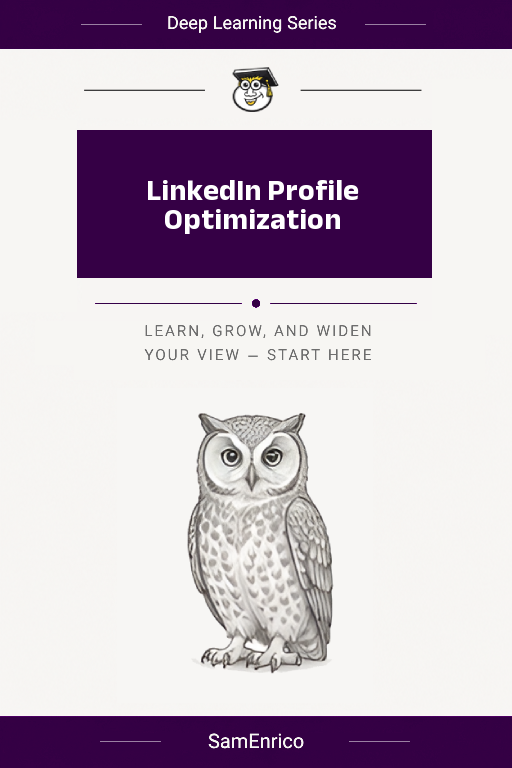
Non-FictionFirst 30 DaysProfileSelf-Help
LinkedIn Profile Optimization eBook
Craft headline, summary, and experience sections f
Craft headline, summary, and experience sections for recruiter appeal.
Formats
Free sample
Chapter 1: The Invisible Graveyard--–- Most professionals have no idea their Linked In profile is already dead. They update it once a year, add a new job title when they switch companies, and assume recruiters will somehow find them. They wait. And wait. And nothing happens.
No messages. No interviews. No offers. Just silence.This chapter is called The Invisible Graveyard because that is exactly where millions of perfectly qualified professionals are buried. Their profiles exist on Linked In’s servers, but they do not exist in recruiter search results.
They are digital ghosts—visible only to people who already know their name, invisible to the people who could change their career.If you have ever wondered why you never hear from recruiters despite having a solid resume and years of experience, this chapter will answer that question. More importantly, it will show you the exact mechanism by which profiles die and the precise steps you need to take to resurrect yours.The problem is not your experience. The problem is not your industry. The problem is not even the economy. The problem is that you have been treating Linked In as a resume holder when it is actually a search engine.
And you have been writing for human readers when you should have been writing for both humans and algorithms.Let me say that again because it is the single most important idea in this entire book: Linked In is a search engine first and a social network second. Until you internalize that distinction, every hour you spend on your profile is wasted.The 950 Million Person Misunderstanding Linked In has over 950 million users across more than 200 countries. That number is impressive, but it is also misleading. Most professionals assume that having a profile on a platform with 950 million people means they are automatically visible. This is like assuming that owning a telephone means people will call you.
The phone is just a tool. You need to give people your number. On Linked In, your “phone number” is your keyword strategy.Recruiters do not scroll through Linked In hoping to stumble upon great candidates. They do not browse aimlessly. They run searches.
Specifically, they use a tool called Linked In Recruiter, which is designed for one purpose: finding people who match a specific set of criteria.Here is what a typical recruiter search looks like. A hiring manager at a financial technology company needs a senior product manager with experience in payments compliance, specifically someone who has worked with the Payment Card Industry Data Security Standard (PCI DSS) and has led teams of at least five people. The recruiter opens Linked In Recruiter and types: (“Senior Product Manager” OR “Product Lead”) AND (“PCI DSS” OR “compliance”) AND “Fin Tech” AND (“team lead” OR “managed”). Then they hit search.Linked In returns a list of profiles that contain those exact words. The recruiter scans the first page of results.
If your profile does not contain “Senior Product Manager” or “Product Lead” and “PCI DSS” or “compliance” and “Fin Tech” and “team lead” or “managed,” you do not appear. It does not matter if you have done all of those things. If the words are not on your profile, you are invisible.This is not speculation. This is how the tool works. Linked In Recruiter is a database query system with a graphical interface.
It has more in common with a SQL database than a social media feed. And yet, most professionals write their profiles as if they are crafting a personal narrative for a human who will sit down and read every word.The gap between these two realities is where careers go to die.The Data That Should Terrify You Linked In has published extensive research on what makes profiles successful. The numbers are stark and should fundamentally change how you approach your profile.First, profiles with five or more listed skills receive 33 times more messages from recruiters than profiles with fewer than five skills. Thirty-three times. That is not a small difference.
That is the difference between a trickle of recruiter outreach and a flood. Yet most professionals list three or four skills, usually the most generic ones they can think of: “Leadership,” “Communication,” “Problem Solving.” These are not skills. These are personality traits. Recruiters do not search for “Leadership.” They search for “Agile Project Management” and “Cross-functional Team Leadership” and “P&L Ownership.”Second, completely filled profiles receive 21 times more views than incomplete profiles. Linked In defines “completely filled” as having a profile photo, a headline, a summary, experience for every position in the last ten years, at least five skills, and at least one endorsement.
Twenty-one times more views. If your profile is missing any of these elements, you are not just slightly less visible. You are an order of magnitude less visible.Third, profiles that include specific job titles in their headline appear in search results three times more often than profiles with generic headlines. A headline that says “Marketing Professional” is essentially invisible. A headline that says “B2B Saa S Marketing Director | Demand Generation | ABM Strategy” appears in nearly every relevant search.Fourth, and most damning: the average recruiter spends less than five seconds reviewing a profile before deciding whether to message the candidate.
Five seconds. That is less time than it takes to read this sentence twice. In five seconds, a recruiter scans your headline, glances at your photo, reads the first line of your summary, and checks how many mutual connections you have. If nothing catches their eye in those five seconds, they click “Next” and you are forgotten forever.Let me pause here because this data point deserves your full attention. Five seconds.
That means every word on your profile above the first fold is fighting for a fraction of a second of attention. Your headline has about one second. Your photo has about half a second. The preview of your summary has about two seconds. If you have not communicated your value proposition in that time, you have lost.This is not because recruiters are lazy or superficial.
It is because they are overwhelmed. A single job posting at a Fortune 500 company can generate thousands of applicants. A recruiter might need to review three hundred profiles in a morning. They cannot afford to spend thirty seconds on each one. They have developed a ruthless efficiency: scan, decide, move on.Your job is not to hope they will spend extra time on you.
Your job is to make sure that in the first five seconds, you are unmistakably relevant.The Resume Trap Most professionals approach their Linked In profile the same way they approach their resume: as a chronological record of their career. They list their jobs from most recent to oldest. Under each job, they write a series of bullet points describing their responsibilities. They end with a list of skills and perhaps a few endorsements from former colleagues.This is a disaster.Your resume serves a different purpose than your Linked In profile. A resume is submitted to a specific job posting.
It is read by a human who already knows what role they are hiring for. That human has time—or at…
This is the end of the free sample. Get the eBook to keep going. Buy now
About this book
Details
- Author
- Corrigan Letitia
- Publisher
- SamEnrico
- Language
- English
- Genre
- Non-Fiction, First 30 Days, Profile, Self-Help, Social Media
- Released
- 2026-06-09
- Pages (approx.)
- 152
- Available as
- eBook, Audiobook

Read better in the ZLOADR app
Your eBooks on your phone or tablet. Sign in with your SamEnrico account and start reading.
More by Corrigan Letitia
 Cody Ko That'sCorrigan Letitia$11.99
 Skilled Trades MigrationCorrigan Letitia$11.99
 Meditation for OCD Intrusive ThoughtsCorrigan Letitia$11.99
 Research Proposal for Marshall ScholarshipCorrigan Letitia$11.99
 Secondary Markets AnalysisCorrigan Letitia$11.99
 Architecture Studio Stress ReliefCorrigan Letitia$11.99
 Aging and Intellectual Worth GuideCorrigan Letitia$11.99
 Volleyball Serve HypnosisCorrigan Letitia$11.99
 The Silk Road Strategist: Li Jun's Forgotten Blueprint for EnduranceCorrigan Letitia$11.99
 The Vanishing of the Phantom HighwaymanCorrigan Letitia$11.99
 How to Start a Crude Natural Phosphates Business (Beginners Guide)Corrigan Letitia$11.99
 The Mineral Guide to CaryopiliteCorrigan Letitia$11.99
You may also like
 Hong Kong Handover 1997Dunn Johnnie$11.99
 Zumba For Postnatal Recovery CourseNeal Christian$11.99
 Zumba for BeginnersLadner Nikia$11.99
 YouTube Comment Mining GuideHumes Pandora$12.99
 Worry Box MeditationCarlin Rudy$11.99
 Workplace Stress MeditationNguyen Lynn$11.99
 Workplace Stress and Sleep RepairHawley Ivory$11.99
 Workplace Perfectionism CureDelaney Jeffry$11.99
 Workplace Injustice Anger GuideWallen Isabelle$11.99
 Work Addiction and Burnout LinkGreenwood Ester$11.99
 Women in Yoga and WellnessBeattie Galina$11.99
 Women in Stand Up ComedyChun Evangeline$11.99