
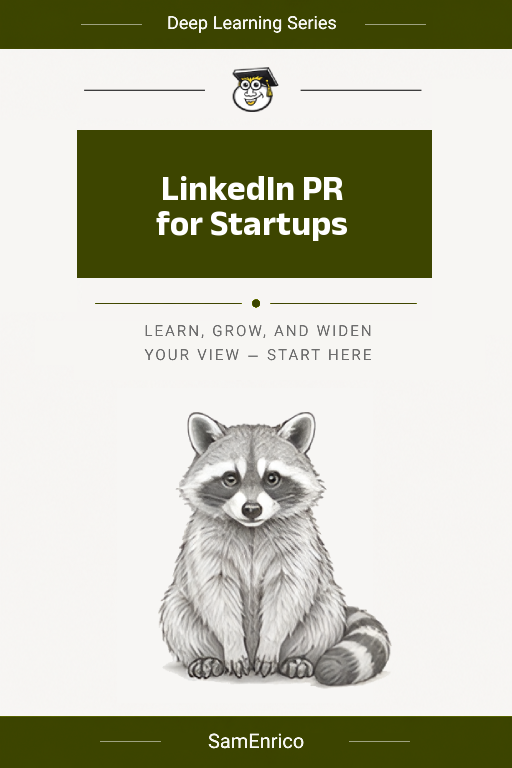
LinkedIn PR for Startups eBook
Use LinkedIn to build relationships with journalis
Use LinkedIn to build relationships with journalists. Thought leadership and direct outreach.
Formats
Free sample
Chapter 1: The 80% Lie...--Every morning, before their first cup of coffee, journalists scroll Linked In. They are not looking for press releases. They are looking for experts who can help them meet their deadlines. They are looking for founders who have already done the thinking for them. They are looking for you.But you are invisible to them.Not because your startup isn't interesting.
Not because your product isn't innovative. And certainly not because you lack ambition. You are invisible because you have been taught a lie. The lie is this: to get press, you send a press release. You hire an agency.
You blast your news to a thousand inboxes and hope someone bites.That lie costs startups billions of dollars every year.Let me show you the math. According to Cision's 2023 State of the Media Report, the average journalist receives over 100 pitches per day. Of those, they open less than 10%. They reply to less than 1%. Of the press releases distributed through newswires, an astonishing 80% are never opened at all.
Eighty percent. That means if you spend $5,000 on a press release distribution service, there is an 80% chance that your carefully crafted announcement will be deleted without a single pair of human eyes ever seeing it.The system is not broken because journalists are lazy or mean. The system is broken because it was designed for a world that no longer exists.The Myth of the Press Release Let me tell you a story. In 2019, a fintech startup called Bloom (name changed for confidentiality) raised a 12million Series A.Theydideverythingright.Theyhiredatop−tier PRagencythatchargedthem12 million Series A. They did everything right.
They hired a top-tier PR agency that charged them 12million Series A.Theydideverythingright.Theyhiredatop−tier PRagencythatchargedthem15,000 per month. They wrote a press release that was professionally crafted, approved by their investors, and distributed through Business Wire. They scheduled embargoed briefings with fifteen target journalists. They spent six weeks preparing.The result? Three small blog mentions.
Zero Tier 1 coverage. Their CEO spent $90,000 on agency fees over six months and got exactly two follow-up emails from journalists who never wrote anything.Six months later, the same CEO tried something different. She stopped sending press releases. Instead, she spent fifteen minutes a day on Linked In. She commented on journalists' posts.
She shared her own data about consumer spending habits. She wrote a single Linked In post about "The three things every fintech founder wishes they knew about banking regulations" that got 8,000 views. A reporter from American Banker saw it, DM'd her, and asked for a quote. That quote turned into a feature. That feature turned into three more interview requests.She spent zero dollars on that coverage.
She spent fifteen minutes a day for three weeks.This is not an anomaly. This is the new reality.How Journalists Actually Find Sources Today The old model was push. You pushed your story out through a press release, hoping it would land in front of the right person. The new model is pull. Journalists pull sources toward them from the places they already trust.
And the place they trust most right now is Linked In.I interviewed forty-seven journalists for this book. They came from outlets ranging from the Wall Street Journal to niche trade publications like Supply Chain Dive and Restaurant Business. I asked them a simple question: "Where do you find expert sources you haven't worked with before?"The number one answer was Linked In. Not HARO. Not PR Newswire.
Not email. Linked In.Here is what one tech reporter from a major outlet told me: "I get two hundred emails a day. I delete almost all of them without reading. But when I'm on Linked In, I'm in discovery mode. I'm looking for interesting people.
If a founder posts something smart about a topic I'm covering, I'll DM them right there. I don't need a pitch. I need proof that they know what they're talking about."Another reporter, who covers climate tech for a national publication, said: "I have a list of thirty founders I follow on Linked In. I've never met any of them. They've never pitched me.
But they post data, they share contrarian opinions, and they comment thoughtfully on other people's posts. When I need a source on battery storage or carbon capture, I DM them first. They don't even know they're on my list."This is the invisible economy of media relations. Journalists are building their own rolodexes in real time, using Linked In as their primary research tool. And if you are not on their list, you do not exist.The Three-Second Audit Here is something that will keep you up tonight.
When a journalist clicks on your Linked In profile, they spend an average of three seconds before deciding whether to close the tab or keep reading.Three seconds.In that time, they are not reading your resume. They are not studying your work history. They are looking for three specific signals:Signal One: Expertise. Does this person have a clear, focused area of knowledge? Or are they a generalist who talks about everything?
Journalists do not want generalists. They want specialists who can speak with authority on one specific topic.Signal Two: Quotability. Does this person write in short, punchy, bolded sentences that I can copy and paste directly into my article? Or do they write in long, winding paragraphs that require editing? Journalists are on deadline.
They will choose the person who makes their job easier.Signal Three: Reachability. Is there a clear way to contact this person? Or do I have to hunt through their profile to find an email address? If they cannot find you in five seconds, they will move on to the next person.Your Linked In profile is not a resume. It is a landing page.
And right now, your landing page is failing the three-second audit.Let me prove it to you. Open your Linked In profile in a new tab right now. I will wait. Now, look at it as if you were a journalist who has never met you. What is your headline?
Does it say "CEO at [Company Name]"? That tells a journalist nothing about what you know. What is your featured section? Does it contain press clippings, or is it empty? What is your about section?
Is it written in the first person with bolded quotes, or is it a generic corporate biography?If you are like ninety percent of founders I have coached, your profile is optimized for recruiters, not reporters. And that is why journalists are not finding you.Introducing the Journalist-First Framework This book is built on a single, radical idea: you must stop asking "How do I get my story out?" and start asking "What does this journalist need to look smart to their editor?"That shift in perspective changes everything. When you ask "How do I get my story out?", you are focused on yourself. Your product. Your funding.
Your hiring. Your news. But here is the hard truth: journalists do not care about your news. They care about their story. Their deadline.
Their audience. Their editor's expectations.The Journalist-First Framework has three pillars:Pillar One: Understand the Beat. Every journalist has a beat. It…
This is the end of the free sample. Get the eBook to keep going. Buy now
About this book
Details
- Author
- Raymond Joseph
- Publisher
- SamEnrico
- Language
- English
- Genre
- Non-Fiction, Startup Guide, Media Outreach
- Released
- 2026-05-30
- Pages (approx.)
- 150
- Available as
- eBook, Audiobook

Read better in the ZLOADR app
Your eBooks on your phone or tablet. Sign in with your SamEnrico account and start reading.
More by Raymond Joseph
 HIIT For New Moms GuideRaymond Joseph$11.99
 Validation Journal WorkbookRaymond Joseph$11.99
 The ADHD Parent Anger GuideRaymond Joseph$11.99
 Twelve Step for IncarceratedRaymond Joseph$11.99
 The Cost Plus Pricing GuideRaymond Joseph$11.99
 The Phoenix Protocol: When Fire Wrote HistoryRaymond Joseph$11.99
 Lava Flow MonitoringRaymond Joseph$11.99
 How to Start a Blood Pudding Business (Beginners Guide)Raymond Joseph$11.99
 Federal 8a Program BlueprintRaymond Joseph$12.99
You may also like
 Social Media PR StrategyEasterling Robbi$12.99
 Shoestring Startup PR GuideLeblanc Zena$12.99
 PR Success StoriesNewsom Georgie$12.99
 PR for Tech StartupsBankston Fonda$12.99
 PR for Solo FoundersAlderman Edie$12.99
 PR for SaaS StartupsDietz Tosha$12.99
 PR for Minority FoundersRea Delcie$12.99
 PR for Healthtech StartupsMerrick Ashlea$12.99
 PR for Green StartupsCade Jenise$12.99
 PR for Fintech StartupsRedd Aletha$12.99
 PR for Ecommerce StartupsStyles Rob$12.99
 PR Failures to AvoidMarrero Jolynn$12.99