
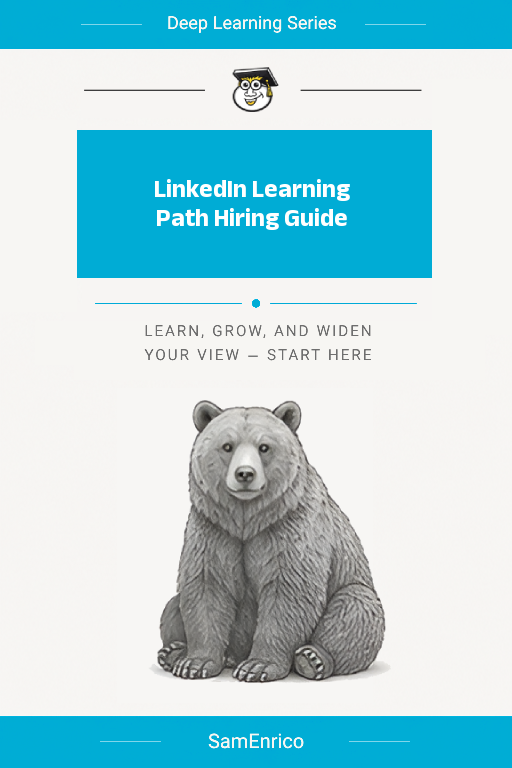
LinkedIn Learning Path Hiring Guide eBook
Complete career focused learning paths endorsed by
Complete career focused learning paths endorsed by recruiters searching for certified candidates.
Formats
Free sample
Chapter 1: The 5-Second Delete--You have exactly five seconds before a recruiter decides whether to keep looking at your Linked In profile or swipe to the next candidate.Not five minutes. Not five days. Five seconds.This is not an exaggeration or a scare tactic. In 2024, the average corporate recruiter scans between 150 and 300 Linked In profiles per day. With an average of eight seconds spent per profile, the first five seconds determine everything.
The remaining three seconds are just confirmation bias—the recruiter finding evidence to support the decision they already made in the first five.Here is what happens in those five seconds:Second one: Your profile photo and headline appear. The recruiter registers your professional identity and whether you look like someone who belongs in their industry.Second two: Your current position and company register. The recruiter categorizes you as "potential fit" or "maybe" or "no."Second three: The recruiter's eyes scan the top of your profile for recent activity. Specifically, they look for the small blue "Learning" badge that appears when you have completed a Linked In Learning course in the past 30 days.Second four: A decision is formed. If they see recent learning activity, you move to the "yes" pile.
If they see no activity or activity older than six months, you move to the "maybe" pile. If they see a completely inactive profile with no learning badges at all, you are deleted.Second five: The recruiter either clicks to view more or scrolls to the next name on their search results page.This chapter exists because most professionals have no idea this process is happening. They spend hours perfecting their resume, writing cover letters, and applying to jobs through company portals—all of which happen after a recruiter has already decided, in five seconds, whether to consider them.The five-second delete is the single most important concept in modern hiring. Everything else in this book—every Learning Sprint, every Boolean string, every badge placement strategy—exists to win those five seconds.The Traditional Model Is Dead Let us start with a confession that most career advice books will not tell you: the traditional job search model is broken beyond repair.The old model looked like this:Find a job posting you like.Tailor your resume and cover letter.Submit your application through an online portal.Wait for a response.Maybe get an interview.Repeat fifty to one hundred times.This model assumed that humans were reading your application. This model assumed that effort translated into visibility.
This model assumed that the best candidate would eventually be discovered.All three assumptions are now false.Assumption One: Humans read your application. In 2024, more than seventy-five percent of corporate job applications are screened by an Applicant Tracking System (ATS) before any human sees them. The ATS scans your resume and Linked In profile for specific keywords. If those keywords are not present in the right places, in the right density, your application is automatically rejected. No human ever lays eyes on it.Assumption Two: Effort translates into visibility.
You can spend ten hours perfecting a resume, but if your Linked In profile does not trigger the Boolean search strings that recruiters use, you will never appear in their search results at all. Recruiters do not search for "hardworking candidates" or "people who wrote good cover letters." They search for skill clusters, certifications, and recent activity signals.Assumption Three: The best candidate gets discovered. Algorithms do not care about your potential, your work ethic, or your unique perspective. They care about machine-readable data points. If your profile does not contain the right data points in the right format, you could be the most qualified person on earth and you will never receive an In Mail.The death of the traditional model has created a new reality: your Linked In profile is no longer a supplement to your job application.
It is your job application. Everything else—the resume, the cover letter, the portfolio—is secondary. Recruiters decide whether to talk to you based almost entirely on what they see in those first five seconds on your profile.This book exists because most job seekers have not yet accepted this new reality. They continue to pour energy into activities that do not matter while ignoring the one activity that matters most: building a recruiter-endorsed Learning Path that wins the five-second delete.The Algorithm Knows Your Name (And Your Inactivity)To understand why the five-second delete exists, you must understand how recruiting technology actually works.Linked In Recruiter, the platform that more than ninety percent of corporate recruiters use to find candidates, is not a neutral search engine. It is a predictive algorithm designed to surface candidates who are most likely to respond, most likely to be qualified, and most likely to accept an offer.The algorithm scores every Linked In profile on dozens of factors.
Some of these factors you already know about: job titles, skills, endorsements, recommendations, connection count.But some of these factors you have probably never considered.Recency of activity. The algorithm gives significant weight to how recently you have been active on Linked In. This does not mean posting every day. It means completing courses, adding badges, updating your headline, and engaging with content. A profile with activity in the past seven days receives a higher "active candidate" score than a profile with no activity in the past six months—even if the inactive profile has better credentials.Learning signals.
Linked In tracks every course you complete, every learning badge you earn, and every skill you add to your profile. The algorithm treats recent learning activity as a proxy for ambition, curiosity, and career engagement. Candidates with three or more completed courses in the past thirty days receive significantly more recruiter In Mails than candidates with no recent learning activity, according to internal Linked In data cited in Garriott and Schifeling's Linked.Profile completeness. The algorithm favors profiles that have filled out every section: photo, headline, about, experience, education, skills, certifications, courses, and projects. A complete profile ranks higher in recruiter searches than an incomplete profile with stronger credentials.Keyword density.
The algorithm scans your profile for keywords related to your target role. If you want to be found as a project manager, the words "project management," "agile," "scrum," "waterfall," "Jira," and "Asana" must appear multiple times across your headline, about section, and experience descriptions. The algorithm does not understand synonyms. If you say "led teams" instead of "project management," the algorithm may not connect the two.Here is the painful truth that most career coaches will not tell you: you could have twenty years of experience and an Ivy League degree, but if your Linked In profile does not trigger the algorithm's scoring factors, you will appear on page twenty of recruiter search results. And recruiters almost never go past page five.The five-second delete is not personal.
It is algorithmic. Recruiters are not rejecting you. They are reacting to a profile that their tool has told them is low priority.This chapter, and every chapter that follows, will teach you how to become a high-priority profile.The Passive vs. Active Audit Before we go any further, you…
This is the end of the free sample. Get the eBook to keep going. Buy now
About this book
Details
- Author
- Overton Joaquina
- Publisher
- SamEnrico
- Language
- English
- Genre
- Non-Fiction, Student's Shortcut
- Released
- 2026-06-01
- Pages (approx.)
- 142
- Available as
- eBook, Audiobook

Read better in the ZLOADR app
Your eBooks on your phone or tablet. Sign in with your SamEnrico account and start reading.
More by Overton Joaquina
 Benzodiazepine Protracted WithdrawalOverton Joaquina$11.99
 Anchor Dream SymbolOverton Joaquina$11.99
 Road Rage Legal ConsequencesOverton Joaquina$11.99
 Immigrant Founder Work Ethic CourseOverton Joaquina$11.99
 Cross Border Franchise Tax GuideOverton Joaquina$12.99
 Morning Reading RitualsOverton Joaquina$11.99
 Self Empathy FirstOverton Joaquina$11.99
 Heartburn Acid RefluxOverton Joaquina$11.99
 Professional Working MemoryOverton Joaquina$11.99
 Buffer Block Scheduling GuideOverton Joaquina$11.99
 The Silent Ropes: How a Legendary Gymnastics Coach Manipulated an EmpireOverton Joaquina$11.99
 The Silk Road Code: The Alchemist’s Heist for the Secrets of LifeOverton Joaquina$11.99
You may also like
 Hong Kong Handover 1997Dunn Johnnie$11.99
 Zumba For Postnatal Recovery CourseNeal Christian$11.99
 Zumba for BeginnersLadner Nikia$11.99
 YouTube Comment Mining GuideHumes Pandora$12.99
 Worry Box MeditationCarlin Rudy$11.99
 Workplace Stress MeditationNguyen Lynn$11.99
 Workplace Stress and Sleep RepairHawley Ivory$11.99
 Workplace Perfectionism CureDelaney Jeffry$11.99
 Workplace Injustice Anger GuideWallen Isabelle$11.99
 Work Addiction and Burnout LinkGreenwood Ester$11.99
 Women in Yoga and WellnessBeattie Galina$11.99
 Women in Stand Up ComedyChun Evangeline$11.99