
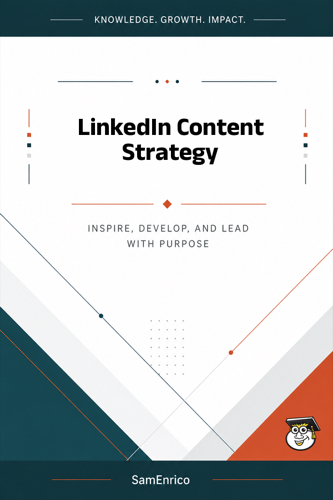
LinkedIn Content Strategy eBook
Post weekly articles and engage in comments.
by Tong Myrl
Post weekly articles and engage in comments.
Formats
Free sample
Chapter 1: The $100k Graveyard--–- Every morning, millions of professionals open Linked In with the same unconscious ritual. They scroll. They like. They comment “Great post!” They share a motivational quote about hustle culture. They feel a small dopamine hit of productivity.
Then they close the app and wonder why their pipeline is still empty.You are not alone in this frustration. According to Linked In’s own internal data shared with content creators in 2024, over 87% of users never post any original content at all. Of the 13% who do post, the vast majority see fewer than 500 views per piece. The average professional spends 6 hours per week on Linked In but generates less than one meaningful business opportunity per month. Six hours.
Fifty-two weeks. Three hundred twelve hours per year. For what?The brutal truth is that most people are using Linked In the way Facebook was used in 2014. They treat it as a social network for broadcasting their wins, sharing generic advice, and performing professionalism for an audience that isn’t really paying attention. But Linked In stopped being a social network years ago.
It is now a knowledge network. And the algorithm has changed so dramatically that the old playbook doesn’t just fail—it actively hurts your credibility.This chapter is not a gentle warm-up. It is a cold shower. By the time you finish reading these pages, you will understand exactly why your current approach is mathematically designed to fail, what the algorithm actually wants from you, and how to reorient your strategy around the only three activities that generate consistent ROI on this platform. You will also choose your time commitment track, because this book offers two paths forward depending on how aggressively you want to grow.Let us begin by burying the corpse of the status update.The Graveyard of Low-Effort Posting Open your Linked In feed right now.
Scroll past the first ten posts. What do you actually see? A salesperson announcing their work anniversary. A consultant sharing a stock photo with an inspirational quote about persistence. A recruiter posting “I’m hiring!” for the seventh time this month.
A CEO sharing a generic listicle titled “10 Ways to Be More Productive.” A meme about Monday mornings.None of these posts are generating leads. None of them are building authority. None of them are creating the kind of trust that makes someone reach for their wallet. And yet, millions of professionals post this content every single day because they saw someone else do it and assumed it must work.This is the graveyard of low-effort posting. It is filled with good intentions and zero ROI.The problem is not that these people are lazy or untalented.
The problem is that they are operating from a mental model of Linked In that is five years out of date. They believe that consistency alone will win. They believe that posting frequency correlates with visibility. They believe that likes and comments from their existing network will somehow translate into opportunities. All of these beliefs are wrong.Here is what the data actually shows.
A study of 50,000 Linked In profiles conducted by the social analytics platform Shield in late 2024 found that professionals who post more than five times per week actually see declining engagement per post after the third weekly post. The algorithm penalizes frequency without depth. Posting every day signals to Linked In that you are a content factory, not a knowledge source. And content factories get buried.The professionals who win on Linked In post less frequently but with significantly more depth. They publish once per week.
They spend 2-3 hours on that single piece of content. And that single piece generates more profile views, connection requests, and inbound messages than an entire month of daily posting from their peers.This is the first and most important mindset shift you must make. Stop counting posts. Start weighing them.The Algorithm’s Secret Language Linked In does not publish its algorithm’s exact ranking factors. But hundreds of experiments conducted by content strategists over the past two years have reverse-engineered the core logic.
Understanding this logic is not optional. It is the foundation of everything else in this book.The algorithm operates on a simple principle. It wants to keep users on the platform for as long as possible. Therefore, it surfaces content that generates dwell time—the amount of time a user spends actively reading or watching a piece of content before scrolling away. Dwell time is the single most important metric on Linked In today.
It matters more than likes, more than comments, more than shares, and certainly more than follower count.Think about what this means. When someone likes your post in 0.5 seconds while scrolling, that action tells the algorithm almost nothing about the value of your content. They could have liked it out of politeness, habit, or reciprocal obligation. But when someone spends 90 seconds reading your article, that action screams value to the algorithm. It says: “This content is worth staying for.
Show it to more people.”The algorithm also tracks what happens after someone finishes your content. Do they click your profile? Do they send you a connection request? Do they scroll away immediately? Each of these actions feeds into a complex scoring system that determines whether your content gets shown to your followers, to followers of followers, or to nobody at all.This explains why short posts have died.
A 200-word status update takes 30 seconds to read. Even if someone reads the entire thing, they have generated only 30 seconds of dwell time. An 1,100-word article takes 3-4 minutes to read. That single reader generates 6-8 times more dwell time than the short post reader. And the algorithm notices.But here is where most people get confused.
They hear “the algorithm rewards dwell time” and assume they should write longer content. They then publish 3,000-word essays that nobody finishes because the mobile reading experience is painful beyond 1,500 words. The algorithm tracks completion rates. If 80% of readers bounce before finishing your article, that high bounce rate signals low value despite the long length.The sweet spot, confirmed by testing across dozens of industries, is 800 to 1,500 words. This range is long enough to demonstrate expertise and generate meaningful dwell time.
It is short enough that mobile readers will actually finish it. And it is structured enough that skimmers can still extract value. We will cover the exact structure of these articles in Chapters 3 and 4.The 70/20/10 Rule That Changes Everything Knowing how the algorithm works is useless without a framework for action. This book offers a single mathematical framework that governs every recommendation you will read. It is called the 70/20/10 Rule, and it dictates how you should invest your time on Linked In.Seventy percent of your content creation time goes into deep value.
This means one weekly article of 800 to 1,500 words. Not five short posts. Not daily updates. One substantial piece of content that demonstrates your expertise, shares a unique perspective, and gives readers something they cannot get anywhere else. This article is your anchor asset.
It is the thing people remember. It is what makes them trust you.Twenty percent of your time goes into strategic…
This is the end of the free sample. Get the eBook to keep going. Buy now
About this book
Details
- Author
- Tong Myrl
- Publisher
- SamEnrico
- Language
- English
- Genre
- Non-Fiction, Self-Help, LinkedIn Strategy
- Released
- 2026-06-08
- Pages (approx.)
- 134
- Available as
- eBook, Audiobook

Read better in the ZLOADR app
Your eBooks on your phone or tablet. Sign in with your SamEnrico account and start reading.
More by Tong Myrl
 Meal Prep for Meal SwapsTong Myrl$11.99
 Musk Social Media UseTong Myrl$11.99
 Delayed Sleep Phase DisorderTong Myrl$11.99
 Social Skills EQ GuideTong Myrl$11.99
 Memory Span Improvement CourseTong Myrl$11.99
 General Liability EssentialsTong Myrl$11.99
 Field Artillery Forward ObserverTong Myrl$11.99
 The Siege of Chittorgarh: Rajput Valor Against the SultanateTong Myrl$11.99
 Beneath the Glass: The Last Song of the Siren’s CallTong Myrl$11.99
 How to Produce Rug PadsTong Myrl$11.99
 How to Produce Financial, Tax and Accounting SoftwareTong Myrl$11.99
 JEE Mathematics Formula HandbookTong Myrl$12.99