
Non-FictionInformativeEducational
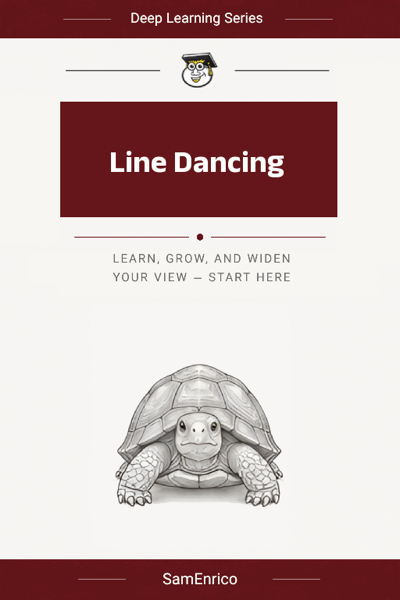
Line Dancing eBook
A Coursebook on Line Dancing
A Coursebook on Line Dancing
Formats
Free sample
Chapter 1: The Invitation to the Line--– Before we talk about shoes, steps, or songs, let me ask you a question. Have you ever been at a wedding, a party, or a club when a familiar song came on—something like the “Cha-Cha Slide” or “The Electric Slide”—and you felt that strange, magnetic pull to join the floor? Maybe you hesitated at first, watching others line up. Then someone grabbed your hand, or a friend nudged you, and suddenly you were in a long row of people, all turning in the same direction at the same time. You didn't know the steps.
You fumbled through the first few counts. But within seconds, you were laughing, stomping, and clapping along with everyone else. For three glorious minutes, you were part of something bigger than yourself. You were moving in perfect, imperfect unison with a crowd of strangers who had become, for that brief moment, your dance family.That feeling—that rush of synchronized joy—is the heart of line dancing. It always has been.This book exists because I believe that feeling should not be reserved for weddings and chance encounters.
It should be something you can access anytime you want, anywhere you go, with any group of people—or even completely alone in your living room at 11 p.m. on a Tuesday. This book will take you from wherever you are right now—perhaps nervous, perhaps excited, perhaps convinced you have “two left feet”—to a place where you can walk onto any dance floor, anywhere in the world, hear the first few beats of a song, and confidently take your place in the line.But before we get to the mechanics—the grapevines, the jazz boxes, the pivot turns, the wall counts, the restarts, and the tags—we need to start with something more fundamental. We need to talk about why line dancing matters, why it has survived for centuries, why it is exploding in popularity right now, and why you—yes, specifically you—already belong on that floor.This chapter is an invitation. It is a permission slip.
It is a gentle but firm push toward something you have probably wanted to try for years but kept putting off. By the time you finish these pages, you will have already taken your first step. You will have already overcome the single biggest barrier that keeps people from dancing: the belief that dancing is something other people do.So take a deep breath. Clear some space in your living room. And let us begin.The Oldest Dance You’ve Never Thought About Here is something that might surprise you.
Line dancing is not a recent invention. It is not a fad that started in the 1990s with country music, nor is it a trend that will fade away when the next musical style comes along. Line dancing—or something very close to it—has existed for thousands of years, in nearly every human culture, on every inhabited continent.Ancient Greek vase paintings show dancers in rows and circles, performing synchronized steps to the rhythm of aulos pipes and lyres. West African drumming traditions include ceremonial dances where entire villages move in parallel lines, their feet pounding the earth in patterns that have been passed down for generations. European folk dances from the Renaissance era—the branle in France, the ballo in Italy, the reel in Scotland and Ireland—all featured dancers arranged in lines or facing each other in coordinated formations.
Native American round dances, still performed today, involve dancers holding hands in a circle and moving together in a single direction, their steps unified by the heartbeat of a drum.What all of these traditions share is something profound: they are not performances for spectators. They are participatory rituals. Everyone dances. There is no audience. There is no stage.
There is only the shared experience of moving through space and time together, your body syncing with the bodies around you, your breath finding the same rhythm.That is the deep history of line dancing. It is not a niche hobby for people who wear cowboy boots and listen to country radio. It is a fundamental human activity, as natural as singing around a campfire or laughing at a shared joke. It is hardwired into our biology.Scientists who study human movement and social bonding have discovered something remarkable. When people move in synchrony—when they walk together, drum together, dance together—their brains release endorphins, the same feel-good chemicals associated with running, laughing, and hugging.
Synchronized movement lowers cortisol levels, reducing stress. It increases pain tolerance. It creates feelings of trust and connection, even between total strangers. In one famous study, participants who tapped their fingers in sync with another person subsequently rated that person more favorably than participants who tapped out of sync. The simple act of moving together, even in the smallest way, literally rewires how you feel about the people around you.Line dancing, then, is not just fun.
It is socially and biologically essential. It is a technology for belonging.The Myth That Keeps People Off the Floor And yet, despite this deep history and these powerful benefits, most people do not line dance. Most people—including, perhaps, you—have spent years avoiding dance floors, making excuses, hiding in the bathroom when the DJ announces a group dance, or lurking at the edge of the floor with a drink in hand, watching others have all the fun.Why?The answer is not laziness or lack of interest. The answer is fear. Specifically, fear of looking stupid.I have taught thousands of people to line dance over the past decade.
I have taught teenagers, retirees, corporate executives, postal workers, stay-at-home parents, recovering athletes, and people who had never danced a single step in their entire adult lives. And every single one of them—every single one—arrived with some version of the same fear. What if I cannot keep up? What if I turn the wrong way? What if everyone sees me make a mistake?
What if I am the worst person on the floor?These fears are real. They are also completely, utterly normal. And they are almost entirely unfounded.Here is what I have learned from standing in front of hundreds of dance classes. The people who look the most confident on the dance floor are not the ones who make the fewest mistakes. They are the ones who have learned to recover from their mistakes quickly and without embarrassment.
They are the ones who understand something that beginners do not: no one is watching you as closely as you think they are.When you are on a crowded dance floor, every other dancer is focused on their own feet, their own timing, their own anxiety about the next move. They do not have the mental bandwidth to scrutinize your performance. And if someone does notice your mistake—if you turn left when everyone else turned right—that person will forget about it within seconds, because the music keeps moving, the dance keeps going, and their attention will shift back to their own body.The only person who will remember your mistake tomorrow morning is you. So…
This is the end of the free sample. Get the eBook to keep going. Buy now
About this book
Details
- Author
- Causey Janiece
- Publisher
- SamEnrico
- Language
- English
- Genre
- Non-Fiction, Informative, Educational
- Released
- 2026-05-08
- Pages (approx.)
- 147
- Available as
- eBook, Audiobook

Read better in the ZLOADR app
Your eBooks on your phone or tablet. Sign in with your SamEnrico account and start reading.
More by Causey Janiece
 The Emotional Vocabulary BuilderCausey Janiece$11.99
 Breath Awareness In SilenceCausey Janiece$11.99
 French Resistance Execution PilesCausey Janiece$11.99
 The Emotional Intelligence Self Assessment GuideCausey Janiece$11.99
 Aging Body Self Esteem WorkbookCausey Janiece$11.99
 The Last Phalanx: Belisarius at Callinicum - A Byzantine Masterstroke That Could Have Changed the WorldCausey Janiece$11.99
 Procurement Process Optimization HandbookCausey Janiece$12.99
 Data Presentation For Technical AudiencesCausey Janiece$12.99
 Understanding Macular DegenerationCausey Janiece$17.99
 A Beginners Guide to Downhill mountain biking (Volume 1)Causey Janiece$11.99
You may also like
 Hong Kong Handover 1997Dunn Johnnie$11.99
 Zumba For Postnatal Recovery CourseNeal Christian$11.99
 Zumba for BeginnersLadner Nikia$11.99
 YouTube Comment Mining GuideHumes Pandora$12.99
 Worry Box MeditationCarlin Rudy$11.99
 Workplace Stress MeditationNguyen Lynn$11.99
 Workplace Stress and Sleep RepairHawley Ivory$11.99
 Workplace Perfectionism CureDelaney Jeffry$11.99
 Workplace Injustice Anger GuideWallen Isabelle$11.99
 Work Addiction and Burnout LinkGreenwood Ester$11.99
 Women in Yoga and WellnessBeattie Galina$11.99
 Women in Stand Up ComedyChun Evangeline$11.99