
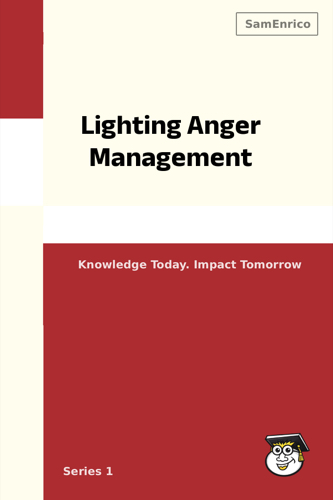
Lighting Anger Management eBook
Adjust office brightness to reduce irritability.
Adjust office brightness to reduce irritability.
Formats
Free sample
Chapter 1: The Overlooked Trigger--You are not an angry person.At least, you didn’t used to be. Somewhere between the morning coffee that tasted slightly burnt and the 3:00 PM email that made your jaw clench, you became someone who snaps at harmless questions, sighs too loudly at coworkers, and feels a low-grade fury simmering for no reason you can name. You have tried the breathing exercises. You have tried walking away. You have even tried the therapist-recommended technique of counting backward from ten.
And yet, here you are, at your desk, with your teeth grinding together and your patience worn thinner than a cheap dress shirt after its tenth wash.Here is what no anger management book has ever told you: the problem might not be in your head. It might be above it.Look up. What do you see? A flickering fluorescent tube? A bare LED bulb casting harsh shadows across your keyboard?
A window so bright that you have to squint just to read your screen? Or perhaps the opposite—a dim, gray gloom that makes you feel like you are working inside a Tupperware container?For the past thirty years, the multi-billion-dollar anger management industry has focused exclusively on internal solutions: cognitive reframing, emotional regulation, deep breathing, mindfulness, and sometimes medication. These approaches are not wrong. They are simply incomplete. They treat the symptom while ignoring the trigger.
Imagine teaching someone to meditate while standing on a bed of hot coals. No amount of deep breathing will stop their feet from burning. The only rational solution is to remove the coals.This book is about removing the coals. Specifically, this book is about the coals hanging from your ceiling, sitting on your desk, and shining through your window. This book is about light.The quietest trigger in the history of workplace psychology is also the most omnipresent.
You cannot see it as a threat because it does not look like one. A lightbulb is not a screaming boss, a missed deadline, or a traffic jam. A lightbulb is a benign, silent, helpful object. And that is precisely why it is so dangerous. You never learn to fear it, so you never learn to control it.
It operates below your conscious awareness, feeding raw data directly into the oldest, most reactive part of your brain, and by the time you feel the anger rising, the damage is already done.This chapter introduces a concept that will fundamentally change how you understand your own irritability. It is called Environmental Irritability: chronic, low-level anger caused by sensory mismatch between your physical environment and your nervous system. And the single most powerful variable in that environment is light.The Retina’s Secret Hotline to Your Anger Center To understand why office lighting makes you angry, you must first understand a piece of neuroanatomy that most psychologists overlook. It is called the retinohypothalamic tract, or RHT for short. Think of it as a secret hotline.
Your eyes are not just cameras that send images to your visual cortex so you can see things. Your eyes are also environmental sensors that send raw data directly to your amygdala—the brain’s fear, anger, and threat-detection center.Here is the terrifying part: this pathway bypasses your conscious awareness entirely.When you look at a photograph of a snake, your visual cortex processes the image, identifies it as a snake, and then sends that information to your amygdala, which then triggers a fear response. That process takes about three hundred milliseconds. You have time to think, Oh, that is a snake, I should be scared. But the retinohypothalamic tract is faster.
Much faster. It operates in milliseconds. It does not wait for interpretation. It simply sends signals about light intensity, flicker frequency, and spectral composition directly to the amygdala, which then prepares your body for a threat—elevating cortisol, increasing heart rate, tightening muscles, and sharpening your senses for danger.Now, imagine that a fluorescent tube in your office is flickering at one hundred times per second. Your visual cortex cannot see this flicker because it is too fast.
But your retinohypothalamic tract can detect it. And your amygdala interprets that flicker as a potential threat—perhaps a predator moving through tall grass, perhaps a fire, perhaps something unknown and dangerous. Your body prepares for battle. Your cortisol rises. Your jaw clenches.
Your patience evaporates.You do not feel any of this happening. You only feel the result: irritability.This is not science fiction. This is peer-reviewed neurobiology, drawn from decades of research summarized in works like Dark Matters (source 4 in our bibliography). The retina contains specialized photosensitive ganglion cells that contain a photopigment called melanopsin. These cells do not help you see shapes or colors.
Their only job is to detect light intensity and timing and to send that information to the suprachiasmatic nucleus (your body clock) and directly to the amygdala. They are, in essence, your brain’s early warning system for environmental threat.And they are triggered by light.Not by meaning. Not by context. Not by your mood. By light.The Case of the Accounting Firm That Could Not Stop Fighting Let me tell you a story.
It is a true story, though the names have been changed to protect the embarrassed.A mid-sized accounting firm in Cincinnati called me for a consultation. They had a problem. Every day, between 2:00 PM and 4:00 PM, the otherwise professional and courteous staff would devolve into shouting matches. Not arguments. Shouting matches.
Partners screamed at junior associates. Associates snarled at each other. Administrative staff cried in the break room. The firm had tried everything: team-building retreats, sensitivity training, even a company-wide meditation app subscription. Nothing worked.
The 2:00 PM rage window remained as reliable as the afternoon mail.When I walked into their open-plan office at 1:45 PM, I noticed something immediately. The ceiling was covered with fluorescent tubes—old ones, the kind that cycle through their dimming phases with a barely perceptible flicker. I pulled out a spectrometer and a light meter. The dominant wavelength was 480 nanometers, which is a particularly harsh blue-white. The illuminance was 650 lux at desk level, which is about twice as bright as recommended for computer work.
And the flicker frequency was 100 hertz, right in the range that the retinohypothalamic tract detects but the visual cortex ignores.I asked the office manager when those tubes had last been replaced. She shrugged. “Maybe five years ago? Six?”Fluorescent tubes degrade over time. Their phosphor coating wears unevenly.
Their ballasts begin to fail. The light becomes harsher, bluer, and more variable. What had once been a tolerable 4000K neutral white had shifted to a sickly 5000K blue-white. And the failing ballasts had introduced a 100Hz flicker that no one consciously saw but everyone unconsciously felt.At 2:00 PM, right on schedule, I watched a partner scream at a junior associate for a minor spreadsheet error. The associate, normally a calm and competent employee, screamed back.
Two other staff members began crying. A fourth threw a stapler.I walked to the electrical panel and turned off the overhead lights. I replaced the tubes above the four worst-affected desks with new, high-CRI, flicker-free LEDs at 3500K. Then I…
This is the end of the free sample. Get the eBook to keep going. Buy now
About this book
Details
- Author
- Drummond Adolph
- Publisher
- SamEnrico
- Language
- English
- Genre
- Non-Fiction, Self-Help, Lighting
- Released
- 2026-06-11
- Pages (approx.)
- 152
- Available as
- eBook, Audiobook

Read better in the ZLOADR app
Your eBooks on your phone or tablet. Sign in with your SamEnrico account and start reading.
More by Drummond Adolph
 Exam Stress Recall FixDrummond Adolph$11.99
 The Family Cult ExposéDrummond Adolph$11.99
 Soccer Player Self HypnosisDrummond Adolph$11.99
 Corrections Officer Prison StressDrummond Adolph$11.99
 Senior Palliative EsteemDrummond Adolph$11.99
 CPR for Coronavirus PandemicDrummond Adolph$11.99
 Goal Setting for Social WorkersDrummond Adolph$11.99
 The Vanishing Billion: India's Greatest Corporate HeistDrummond Adolph$11.99
 En Pointe: The Royal Ballet of the Kongo KingdomDrummond Adolph$11.99
 How to Become a HatterDrummond Adolph$11.99
 How to Produce Pretend Professions and Role PlayingDrummond Adolph$11.99
 Freemium Upgrade Discount CadenceDrummond Adolph$12.99
You may also like
 Hong Kong Handover 1997Dunn Johnnie$11.99
 Zumba For Postnatal Recovery CourseNeal Christian$11.99
 Zumba for BeginnersLadner Nikia$11.99
 YouTube Comment Mining GuideHumes Pandora$12.99
 Worry Box MeditationCarlin Rudy$11.99
 Workplace Stress MeditationNguyen Lynn$11.99
 Workplace Stress and Sleep RepairHawley Ivory$11.99
 Workplace Perfectionism CureDelaney Jeffry$11.99
 Workplace Injustice Anger GuideWallen Isabelle$11.99
 Work Addiction and Burnout LinkGreenwood Ester$11.99
 Women in Yoga and WellnessBeattie Galina$11.99
 Women in Stand Up ComedyChun Evangeline$11.99