
Non-FictionSelf-HelpFinding Safety
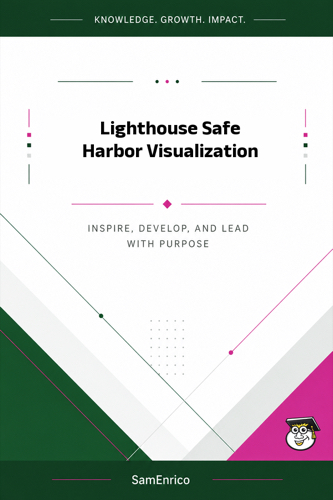
Lighthouse Safe Harbor Visualization eBook
Watch a beam sweep from a lighthouse that guides y
Watch a beam sweep from a lighthouse that guides you to safety.
Formats
Free sample
Chapter 1: The Fog Epidemic--–- The sea was calm when you left the harbor. That is what you remember most clearly—not the storm that followed, but the ordinary stillness before it. The sky was a pale, indifferent gray. The water lapped against the hull with a rhythm you barely noticed. You had your bearings.
You had your map. You were certain of the destination, even if the route was long.Then the fog came.It did not arrive with a roar or a crash. It arrived like a slow erasure. First, the horizon vanished. Then the shoreline blurred into memory.
Then the sounds began to distort—a gull’s cry became a question mark, the slap of waves became a threat you could not locate. Within minutes, you were adrift in a world without edges, without landmarks, without the simple comfort of knowing which way was up.You are still on the water now. You have been for years. The fog has become so familiar that you have stopped calling it fog. You call it “just how things are.” You call it “stress.” You call it “being realistic.” You have learned to navigate by guesswork, by memory, by the faint echoes of bells that may or may not be real.
You have learned to live with the constant, low-grade terror of striking rocks you cannot see.This book is not about teaching you to live with the fog. It is about teaching the fog to clear.The Diagnosis You Didn’t Know You Needed Every generation believes its own suffering is unique, and every generation is both right and wrong. The specific textures of modern anxiety—the ping of a notification at 11:47 PM, the scroll of bad news that never ends, the silent calculation of whether you can afford both rent and a doctor’s visit—these are new. But the architecture of fear is ancient. Your brain was designed to handle three or four genuine threats per day: a predator near the cave, a rival tribe at the river, a child who wandered too close to the fire.
It was not designed for six hundred ambient threats per hour.Here is what the data actually says, stripped of academic jargon and presented as the simple truth it is. The average person experiences a measurable stress response every ninety seconds during waking hours. That does not mean a panic attack. It means a micro-spike of cortisol, a slight elevation of heart rate, a subtle narrowing of attention. Ninety seconds.
Six hundred times a day. Ten thousand times a month. Your nervous system is a smoke alarm that has been rigged to chirp continuously because someone left a piece of toast in the toaster three years ago.You are not broken. You are not weak. You are not failing at a game everyone else seems to be winning.
You are a finely tuned survival machine that has been pointed at a world of office emails and social comparisons and climate headlines and told to treat all of it as equally urgent. The machine is doing exactly what it was built to do. The problem is the environment, not the engine.But you cannot change the environment by willing it away. You cannot silence the notifications by screaming at your phone. You cannot lower the ambient threat level of modern life by wishing for a simpler time.
What you can change is your relationship to the fog. You can learn to recognize it as fog—not as solid ground, not as permanent truth, not as the shape of things to come. And recognition, as we will establish in this chapter and invoke throughout this book as The First Law of the Lighthouse, is the beginning of navigation.The Three Ways Fog Disorients Fog does not attack you. It does not strike like a wave or pierce like a rock. This is why it is so insidious.
Fog disorients through three mechanisms, each of which has a direct parallel in modern psychological distress.The first mechanism is the loss of horizon. When you cannot see where the sea ends and the sky begins, you lose your most fundamental reference point. Up and down become questions. Distance becomes guesswork. In psychological terms, this is the collapse of meaning structures—the slow erosion of the narratives that once told you who you were, what mattered, and where you were headed.
You wake up one day and realize you cannot remember why you took this job, married this person, moved to this city. The horizon has been erased, and you did not even notice it happening.The second mechanism is the distortion of sound. In dense fog, sound behaves strangely. A foghorn fifty yards away can seem to come from every direction at once. Your own voice echoes back to you with a delay that feels like mockery.
In psychological terms, this is the amplification of inner criticism. The fog takes the small, quiet voice that says “you could have done better” and bounces it off invisible walls until it becomes a chorus. You cannot tell whether the criticism is coming from your own judgment, from someone else’s expectations, or from the general pressure of a culture that demands constant optimization. It simply surrounds you.The third mechanism is the illusion of movement. Have you ever stood in fog so thick that you could not tell whether you were moving forward or standing still?
Your inner ear insists you are in motion. Your eyes insist you are fixed. The contradiction creates a queasy vertigo that has nothing to do with the stomach and everything to do with the soul. In psychological terms, this is the exhaustion of effort without progress. You are working, striving, pushing—but nothing changes.
You answer every email, and three more appear. You lose five pounds, and the scale reminds you of the twenty that remain. You have a difficult conversation, and the silence that follows feels exactly like the silence that preceded it. You cannot tell if you are sailing or stuck.These three mechanisms—loss of horizon, distortion of sound, illusion of movement—are not metaphors. They are the actual experiences of a nervous system that has lost its anchor.
And they are reversible.Mapping Your Fog: The First Exercise Before you can navigate through fog, you must map it. This is not a poetic suggestion. It is a neurological necessity. The act of naming a threat reduces its activation in the amygdala—the brain’s fear center—by approximately forty percent in clinical studies. That is not a small effect.
That is the difference between drowning and treading water.Take out a journal, a notes app, or a sheet of paper. You are going to create what we will call, for the duration of this book, your Fog Map. Unlike the future-oriented exercises in later chapters (specifically the Three Futures Lighthouse Scan in Chapter 8), this map is concerned only with the present. You are not predicting. You are not solving.
You are simply observing and naming.Write down the answer to this question: What are the top five sources of confusion or fear currently clouding your horizon?Do not…
This is the end of the free sample. Get the eBook to keep going. Buy now
About this book
Details
- Author
- Kirchner Sondra
- Publisher
- SamEnrico
- Language
- English
- Genre
- Non-Fiction, Self-Help, Finding Safety
- Released
- 2026-06-06
- Pages (approx.)
- 154
- Available as
- eBook, Audiobook

Read better in the ZLOADR app
Your eBooks on your phone or tablet. Sign in with your SamEnrico account and start reading.
More by Kirchner Sondra
 Fear Of Failure At WorkKirchner Sondra$11.99
 Turkish Seller Amazon USAKirchner Sondra$11.99
 Rapid Self HypnosisKirchner Sondra$11.99
 The Loving Kindness for BurnoutKirchner Sondra$11.99
 The Sydney Yakuza Gold Heist: The Untold 1970s Underworld WarKirchner Sondra$11.99
 Understanding Reifenstein SyndromeKirchner Sondra$17.99
 Alibaba Seller Costs GuideKirchner Sondra$12.99
 Lawn Care GuideKirchner Sondra$12.99
 Inside Account ExecutiveKirchner Sondra$11.99
 How to Start a Nails Made of Steel Wire Business (Beginners Guide)Kirchner Sondra$11.99
You may also like
 Hong Kong Handover 1997Dunn Johnnie$11.99
 Zumba For Postnatal Recovery CourseNeal Christian$11.99
 Zumba for BeginnersLadner Nikia$11.99
 YouTube Comment Mining GuideHumes Pandora$12.99
 Worry Box MeditationCarlin Rudy$11.99
 Workplace Stress MeditationNguyen Lynn$11.99
 Workplace Stress and Sleep RepairHawley Ivory$11.99
 Workplace Perfectionism CureDelaney Jeffry$11.99
 Workplace Injustice Anger GuideWallen Isabelle$11.99
 Work Addiction and Burnout LinkGreenwood Ester$11.99
 Women in Yoga and WellnessBeattie Galina$11.99
 Women in Stand Up ComedyChun Evangeline$11.99