
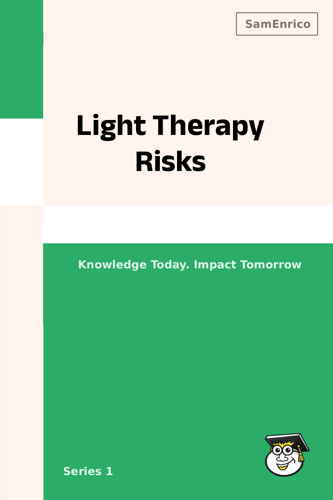
Light Therapy Risks eBook
Warns bright light may induce mania in bipolar.
Warns bright light may induce mania in bipolar.
Formats
Free sample
Chapter 1: The Paradox of Light--–- The morning sun streams through the window, and for a moment, the world feels manageable again. That simple, instinctive act—seeking light—has been a human impulse since we first emerged from caves. We build homes with east-facing windows. We book vacations to sunny destinations. We instinctively know that light lifts mood.
And for good reason: the science confirms it. Bright light therapy is one of the most effective non-pharmacological treatments for depression, with response rates that in some studies rival or exceed those of traditional antidepressant medications. But here is the truth that this book will confront, chapter by chapter: the same intervention that lifts one person out of the darkness of bipolar depression can, with terrifying speed, propel another into the blinding, destructive chaos of mania.This is the paradox of light. It is both cure and curse. It is both a legitimate medical intervention with decades of research behind it and a potential trigger for one of the most dangerous states in all of psychiatry.
And most patients—and, disturbingly, many clinicians—do not fully understand the risk.The central argument of this book is straightforward: light therapy for bipolar disorder is neither inherently safe nor inherently dangerous. Its safety depends entirely on how it is implemented. Used correctly—with proper patient selection, adequate mood stabilizer coverage, precise timing, gradual dosing, and active monitoring—light therapy can be a life-changing treatment for bipolar depression. Used incorrectly—or, more commonly, used without any protocol at all—it can precipitate a manic or hypomanic episode with devastating consequences for the patient’s relationships, finances, career, and physical safety.This chapter introduces the fundamental problem that drives every page that follows. We will examine what light therapy actually is, how it works, and why the medical establishment has been both enthusiastic and cautious about its use in bipolar disorder.
We will establish the hierarchy of risk management that structures this entire book. And we will begin to understand why a treatment that seems so simple—just sit in front of a light box for half an hour each morning—requires such careful, intentional oversight.What Is Light Therapy, Really?Before we can understand the risks, we must understand the intervention itself. Light therapy, also known as phototherapy or bright light therapy, involves daily exposure to artificial light that mimics the intensity and spectrum of natural sunlight. A standard light therapy device emits between 5,000 and 10,000 lux of illumination—compare this to a typical office environment, which measures around 300 to 500 lux, or a dimly lit room at 50 lux. The patient sits approximately 12 to 16 inches from the device for a prescribed duration, typically 30 to 60 minutes, while keeping their eyes open but not staring directly into the light.The mechanism of action is not merely psychological—it is deeply biological.
Light enters the eye and strikes a specialized population of retinal cells called intrinsically photosensitive retinal ganglion cells. Unlike the rods and cones responsible for vision, these cells contain a photopigment called melanopsin and do not help us see shapes or colors. Instead, they detect ambient light levels and send signals directly to the suprachiasmatic nucleus (SCN), the brain’s master circadian clock, located in the anterior hypothalamus.This pathway, known as the retinohypothalamic tract, is the body’s primary mechanism for synchronizing internal biological rhythms with the external day-night cycle. When light hits these retinal ganglion cells, the SCN receives a signal that can advance or delay the timing of the entire circadian system. This is why light therapy can shift sleep-wake cycles, alter melatonin secretion, and change the timing of cortisol release.
And this is why light therapy affects not just sleep but mood, energy, appetite, and cognition.For individuals with seasonal affective disorder (SAD), the condition for which light therapy was first developed and remains the first-line treatment, the logic is straightforward. These patients experience depressive symptoms during the winter months when natural light is scarce. The hypothesized mechanism involves a phase delay of the circadian rhythm—the internal clock running late relative to the external environment. Morning light therapy corrects this delay, shifting the clock earlier and restoring alignment with the solar day. Response rates in SAD are impressive, with 50 to 80 percent of patients showing significant improvement within one to two weeks.But bipolar disorder is not seasonal affective disorder.
And this is where the trouble begins.Bipolar Depression: A Different Beast Bipolar disorder affects approximately 2 to 3 percent of the global population. It is characterized by recurrent episodes of depression and mania (or hypomania, a milder form of overactivation). The depressive episodes in bipolar disorder are often severe, protracted, and highly refractory to treatment. In fact, patients with bipolar disorder spend approximately three times as many weeks depressed as they do manic or hypomanic. The depression causes enormous suffering: inability to work, withdrawal from relationships, loss of pleasure in previously enjoyed activities, sleep disturbances, appetite changes, and, in the most severe cases, suicidal ideation and behavior.For decades, the standard approach to bipolar depression was to use the same antidepressant medications that work for unipolar major depression—SSRIs like fluoxetine (Prozac) and sertraline (Zoloft), SNRIs like venlafaxine (Effexor), and others.
But a troubling pattern emerged. A substantial minority of bipolar patients who received these antidepressants did not simply recover from their depression. Instead, they switched abruptly into mania or hypomania. This phenomenon, known as antidepressant-induced switching, occurs in approximately 10 to 40 percent of bipolar patients depending on the study and the specific medication used.The problem with antidepressant-induced mania is not merely academic. A full manic episode often requires hospitalization.
It can destroy careers through impulsive resignations or reckless business decisions. It can devastate finances through uncontrolled spending. It can rupture marriages through infidelity or aggression. And in rare cases, manic psychosis can lead to dangerous or even life-threatening behavior.Given this risk, clinical guidelines have increasingly recommended caution with traditional antidepressants in bipolar disorder. Some guidelines suggest using them only in conjunction with mood stabilizers.
Others recommend avoiding them altogether in patients with a history of rapid cycling or mixed features. This cautious stance has left a treatment gap: what can we offer to bipolar patients suffering from severe depression when standard antidepressants are too risky?Enter light therapy.Why Light Therapy for Bipolar Depression? The Evidence The rationale for using light therapy in bipolar depression is compelling on multiple levels. First, the circadian disruption that characterizes SAD is also present in bipolar disorder. Numerous studies have documented abnormalities in the circadian rhythms of bipolar patients, including delayed or advanced melatonin secretion, flattened body temperature curves, and altered sleep-wake cycles.
If light therapy can correct circadian misalignment in SAD, perhaps it can do the same in bipolar depression.Second, the switch risk with light therapy appears—at least in some studies—to be lower than with traditional antidepressants. This is not because light therapy is inherently safer but because its effects are more titratable. You can start with 15 minutes of exposure and gradually increase. You can shift the time of day from morning to midday. You can adjust the lux level by changing the distance from the device.
This flexibility allows clinicians to find a therapeutic dose that lifts depression without crossing the threshold into overactivation.Third, and perhaps…
This is the end of the free sample. Get the eBook to keep going. Buy now
About this book
Details
- Author
- Mccarter Lenita
- Publisher
- SamEnrico
- Language
- English
- Genre
- Non-Fiction, Health & Wellness, Phototherapy
- Released
- 2026-06-05
- Pages (approx.)
- 151
- Available as
- eBook, Audiobook

Read better in the ZLOADR app
Your eBooks on your phone or tablet. Sign in with your SamEnrico account and start reading.
More by Mccarter Lenita
 Financial Services Precedent DealsMccarter Lenita$11.99
 Pet Product AddictionMccarter Lenita$11.99
 Verdun Memorial InterpretationMccarter Lenita$11.99
 Gambling Addiction Recovery AffirmationsMccarter Lenita$11.99
 We vs They Language GuideMccarter Lenita$11.99
 Crampon Techniques GuideMccarter Lenita$11.99
 The Boyfriend TraffickerMccarter Lenita$11.99
 The Great Jewel Heist of the British Crown: The Mystery of the Stuart SapphiresMccarter Lenita$11.99
 The Forge of Hephaestus: A Blacksmith’s CurseMccarter Lenita$11.99
 How to Produce Terra CottaMccarter Lenita$11.99
 Service Providers Guide to ExcavatingMccarter Lenita$11.99
 A Collector's Handbook to the Ford Prefect 107eMccarter Lenita$11.99
You may also like
 Morning Light Phase AdvanceWeller Alec$11.99
 Light Box TherapyOneill Anissa$11.99
 Light Exposure Therapy for Night ShiftLau Arianne$11.99
 Sarcopenia Infrared TherapyBullard Jenni$11.99
 Light Therapy Box Selection GuideNguyen Lynn$11.99
 Postpartum Depression Light TherapyCantrell Leone$11.99
 Light Therapy DepressionGardner Ian$11.99
 Bipolar Light Therapy CourseMark Fausto$11.99
 Light Therapy for Depression GuideSchroeder Sung$11.99
 Light Therapy For Circadian DisordersMarkley Kamala$11.99