
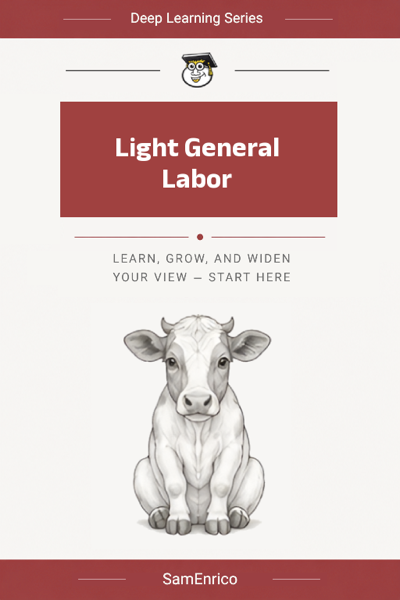
Non-FictionInformativeEducational
Light General Labor eBook
A Coursebook on Light General Labor
A Coursebook on Light General Labor
Formats
Free sample
Chapter 1: The $50 Billion Blind Spot--Maria sorted packages for three years before anyone learned her name. Not her real name—she was “Maria” to the temps, “hey you” to the shift supervisors, and “that fast one” to the line leads who clocked her unit count. She worked the night sort at a regional UPS hub outside Louisville, Kentucky, lifting boxes that weighed anywhere from one pound to forty-seven pounds, placing them into labeled cages, and doing it again. And again. And again.
Twelve hundred times per shift, on a good night. Eight hundred on a bad one when her shoulder ached from a old injury she couldn’t afford to treat.She never missed a shift. Not when her car broke down (she borrowed her neighbor’s). Not when her daughter had a fever (her mother sat up with the child). Not when she herself ran a fever of 101 and the night supervisor told her to “push through, we’re short-staffed.” She pushed.
She sorted. She went home, slept four hours, picked up her daughter from school, made dinner, and went back to the warehouse.Three years of that. Three years of being invisible.Then the regional manager did a site visit. He watched the line for twenty minutes and noticed something that the shift supervisors had missed entirely: Maria never stopped moving, true, but she also never made a mistake. Her error rate was 0.3 percent.
The line average was 4.2 percent. She caught mislabels before they went to the wrong region. She flagged damaged boxes before they burst open on the conveyor. She did all of this while the workers around her chatted, checked their phones, and took extra minutes on break.The regional manager pulled her file. No write-ups.
No attendance issues. No complaints.Six months later, Maria became a lead hand. One year after that, she was promoted to shift supervisor. Today, she manages a regional logistics center with seventy-eight employees and earns $78,000 per year. She has no college degree.
She has no formal management training. What she has is a deep, practical understanding of light general labor—the kind that no classroom teaches and that most white-collar professionals cannot replicate.Maria’s story is not an exception. It is evidence of a hidden economy.The Invisible Economy That Runs Your Life Every morning, you wake up in a room lit by light fixtures assembled by someone like Maria. You walk on carpet that was rolled, cut, and packed in a warehouse. You brew coffee from a machine that passed through the hands of quality control inspectors who looked at hundreds of identical units per shift.
You open a refrigerator built on a line where workers attached handles, installed shelves, and tested door seals. Your breakfast cereal came from a factory where sorters removed defective flakes—by hand, by eye, by the kind of attention that machines still cannot fully replicate.By the time you leave for work, you have already touched the product of light general labor a dozen times.And yet, when most people think of “labor,” they picture construction sites, oil rigs, coal mines, or steel foundries. They imagine hard hats and steel-toed boots, heavy machinery and dangerous heights. They imagine the kind of work that breaks bodies and builds myths. That work exists, and it matters.
But it employs far fewer people than the quiet, repetitive, precision-focused world of light general labor.Consider these numbers: In the United States, light general labor roles—warehouse associates, production workers, sorters, packers, assemblers, custodial technicians, and logistics coordinators—employ more people than construction, mining, and commercial farming combined. The Bureau of Labor Statistics estimates that over 4.5 million Americans work in warehousing and storage alone, a number that has grown 27 percent in the last decade. Another 6.2 million work in manufacturing assembly and production. Add in logistics sorters, hospitality cleaners, retail backroom stockers, and pharmaceutical packers, and the total exceeds 15 million workers.That is larger than the population of New York City. That is an economy within an economy.And yet, these workers are largely invisible.
They work in buildings without windows, on shifts that start before dawn and end after midnight. They are called “unskilled” by politicians who have never stood for ten hours at a conveyor belt. They are told that their jobs are temporary, that automation will replace them, that they should aspire to anything—anything—other than the work they do.This book argues the opposite: light general labor is not a dead end. It is a launchpad. But only if you understand it.What This Chapter Will Teach You Before you can succeed in light general labor, you must first understand what it actually is—and what it is not.
This chapter provides a functional, practical definition of light general labor that will serve as the foundation for every skill taught in the remaining eleven chapters.You will learn:The precise distinction between light labor and heavy labor, including lifting limits, environmental factors, and task characteristics The most common job titles and industry sectors where light labor positions exist The economic value of these roles, including wage data, growth projections, and automation risk assessments Why many “entry-level” jobs are actually light labor positions with documented advancement potential How to identify light labor opportunities in job postings and avoid misclassifying yourself into roles that will break your body By the end of this chapter, you will never again describe yourself as “just” a laborer. You will have the language and the data to advocate for yourself, to set realistic expectations, and to begin seeing your work not as a temporary necessity but as a transferable skillset.The Functional Definition of Light General Labor Let us begin with precision. Light general labor is work that involves repetitive tasks, lifting loads typically under 50 pounds (23 kilograms), operating in controlled environments (warehouses, factories, hotels, retail backrooms, hospitals, and commercial kitchens), and emphasizing fine motor skills, visual accuracy, and sustained attention over raw physical strength.Each element of this definition matters.Repetitive Tasks. Light labor is defined by repetition. A packer folds the same box, applies the same tape, inserts the same dunnage, and places the same label hundreds or thousands of times per shift.
An assembler attaches the same screw, clips the same wire, or snaps the same connector. This repetition is not a design flaw; it is the essence of efficient production. The human body can learn to perform a task with remarkable speed and accuracy after enough repetition—but only if the worker understands ergonomics (Chapter 4) and takes micro-breaks (also Chapter 4). Repetition without awareness leads to injury. Repetition with awareness leads to expertise.Lifting Under 50 Pounds.
The 50-pound threshold is not arbitrary. It appears in Occupational Safety and Health Administration (OSHA) guidelines, in union contracts, and in the Americans with Disabilities Act as a rough boundary between “light” and “medium” work. A job that requires frequent lifting over 50 pounds is not light labor; it is medium or heavy labor, with correspondingly higher risks of back injury, hernias, and joint damage. However, do not mistake “under 50 pounds” for “easy.” Lifting 45 pounds once is trivial. Lifting 45 pounds four hundred times per shift is a completely different…
This is the end of the free sample. Get the eBook to keep going. Buy now
About this book
Details
- Author
- Bassett Quinn
- Publisher
- SamEnrico
- Language
- English
- Genre
- Non-Fiction, Informative, Educational
- Released
- 2026-06-02
- Pages (approx.)
- 147
- Available as
- eBook, Audiobook

Read better in the ZLOADR app
Your eBooks on your phone or tablet. Sign in with your SamEnrico account and start reading.
More by Bassett Quinn
 Body Language Classroom MgmtBassett Quinn$11.99
 Slide Design for ImpactBassett Quinn$11.99
 Remote Presentation Anxiety GuideBassett Quinn$11.99
 Senior Sleep And ExerciseBassett Quinn$11.99
 The Last Supper: Death Row’s Final Meals and the Copycat Killers Who Obsessed Over ThemBassett Quinn$11.99
 Price Lining Strategy for InflationBassett Quinn$12.99
 How to Produce CarbonBassett Quinn$11.99
 How to Start a Oilskins for Women and Girls Business (Beginners Guide)Bassett Quinn$11.99
You may also like
 Hong Kong Handover 1997Dunn Johnnie$11.99
 Zumba For Postnatal Recovery CourseNeal Christian$11.99
 Zumba for BeginnersLadner Nikia$11.99
 YouTube Comment Mining GuideHumes Pandora$12.99
 Worry Box MeditationCarlin Rudy$11.99
 Workplace Stress MeditationNguyen Lynn$11.99
 Workplace Stress and Sleep RepairHawley Ivory$11.99
 Workplace Perfectionism CureDelaney Jeffry$11.99
 Workplace Injustice Anger GuideWallen Isabelle$11.99
 Work Addiction and Burnout LinkGreenwood Ester$11.99
 Women in Yoga and WellnessBeattie Galina$11.99
 Women in Stand Up ComedyChun Evangeline$11.99