
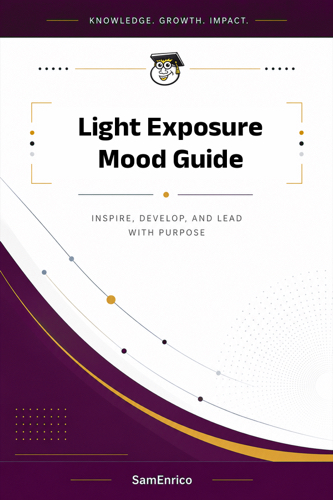
Non-FictionSelf-HelpLight Therapy
Light Exposure Mood Guide eBook
Uses circadian lighting for long-term emotional he
by Way Brigette
Uses circadian lighting for long-term emotional health.
Formats
Free sample
Chapter 1: The Mood Gap--–- The first time I realized that light was controlling my emotions, I was sitting in a windowless airport gate at 6:47 PM, eating an overpriced sandwich that tasted like cardboard, and crying for no reason I could name.I hadn't received bad news. I wasn't homesick. My flight wasn't delayed. By every objective measure, my life was fine—even good. And yet my jaw was clenched, my chest felt tight, and a dull fog of sadness had settled over me so gradually that I hadn't noticed its arrival until it was suffocating.
I remember looking up at the fluorescent tubes buzzing overhead—that sickly green-white glow that seems to exist in every airport, every hospital, every office building on earth—and thinking: Something about this light is making me unwell.At the time, I dismissed it as stress or fatigue or the general misery of travel. But over the following years, as I completed my neuroscience training and began treating patients with mood disorders that didn't seem to respond reliably to medication or talk therapy, I kept coming back to that moment. I kept noticing patterns that my textbooks couldn't explain. Why did so many of my patients feel worse in winter? Why did night shift workers have depression rates nearly double the general population?
Why did people who worked in windowless offices report more anxiety than their colleagues sitting twenty feet closer to glass?The answers, it turns out, were hiding in plain sight—streaming through every window, emanating from every screen, radiating from every light bulb in our homes. And they have almost nothing to do with vision.The Second Job Your Eyes Never Told You About You were taught that eyes are for seeing. That's what most of us believe: light enters the pupil, hits the retina, sends signals to the visual cortex, and we perceive shapes, colors, and movement. End of story.That story is incomplete. Dangerously incomplete.Embedded within your retinas—woven between the rods and cones that handle vision—are approximately two million specialized cells called intrinsically photosensitive retinal ganglion cells, or ip RGCs.
These cells were discovered only in 2002, which is astonishing when you consider that humans have been studying the eye for centuries. We missed them because they don't do what we expected. They don't help you see at all.What do they do?They measure the quality, timing, and intensity of light in your environment—not to form images, but to regulate your mood, your energy, your sleep, your appetite, your immune system, your hormone release, and even your ability to learn and remember. These cells project directly to the suprachiasmatic nucleus (your brain's master clock), the amygdala (your fear and anxiety center), the prefrontal cortex (your emotional regulation hub), and the hypothalamus (your hormone control panel). Light hits your eyes, and within milliseconds, your entire emotional state can shift—whether you're aware of it or not.Let me say that again because it's the most important sentence in this entire chapter: Light is not a neutral background condition of your life.
It is an active, potent, continuous regulator of your emotional biology.You have been living your entire life inside a drug trial where the drug is light, the dosage is determined by your environment, the timing is set by your daily schedule, and nobody told you that you were even in the study.The Mood Gap: A Modern Epidemic You've Never Named Consider two scenarios.Scenario A: You spend a Saturday indoors. You wake up, scroll on your phone for an hour, eat breakfast under kitchen LEDs (400 lux, 5000K), drive to the mall (300 lux in the parking garage), shop under fluorescent lights (500 lux, 4000K), have lunch in a food court (300 lux), drive home as the sun sets (you barely notice), watch three hours of television in a dim living room (100 lux, 6500K from the screen), and fall asleep with your phone charging on the nightstand (a tiny green LED emitting 1 lux directly toward your face).Scenario B: You spend a Saturday outside. You wake up, step onto your porch for 10 minutes while drinking coffee (10,000 lux from morning sun, even on a cloudy day), take a 20-minute walk at noon (50,000 lux), sit in a park reading from 2–4 PM (still 20,000–30,000 lux), watch the sunset for 10 minutes (red-shifted spectrum, dropping from 1000 lux to 10 lux), and return home to a house lit only by dim amber lamps (50 lux, 2200K).Here's my question: Which Saturday leaves you feeling better?Everyone knows the answer. You don't need a neuroscience degree to understand that Scenario B produces better mood, more stable energy, and deeper sleep. But here's what's fascinating—and what most people miss completely: The physical comforts are better in Scenario A.
You had air conditioning. You didn't get sunburned. You didn't have to deal with bugs or weather. You had a softer chair. You had entertainment on demand.
By every metric of modern convenience, Scenario A was the more comfortable day.And yet you felt worse.I call this the Mood Gap—the measurable, predictable, and preventable difference between how you feel indoors versus outdoors, even when the indoor environment is objectively more comfortable. The Mood Gap is not about exercise (you didn't exercise much in either scenario). It's not about social connection (you were alone in both). It's not about food or hydration or sleep quality from the night before.The Mood Gap is about light. Specifically, it's about the spectrum, intensity, and timing of light that your brain evolved to expect—and what happens when that expectation is violated day after day, year after year.A Brief History of What We Lost To understand why the Mood Gap exists, we have to go back about 300,000 years—to the emergence of Homo sapiens.
For the vast majority of our existence as a species, there was no such thing as indoor lighting. There were no screens, no light bulbs, no streetlamps, no LEDs glowing on chargers. There was the sun, the moon, the stars, and fire. That was the entire light diet available to the human brain during its evolution.Think about what that means. Every physiological system that responds to light—every hormone, every neural circuit, every cellular clock—was calibrated over hundreds of thousands of generations to a very specific daily pattern.
A pattern that looks like this:Morning (sunrise to 10 AM): Low-angle, blue-enriched light rising from 0 to 10,000+ lux. This signals the brain: Wake up. Cortisol should rise now. You'll need energy for the day ahead.Midday (10 AM to 2 PM): High-angle, high-intensity light reaching 50,000–100,000 lux. This signals: Peak alertness.
Your prefrontal cortex should be online. This is the time for complex thinking, social cooperation, and avoiding predators.Afternoon (2 PM to sunset): Gradually decreasing intensity, spectrum shifting toward amber/red. This signals: Start winding down. Conserve energy. Prepare for darkness.Sunset: Rapid loss of blue light, brief window of red-dominated spectrum.
This signals: The day is ending. Predators will be less active. Release the emotional brakes. Safety is coming.Night (after sunset to sunrise): Absolute darkness, or near-darkness illuminated only by fire (which is red-shifted and low-intensity). This signals: Melatonin production allowed.
Cellular repair, memory consolidation, and emotional processing can begin.That pattern is what your brain expects. That pattern is what your…
This is the end of the free sample. Get the eBook to keep going. Buy now
About this book
Details
- Author
- Way Brigette
- Publisher
- SamEnrico
- Language
- English
- Genre
- Non-Fiction, Self-Help, Light Therapy
- Released
- 2026-06-06
- Pages (approx.)
- 152
- Available as
- eBook, Audiobook

Read better in the ZLOADR app
Your eBooks on your phone or tablet. Sign in with your SamEnrico account and start reading.
More by Way Brigette
 The Curse of KnowledgeWay Brigette$11.99
 Catherine Great Art PatronageWay Brigette$11.99
 Stress Management for JournalistsWay Brigette$11.99
 Simona Amânar: The Phoenix of Romanian GymnasticsWay Brigette$11.99
 How to Start a Non-dairy Milk and Cheese Substitutes Business (Beginners Guide)Way Brigette$11.99
 Multi Currency Accounting PrimerWay Brigette$12.99
 How to Produce Artificial CraftsWay Brigette$11.99
 Behaviour Support AssistantWay Brigette$11.99
You may also like
 Hong Kong Handover 1997Dunn Johnnie$11.99
 Zumba For Postnatal Recovery CourseNeal Christian$11.99
 Zumba for BeginnersLadner Nikia$11.99
 YouTube Comment Mining GuideHumes Pandora$12.99
 Worry Box MeditationCarlin Rudy$11.99
 Workplace Stress MeditationNguyen Lynn$11.99
 Workplace Stress and Sleep RepairHawley Ivory$11.99
 Workplace Perfectionism CureDelaney Jeffry$11.99
 Workplace Injustice Anger GuideWallen Isabelle$11.99
 Work Addiction and Burnout LinkGreenwood Ester$11.99
 Women in Yoga and WellnessBeattie Galina$11.99
 Women in Stand Up ComedyChun Evangeline$11.99