
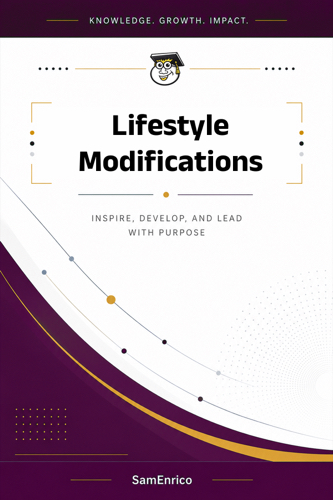
Non-FictionHealth & WellnessLifestyle
Lifestyle Modifications eBook
Teaches weight loss, head elevation, and meal timi
Teaches weight loss, head elevation, and meal timing.
Formats
Free sample
Chapter 1: The Obsolete Math--–- The woman sitting across from me had done everything right. For six months, she had eaten exactly 1,800 calories per day—weighed, measured, and logged in a phone app with religious precision. She had cut out sugar, abandoned white bread, and swapped her afternoon latte for black coffee. She had joined a gym and attended three spin classes per week without exception. She had lost twelve pounds in the first eight weeks.
Then nothing. For the next sixteen weeks, the scale did not move a single ounce. She was eating less and moving more. And her body was winning.Her doctor had told her to "try harder." Her trainer suggested she was "cheating on her logs." Her husband, well-meaning but clueless, asked if she had considered "just eating a little less." She had come to me not for more discipline, but for an explanation. She wanted to know why her body was defying the laws of thermodynamics.The answer, I told her, is that the laws of thermodynamics are not the problem.
The problem is that you are not a bomb calorimeter. You are a living, adapting, feedback-driven biological system that has spent millions of years evolving to survive precisely the kind of calorie restriction you are inflicting upon it. And it is winning.The Thermodynamic Trap Let us be clear about something from the outset. The first law of thermodynamics—energy cannot be created or destroyed, only transformed—is inviolable. If you consume fewer calories than your body expends, you will lose mass.
This is physics. It is not up for debate.But here is what the calorie-counting industry does not want you to know: your body controls both sides of that equation. When you reduce calorie intake, your body does not simply sit back and burn through its fat stores like a car burning gasoline. Instead, it launches a coordinated, multi-system defense strategy designed to preserve its current weight. This is called metabolic adaptation, and it is the single most important concept in weight management that almost no one understands.Metabolic adaptation is not a failure of willpower.
It is not a character flaw. It is not evidence that you are "lazy" or "lack discipline." It is a sophisticated survival mechanism that your ancestors depended upon to survive famines. And it is the reason that 95 percent of diets fail within three years.Consider the landmark study from the National Institutes of Health that followed contestants from the television show "The Biggest Loser." These were individuals who lost dramatic amounts of weight—thirty, fifty, even one hundred pounds—under intense medical supervision. Six years later, nearly all had regained the weight. But here is the shocking part: their resting metabolic rates had never recovered.
A contestant who lost one hundred pounds and regained it all now had a resting metabolic rate that was five hundred calories per day lower than when they started—meaning they had to eat five hundred fewer calories every single day just to maintain their new, higher weight. Their bodies had permanently adjusted their "thermostat" downward.This is metabolic adaptation. And it explains why the woman eating 1,800 calories per day stopped losing weight. Her body, sensing the prolonged calorie deficit, had reduced her resting energy expenditure, lowered her body temperature slightly, reduced her spontaneous movement (fidgeting, posture changes, unconscious activity), and increased her hunger hormones. She was not cheating.
She was being outmaneuvered by her own biology.The Set Point Theory Closely related to metabolic adaptation is the concept of set point theory. The idea is simple: your body defends a particular weight range with the same ferocity that it defends its internal temperature. Just as your body will shiver to raise temperature and sweat to lower it, your body will adjust hunger, metabolism, and energy expenditure to keep you within a ten- to twenty-pound weight range.This set point is not fixed. It can be changed, but slowly, and not through willpower alone. The set point is influenced by genetics, hormones, sleep quality, stress levels, medication use, and—crucially for this book—the timing and pattern of your eating.
What the set point does not respond to is short-term calorie restriction. In fact, aggressive calorie cutting tends to lower the set point in the wrong direction, convincing your body that it needs to defend an even lower weight than before.Think of your set point as a thermostat. If you want to change the temperature of a room, you do not stand in front of the thermostat blowing cold air on it. You adjust the setting. Similarly, if you want to change your body's defended weight range, you do not simply eat less.
You adjust the biological levers that control the set point itself.This book is about those levers.The Three Levers You Have Never Been Told About Most weight loss advice focuses exclusively on one variable: what you eat. Eat less fat. Eat less carbs. Eat more protein. Eat only plants.
Eat only meat. The advice changes every year, but the underlying assumption remains constant: weight loss is about food choice.That assumption is wrong.Food choice matters, of course. A diet of donuts and soda will not support metabolic health regardless of when you eat it. But the overwhelming emphasis on food composition has blinded us to three far more powerful levers that have been hiding in plain sight. This book calls them the Triad: Chrono-nutrition, Postural Hygiene, and Digestive Mechanics.Lever One: Chrono-nutrition (When You Eat)Chrono-nutrition is the study of how meal timing affects metabolism.
It is based on a simple but profound insight: your body processes food differently at different times of day. The same meal eaten at 8 AM produces a different metabolic response than that same meal eaten at 8 PM. This is not a small difference. Research shows that eating a meal late in the evening can spike blood sugar by 40 percent more than eating the identical meal at midday. The same number of calories.
The same macronutrients. A completely different metabolic outcome.This happens because your body runs on a circadian rhythm—a twenty-four-hour internal clock that coordinates virtually every biological process. Your digestive system is not designed to process food around the clock. It has peak hours and off hours. And when you eat during off hours, you are asking your pancreas to release insulin at a time when it is biologically least prepared to do so.
The result is higher blood sugar, higher insulin, and more fat storage.Most people have never considered that when they eat might matter as much as what they eat. But the evidence is overwhelming. Time-restricted eating—confining all calories to an eight- to ten-hour window—has been shown to improve insulin sensitivity, reduce inflammation, lower blood pressure, and promote weight loss, all without changing a single ingredient of the diet. In one study, participants who simply stopped eating after 7 PM lost more weight than those who ate the same foods but spread them across a longer window.Lever Two: Postural Hygiene (How You Sleep)Postural hygiene is the practice of optimizing your body's position during rest. For the purposes of this book, it refers specifically to one intervention…
This is the end of the free sample. Get the eBook to keep going. Buy now
About this book
Details
- Author
- Wahl Cleveland
- Publisher
- SamEnrico
- Language
- English
- Genre
- Non-Fiction, Health & Wellness, Lifestyle
- Released
- 2026-06-05
- Pages (approx.)
- 129
- Available as
- eBook, Audiobook

Read better in the ZLOADR app
Your eBooks on your phone or tablet. Sign in with your SamEnrico account and start reading.
More by Wahl Cleveland
 Emotional Intelligence Development GuideWahl Cleveland$11.99
 Bezos Long Term VisionWahl Cleveland$11.99
 Marilyn Sheppard PregnancyWahl Cleveland$11.99
 Meal Prep for TwoWahl Cleveland$11.99
 Apathy in Chronic IllnessWahl Cleveland$11.99
 Philippines Liberation MarineWahl Cleveland$11.99
 Global Cyber LegislationWahl Cleveland$11.99
 The Bloodstained Letters: France's First Serial Killer and the Wrongfully AccusedWahl Cleveland$11.99
 Neon Requiem: The Last Broadcast of the Titanic’s AIWahl Cleveland$11.99
 How to Produce a FillerWahl Cleveland$11.99
 How to Start a Propane Gas (wholesale) Business (Beginners Guide)Wahl Cleveland$11.99
 How to Produce an Rt-rkWahl Cleveland$11.99
You may also like
 Hong Kong Handover 1997Dunn Johnnie$11.99
 Zumba For Postnatal Recovery CourseNeal Christian$11.99
 Zumba for BeginnersLadner Nikia$11.99
 YouTube Comment Mining GuideHumes Pandora$12.99
 Worry Box MeditationCarlin Rudy$11.99
 Workplace Stress MeditationNguyen Lynn$11.99
 Workplace Stress and Sleep RepairHawley Ivory$11.99
 Workplace Perfectionism CureDelaney Jeffry$11.99
 Workplace Injustice Anger GuideWallen Isabelle$11.99
 Work Addiction and Burnout LinkGreenwood Ester$11.99
 Women in Yoga and WellnessBeattie Galina$11.99
 Women in Stand Up ComedyChun Evangeline$11.99