
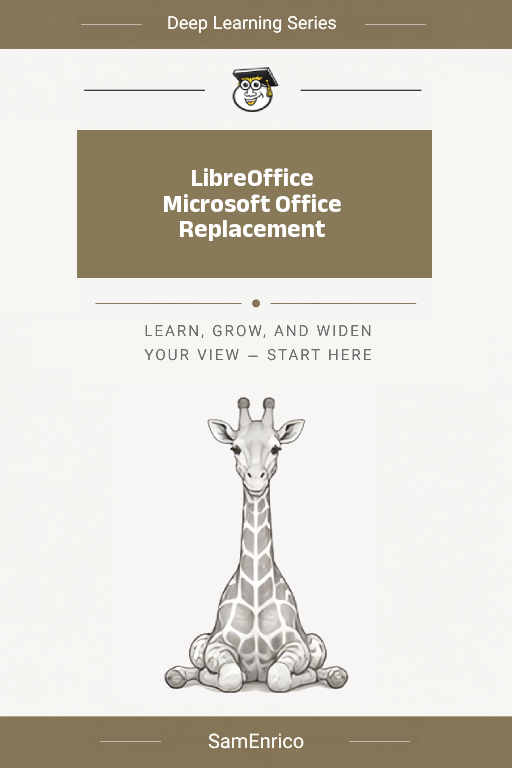
Non-FictionStartup GuideOffice SuiteProductivity
LibreOffice Microsoft Office Replacement eBook
Create documents spreadsheets and presentations wi
by Murray Faye
Create documents spreadsheets and presentations with free LibreOffice instead of paying for Microsoft Office.
Formats
Free sample
Chapter 1: The $10,000 Typing Fee--By the time you finish reading this sentence, Microsoft has charged American households roughly forty-seven cents in subscription fees. That doesn't sound like much, and that is exactly how the trap works. A few cents here, a few dollars there, and before you know it, you have paid the equivalent of a used car simply for the privilege of typing letters, making grocery lists, and helping your child build a science fair slideshow. This chapter is not about software features or technical specifications. It is about waking up to a reality that software companies desperately hope you never calculate: the true lifetime cost of renting your office suite.Let us run the numbers together, and let us be honest about them.
Microsoft 365 Family currently costs approximately one hundred dollars per year for up to six people. That seems reasonable on the surface. A family of four buys two laptop computers, perhaps one desktop for the home office, and each person needs to write emails, edit resumes, build budgets, and create school projects. One hundred dollars annually feels like a small convenience fee for software that just works. But convenience fees have a habit of compounding into fortunes.Consider a typical adult who begins using Microsoft Office at age twenty in college and continues until retirement at age sixty-five.
That is forty-five years of subscriptions. Even if the price never increases—and we all know it will—that family has paid four thousand five hundred dollars. For typing. Add a spouse, and you are now approaching nine thousand dollars. Add children who need Office for school, and you easily cross ten thousand dollars before anyone in the household has written anything more important than a grocery list.
Ten thousand dollars to rent access to word processing, spreadsheets, and presentation software. That is not a software purchase. That is a long-term financial commitment that you signed without reading the fine print.The software industry has trained us to accept this model through a brilliant psychological trick. When you pay one hundred dollars once per year, you never feel the pain of a large expense. You feel a small, manageable pinch that your credit card automatically handles.
But if Microsoft had sold you a perpetual license for ten thousand dollars upfront, you would have laughed and walked away. By breaking the price into tiny, forgettable pieces, they turned a luxury into a perceived necessity. This chapter exists to break that spell.But the financial argument, as compelling as it is, barely scratches the surface. The real story of Libre Office is not about saving money, though saving money is wonderful. The real story is about ownership, privacy, and the quiet rebellion of running software that answers to no one but you.Let us talk about open source, because that phrase confuses many people.
When you hear "open source," you might imagine hobbyists in basements, unreliable software, or something that cannot possibly compete with the polished products of a trillion-dollar corporation. Nothing could be further from the truth. Open source software is software whose source code—the actual human-written instructions that tell the computer what to do—is publicly available for anyone to inspect, modify, and improve. This is not a weakness. This is a superpower.Think about the last time you signed a contract with a bank, an insurance company, or a cell phone provider.
You trusted them because they had lawyers, fine print, and government regulators watching over their shoulders. But you never actually read the underlying agreements that govern how they treat your money. Now imagine if every bank were required to publish its entire internal rulebook for public inspection. That is what open source does for software. Every line of code that makes up Libre Office has been examined by thousands of developers, security researchers, and curious users from around the world.
If there were a backdoor, a privacy violation, or a deliberate vulnerability, someone would have found it, shouted about it, and fixed it.Microsoft Office is closed source. Its code is a secret locked inside corporate vaults. You trust that Microsoft is not doing anything nefarious because you trust the brand, the lawyers, and the regulators. But trust is not the same as verification. With Libre Office, you do not need trust.
You have verification. Every single person with programming skills can audit the software that runs on your computer. That is not a theoretical advantage. That is a fundamental shift in the power dynamic between you and your software vendor.This brings us to privacy, and here the differences become genuinely startling. Microsoft collects an enormous amount of data about how you use its software.
Telemetry reports what features you use, how often you use them, and when the software crashes. Telemetry can include document metadata, anonymous usage patterns, and in some configurations, actual content from your documents. Microsoft states that it uses this data to improve its products, and that is likely true. But they also use it for targeted advertising, machine learning training, and whatever other purposes their ever-expanding privacy policy permits.Libre Office collects nothing. Not a single byte of telemetry leaves your computer unless you explicitly choose to send a crash report through a separate, manual process.
The software runs entirely offline by default. It does not phone home. It does not report your keystrokes. It does not analyze your documents to serve you better ads. It simply does what you tell it to do, nothing more.
In an age where every application seems desperate to connect to the cloud, slurp up your data, and monetize your attention, a completely offline, silent, obedient office suite feels almost radical.Consider what you write in word processing documents. Resumes with your address and phone number. Legal correspondence with sensitive client information. Personal journals, tax documents, medical histories, love letters, and private thoughts. Now consider spreadsheets.
Business financials, household budgets, passwords stored in poorly secured cells, client lists, and investment portfolios. Presentations often contain proprietary company strategies, unreleased product information, and confidential sales forecasts. Do you want all of that material analyzed, indexed, and stored on servers you do not control?Microsoft stores your documents in One Drive by default. You can choose to save locally, but the default is the cloud, and defaults matter because most users never change them. Libre Office stores your documents on your own hard drive by default.
You can choose to sync them to the cloud using Dropbox, Google Drive, or Nextcloud, but that choice is yours, not the software's. This distinction between opt-out and opt-in shapes everything about your digital privacy. One model assumes your data belongs to the company unless you fight to keep it. The other model assumes your data belongs to you unless you choose to share it.The privacy advantages of Libre Office extend beyond telemetry and cloud storage. The Open Document Format (ODF) that Libre Office uses by default is an open, standardized file format that any software can read.
Microsoft's DOCX and XLSX formats are nominally open but contain proprietary extensions and undocumented behaviors that give Microsoft an advantage. More importantly, ODF files are simple. They do not contain hidden…
This is the end of the free sample. Get the eBook to keep going. Buy now
About this book
Details
- Author
- Murray Faye
- Publisher
- SamEnrico
- Language
- English
- Genre
- Non-Fiction, Startup Guide, Office Suite, Productivity
- Released
- 2026-05-30
- Pages (approx.)
- 149
- Available as
- eBook, Audiobook

Read better in the ZLOADR app
Your eBooks on your phone or tablet. Sign in with your SamEnrico account and start reading.
More by Murray Faye
 Calisthenics Hypertrophy GuideMurray Faye$11.99
 Gut Brain Axis OptimizationMurray Faye$11.99
 Group Creative Pitching Techniques CourseMurray Faye$11.99
 Colombian Labor MigrationMurray Faye$11.99
 Blue Zone Water Drinking HabitMurray Faye$11.99
 Mattress and Pillow Selection GuideMurray Faye$11.99
 Time Pressure Anger SourceMurray Faye$11.99
 Parenting Stress and Self CompassionMurray Faye$11.99
 Mindfulness for GamblingMurray Faye$11.99
 The Girl Who Outsmarted the Nazis: The Untold Story of Noor Inayat KhanMurray Faye$11.99
 Echoes from the Desert: The Secret Soviet-Middle Eastern Space RaceMurray Faye$11.99
 Fela Kuti’s Afrobeat Revolution: The Sound That Shook the World (1970s)Murray Faye$11.99
You may also like
 Hong Kong Handover 1997Dunn Johnnie$11.99
 Zumba For Postnatal Recovery CourseNeal Christian$11.99
 Zumba for BeginnersLadner Nikia$11.99
 YouTube Comment Mining GuideHumes Pandora$12.99
 Worry Box MeditationCarlin Rudy$11.99
 Workplace Stress MeditationNguyen Lynn$11.99
 Workplace Stress and Sleep RepairHawley Ivory$11.99
 Workplace Perfectionism CureDelaney Jeffry$11.99
 Workplace Injustice Anger GuideWallen Isabelle$11.99
 Work Addiction and Burnout LinkGreenwood Ester$11.99
 Women in Yoga and WellnessBeattie Galina$11.99
 Women in Stand Up ComedyChun Evangeline$11.99