
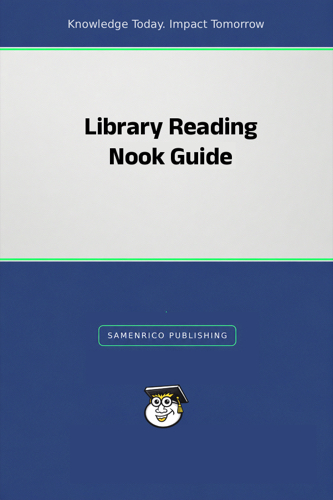
Library Reading Nook Guide eBook
Sits in leather chair surrounded by books, smellin
by Mosby Yvone
Sits in leather chair surrounded by books, smelling old pages.
Formats
Free sample
Chapter 1: Cartography of the Corner...--–- Before you spend a single dollar on a leather chair, a vintage lamp, or a single scented candle, you must answer one question with brutal honesty: Where, exactly, will this nook live? Most people skip this step. They buy beautiful objects first, then try to force them into whatever corner remains unoccupied. This is architectural hubris. It leads to chairs that block doorways, shelves that swallow windows, and lamps that cast light exactly where it is not needed.
The result is not a sanctuary. It is a furniture storage unit with pretensions.This chapter is not about shopping. It is about seeing your home differently. You will learn to hear the difference between a quiet corner and a dead one. You will understand why your brain craves enclosure.
You will map the sun’s journey across your rooms and learn to bend light to your will. And when you finish these pages, you will not have acquired a single new object. You will have acquired something far more valuable: a location, chosen with the precision of a chess master placing their first pawn. Everything else—the chair, the books, the scent, the sound—builds from this single, foundational decision.The Geography of the Reading Mind Before we discuss walls and windows, we must understand what your brain actually needs to read deeply. Neuroscience offers a clear answer.
When you read fiction, your brain activates the same regions used to navigate real physical spaces. The hippocampus—the organ responsible for mapping your environment—fires as if you are walking through the novel's imagined rooms. This is why reading can feel like travel. It is travel, of a kind.But here is the catch: your hippocampus cannot map two spaces at once. If your physical environment is chaotic, loud, or visually distracting, your brain splits its attention.
Part of it navigates the fictional world while another part monitors the real one for threats—a door opening, a television blaring, a child running past. This split attention is exhausting. It is why you can read three pages, realize you remember nothing, and have to start over. Your brain was doing double duty.A properly chosen nook solves this problem by reducing the real-world navigation load. When you sit in a corner with solid walls behind you and on one side, your brain knows exactly where the boundaries are.
It stops monitoring. It relaxes. The hippocampus hands over the keys and says, Fine, go read. I will wait here. This is not metaphor.
This is neuroarchitecture.The research on enclosed spaces is striking. Studies of open-plan offices consistently show higher cortisol levels, faster heart rates, and reduced cognitive performance compared to private offices. The same principle applies to reading spaces. An open-plan living room with a chair pushed against a wall is not a nook. It is a chair.
A true nook requires at least two walls meeting at an angle, a corner that defines a territory. The chair goes in the vertex of that angle, facing outward into the room but backed by solid support. Your brain reads this geometry as a cave—safe, defensible, and profoundly calming.The Whisper Test and the Footfall Map Theory is useless without practice. This chapter provides two diagnostic tools you will use exactly once, then remember for the rest of your life. The first is the whisper test.Take a potential nook location—a corner of your living room, an alcove off the hallway, a window seat in the bedroom.
Stand in that spot. Have a friend or family member stand in the adjacent room, or in the kitchen, or anywhere that is not the nook. Ask them to whisper a sentence. Can you hear the words? If yes, cross that location off the list.
Whisper-level noise is the enemy. It is not loud enough to notice consciously, but it is loud enough for your subconscious to process. Your brain will spend energy filtering those whispers, and that energy will not be available for reading.The ideal nook location passes the whisper test completely. You should hear nothing from adjacent spaces. HVAC vents are particularly deceptive.
A vent that blows air is not necessarily loud, but the低频 rumble of a furnace or air conditioner registers in the same part of the brain as an approaching predator. It triggers a low-grade stress response. If your only potential corner sits directly under a vent, you have two options: redirect the vent (close it or install a deflector) or choose a different corner.The second diagnostic tool is the footfall map. For one week, track where people in your household walk. Do this on paper.
Draw a rough floor plan of your home, then mark every path taken by every person and every pet. You are looking for intersections. A corner that sits at the intersection of two walking paths is a corner that will constantly be interrupted. Avoid it. A corner that sits off the main pathways—a dead-end, a cul-de-sac of domestic traffic—is a candidate.Do not underestimate the importance of this map.
Most people believe they know their own home's traffic patterns. They are wrong. The footfall map reveals that the hallway corner you loved is actually the place where everyone drops their mail. The window seat you admired is directly between the kitchen and the bathroom, a path walked thirty times a day. The map does not lie.
Trust it.The Psychology of Cocooning Why do humans prefer corners? The answer is older than furniture. It predates houses, villages, even language. Our ancestors slept in caves for a reason. A cave provides three critical features: a solid back wall, a roof overhead, and a single direction from which threats can approach.
That geometry is coded into your nervous system.When you sit in a corner with walls behind you and to one side, you have reduced the number of directions from which something can surprise you from 360 degrees to about 90. Your brain knows this. It stops scanning the rear. It stops scanning the flanks. It focuses entirely on what is in front of you—which, if you have done your job, is a book.This is called prospect-refuge theory, developed by the geographer Jay Appleton in the 1970s.
The theory argues that all animals, including humans, seek environments that offer two things simultaneously: prospect (the ability to see out) and refuge (the assurance of not being seen from behind). A chair backed into a corner provides both. You can see the entire room because you are facing outward. But no one can approach you from behind because there is a wall there. Your brain reads this as the ideal defensive position.
And when your brain stops defending, it starts reading.Window seats are a special case of this geometry. A window seat offers refuge (the walls of the alcove) but also a different kind of prospect—not the room, but the outside world. For some readers, this is perfect. The view outside becomes a kind of white noise, a gentle distraction that does not demand attention. For others, a window is a constant temptation, a reminder of the world…
This is the end of the free sample. Get the eBook to keep going. Buy now
About this book
Details
- Author
- Mosby Yvone
- Publisher
- SamEnrico
- Language
- English
- Genre
- Non-Fiction, Self-Help, Library
- Released
- 2026-06-07
- Pages (approx.)
- 112
- Available as
- eBook, Audiobook

Read better in the ZLOADR app
Your eBooks on your phone or tablet. Sign in with your SamEnrico account and start reading.
More by Mosby Yvone
 Sunrise on the WaterMosby Yvone$11.99
 Flow in LeadershipMosby Yvone$11.99
 Self Talk for HealingMosby Yvone$11.99
 The ADHD Focus GuideMosby Yvone$11.99
 Stress Digestive System ImpactMosby Yvone$11.99
 ABCDE Method for Task SortingMosby Yvone$11.99
 Triathlete's Hypnosis GuideMosby Yvone$11.99
 The Whispering Witness: How a Teenage Girl Brought Down Kenya’s Most Notorious Bootlegger (1920s)Mosby Yvone$11.99
 The Last Words of the Navajo Code TalkersMosby Yvone$11.99
 How to Become a Medical-record ClerkMosby Yvone$11.99
 Wasps: Stinging InsectMosby Yvone$11.99
 A Collector's Handbook to the Wolseley 6-110 Series IMosby Yvone$11.99
You may also like
 Hong Kong Handover 1997Dunn Johnnie$11.99
 Zumba For Postnatal Recovery CourseNeal Christian$11.99
 Zumba for BeginnersLadner Nikia$11.99
 YouTube Comment Mining GuideHumes Pandora$12.99
 Worry Box MeditationCarlin Rudy$11.99
 Workplace Stress MeditationNguyen Lynn$11.99
 Workplace Stress and Sleep RepairHawley Ivory$11.99
 Workplace Perfectionism CureDelaney Jeffry$11.99
 Workplace Injustice Anger GuideWallen Isabelle$11.99
 Work Addiction and Burnout LinkGreenwood Ester$11.99
 Women in Yoga and WellnessBeattie Galina$11.99
 Women in Stand Up ComedyChun Evangeline$11.99