
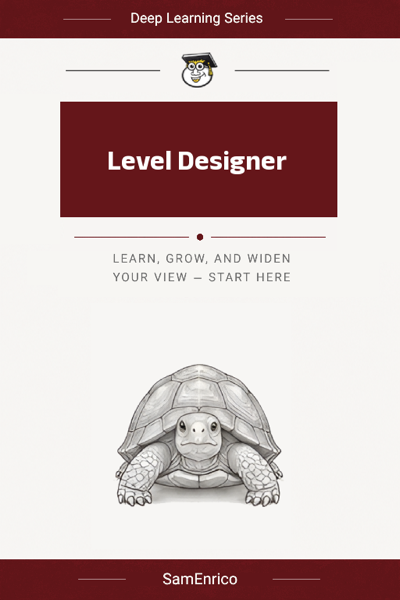
Non-FictionInformativeEducational
Level Designer eBook
A Coursebook on Level Designer
by Hale Dennis
A Coursebook on Level Designer
Formats
Free sample
Chapter 1: The Orchestra of Empty Rooms...--–- The first lie they tell you about level design is that it’s about decorating spaces. The second lie is that it’s about making things look “cool.” The third, and most dangerous, is that anyone with good taste can do it.I learned all three lies on the same day, in the same room, at my first real job in games.The room was empty. Not metaphorically empty—literally, geometrically empty. A gray box the size of a suburban garage, with four walls, a floor, a ceiling, and one door. The kind of space that architects call a “primitive” and game developers call a “graybox.” It had no textures, no lighting, no props, no sound.
Just walls. Six flat planes of medium-gray material waiting for someone to decide what they would become.My lead designer, a woman who had shipped seven titles while I was still learning to mod Half-Life in my parents’ basement, stood behind my shoulder. She pointed at the center of the screen.“What is this room for?”I had an answer ready. “It’s the intro combat tutorial. The player spawns here, an enemy spawns there”—I pointed at the opposite corner—“and the player learns the basic attack.”She nodded slowly, the way a surgeon nods before telling you the prognosis is worse than you thought.
“Walk me through it. Step by step. What does the player see first?”I described the scene: spawn in, see the enemy across the room, learn to move toward it, attack, win. Simple. Elegant.
Functional.She asked one more question. “What does the player feel?”I didn’t understand the question. Not really. I thought she meant the gameplay feel—the weight of the attack, the response time of the controls. So I talked about frame rates and input lag and hitbox precision.She waited for me to finish.
Then she said something I have never forgotten.“You’re thinking like an engineer who builds furniture. You need to think like a composer who writes symphonies. The furniture-maker asks, ‘Does this chair hold weight?’ The composer asks, ‘Does this silence make you lean forward?’ Your level isn’t a container for gameplay. It’s a conversation between you and the player, and right now, you’re just shouting.”That conversation changed everything. This chapter is about learning to hear the silence.The Three Lies Level Designers Tell Themselves Before we can build anything, we have to unlearn what the industry, the internet, and our own egos have taught us about this craft.
Let me name the three lies explicitly, because I will be debunking them throughout this entire book.Lie #1: Level design is environment art. This is the most common misconception, perpetuated by every “before and after” screenshot that shows a graybox next to a fully textured, lit, and decorated scene. The lie suggests that the graybox is the unfinished version and the art-pass is the finished version. In reality, a great level is a great level at graybox. Art makes it beautiful; layout makes it playable.
If your level isn’t fun as a collection of gray cubes, it won’t be fun with a billion-dollar art budget. Art is a multiplier, not a foundation.Lie #2: Level design is about making things “cool.” I have watched junior designers spend weeks creating “epic” moments—collapsing bridges, exploding helicopters, slow-motion door breaches—without ever asking whether those moments served the player’s understanding of the game’s systems. A level is not a highlight reel. A level is a teaching machine. Every room, every corridor, every enemy placement is an opportunity to teach the player something about how to think, move, and decide.
“Cool” is a byproduct of clarity, not a substitute for it.Lie #3: Anyone with good taste can do it. This lie is the most seductive because it flatters the listener. You play games. You know what you like. Surely you can make what you like?
But taste without craft is just opinion. Level design requires a specific set of skills: spatial reasoning, systems thinking, psychology, pacing, iteration discipline, and—most surprisingly—emotional intelligence. You are not decorating a room for yourself. You are building a path for a stranger whose attention you are constantly fighting to keep.These three lies have one thing in common. They all center the designer rather than the player.
And that is the fundamental error that separates amateurs from professionals: the amateur asks, “What do I want to make?” The professional asks, “What does the player need to learn next?”The Player Advocate: Your Only Job Title That Matters Let me give you a new definition of level design. Write it down. Tape it to your monitor.Level design is the act of arranging space, time, and systems to elicit a specific emotional and cognitive response from a player, while always advocating for their understanding and agency.Every word in that definition matters, but the most important phrase is the last one: “advocating for their understanding and agency.” This is the Player Advocate philosophy, and it will be the lens through which we evaluate every decision in this book.What does it mean to be a player advocate? It means that when you place a door, you don’t ask “Does this door look cool?” You ask “Will the player know this door is interactive within two seconds of seeing it?” It means that when you design a combat encounter, you don’t ask “Is this hard enough for experienced players?” You ask “Does this encounter teach the player a new tactic, or does it just frustrate them?” It means that when you build a puzzle, you don’t ask “Is this clever?” You ask “Will the player feel smart when they solve it, or will they feel like they guessed?”The player advocate does not reduce challenge. The player advocate clarifies it.
There is a profound difference between a level that is difficult because it tests skill and a level that is difficult because it is confusing. The first respects the player. The second disrespects them.Here is a test you can apply to every design decision you will ever make. I call it the Advocate’s Question:“Does this decision help the player understand what they need to do, or does it make them guess?”If the answer is “help,” you are designing. If the answer is “guess,” you are gambling with someone else’s time and attention.
And time and attention are the only resources players cannot earn back.The Composer, Not the Architect: Why Music Is the Better Metaphor I have read dozens of books that compare level design to architecture. Christopher Totten’s excellent An Architectural Approach to Level Design makes a compelling case, and we will borrow heavily from architectural concepts like circulation, prospect-refuge theory, and the parti in Chapter 2. But I have come to believe that architecture is the wrong primary metaphor for what we do.Architecture creates static spaces. A building does not change when you walk through it. The rooms do not rearrange themselves based on your choices.
The stairs do not collapse behind you to create tension. Architecture is about permanence, solidity, and the illusion of control.Level…
This is the end of the free sample. Get the eBook to keep going. Buy now
About this book
Details
- Author
- Hale Dennis
- Publisher
- SamEnrico
- Language
- English
- Genre
- Non-Fiction, Informative, Educational
- Released
- 2026-05-11
- Pages (approx.)
- 160
- Available as
- eBook, Audiobook

Read better in the ZLOADR app
Your eBooks on your phone or tablet. Sign in with your SamEnrico account and start reading.
More by Hale Dennis
 Catherine Great Trade ExpansionHale Dennis$11.99
 Cultural Resentment ReleaseHale Dennis$11.99
 Urban Walking Meditation GuideHale Dennis$11.99
 Caregiver Burnout for Cancer CaregiversHale Dennis$11.99
 The Conqueror of Two Continents: Mehmed the First’s Bold AmbitionsHale Dennis$11.99
 How to Start a Driving Ranges - Golf BusinessHale Dennis$11.99
 UN P11 Form Completion GuideHale Dennis$12.99
 How to Produce an Averruncator (Pruning Tool)Hale Dennis$11.99
You may also like
 Hong Kong Handover 1997Dunn Johnnie$11.99
 Zumba For Postnatal Recovery CourseNeal Christian$11.99
 Zumba for BeginnersLadner Nikia$11.99
 YouTube Comment Mining GuideHumes Pandora$12.99
 Worry Box MeditationCarlin Rudy$11.99
 Workplace Stress MeditationNguyen Lynn$11.99
 Workplace Stress and Sleep RepairHawley Ivory$11.99
 Workplace Perfectionism CureDelaney Jeffry$11.99
 Workplace Injustice Anger GuideWallen Isabelle$11.99
 Work Addiction and Burnout LinkGreenwood Ester$11.99
 Women in Yoga and WellnessBeattie Galina$11.99
 Women in Stand Up ComedyChun Evangeline$11.99