
Non-FictionInformativeEducational
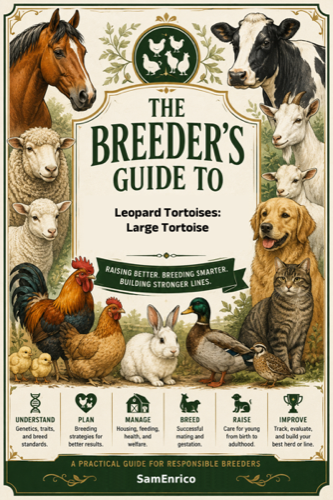
Leopard Tortoises: Large Tortoise eBook
This wildlife publication, published by SamEnrico,
This wildlife publication, published by SamEnrico, covers Leopard Tortoises: Large Tortoise
Formats
Free sample
Chapter 1: The Spotted Giant...--The first time you see a leopard tortoise in person, you will understand why it carries that name. The shell is not merely patterned – it is painted. Each scute, each individual plate of the carapace, holds a constellation of dark spots against a background of warm amber and gold. No two tortoises have the same pattern, any more than two leopards share the same rosettes. And then you notice the size.
This is not a creature you cup in two hands. An adult leopard tortoise can weigh as much as a large dog, walk through a screen door without slowing, and live long enough to witness your children's children graduate from high school.This is the fourth-largest tortoise species on Earth. Only the Galapagos, Aldabra, and African spurred tortoises grow larger. But what leopard tortoises lack in absolute size compared to those island and desert giants, they make up in adaptability, beauty, and personality. They are the tortoises of the savanna – animals shaped by the rhythms of African wet and dry seasons, the threat of predators, and the endless search for grass, fruit, and water.This chapter is where we begin.
Before you build an enclosure, before you buy a single light bulb or bag of calcium powder, you need to understand what a leopard tortoise is, where it came from, and how it fits into the natural world. The decisions you make as a keeper will be better – safer, healthier, more ethical – if you understand the animal you are caring for. A leopard tortoise is not a rock with legs. It is a survivor of millions of years of evolution, a creature perfectly adapted to a harsh and beautiful continent.What's in a Name – The Taxonomy of Stigmochelys pardalis Every living thing has a scientific name, and those names tell a story. The leopard tortoise's scientific name is Stigmochelys pardalis.
Break it down: Stigmochelys comes from the Greek words "stigma" (meaning mark or spot) and "chelys" (meaning tortoise). Pardalis is Greek for "leopard." So the name literally means "spotted leopard tortoise" – a tautology that emphasizes the most obvious feature of this animal.But the naming history is more complicated than that. For many years, the leopard tortoise was classified as Geochelone pardalis, grouped together with African spurred tortoises, Indian star tortoises, and a dozen other species in a sprawling "catch-all" genus. Modern genetic analysis changed that. Researchers discovered that Geochelone was an artificial grouping – a convenient box that did not reflect evolutionary relationships.
In 2006, the leopard tortoise was moved to its own genus: Stigmochelys, a monotypic genus containing only this single species.Why does this matter to you, the keeper? Because it tells you that the leopard tortoise is evolutionarily unique. It has no close living relatives. The adaptations that allow it to thrive across a vast range of eastern and southern Africa – from semi-arid savannas to grasslands to thorny shrublands – are its own. You cannot look at the care requirements of an African spurred tortoise and assume they apply directly to a leopard tortoise.
They are different animals, evolved for different conditions.The Subspecies Debate – One Species or Two?Here is where things get interesting, and a little contentious. Many herpetologists recognize two subspecies of leopard tortoise: Stigmochelys pardalis pardalis (the Southern form) and Stigmochelys pardalis babcocki (the Eastern form). The differences are not merely geographic – they are visible, measurable, and potentially significant for keepers.The Southern form (S. p. pardalis) is found in South Africa, Namibia, Botswana, and Zimbabwe.
These are the giants. Southern form adults commonly reach 18-24 inches in carapace length and weigh 40-60 pounds, with exceptional individuals reaching 28 inches and 100-120 pounds. Their shells are higher-domed and more heavily patterned, with dark spots that can coalesce into irregular blotches as the animal ages.The Eastern form (S. p. babcocki) ranges from Sudan and Ethiopia south through Kenya and Tanzania.
These are smaller – typically 12-18 inches and 20-40 pounds. Their shells are somewhat flatter, and the patterning is more open, with distinct spots that rarely merge. Some Eastern form tortoises show reduced spotting on the carapace, appearing almost patternless.Recent genetic evidence has complicated this tidy picture. Some studies suggest that the two forms are genetically distinct enough to be considered separate species. Other research indicates that there is a gradient of intergradation across their ranges, with animals in Mozambique and Zambia showing intermediate characteristics.
The debate is not settled.What does this mean for you? Practically speaking, you need to know which form you have, because the Southern form can grow much larger. An enclosure that is adequate for an adult Eastern form may be cramped for a Southern form. The breeder or seller should be able to tell you the geographic origin of your tortoise's lineage. If they cannot, assume you have a Southern form and plan for larger enclosure space – it is better to have extra room than to be scrambling to build a bigger enclosure when your tortoise outgrows its home.The Fossil Record – A Lineage Millions of Years Old Leopard tortoises did not appear yesterday.
Their ancestors walked the African continent alongside creatures that no longer exist. Fossil evidence places the genus Stigmochelys in the Miocene period, between 5 and 23 million years ago. That means leopard tortoises were already a distinct lineage when the first hominids were evolving in the same African landscapes.The Miocene was a time of change. Africa was colliding with Eurasia, mountain ranges were rising, and the climate was shifting from wetter forests to drier grasslands. The ancestors of leopard tortoises adapted to these open landscapes, developing legs strong enough to carry heavy bodies long distances and digestive systems capable of extracting nutrition from coarse, fibrous grasses.The fossil record shows that leopard tortoises were once more widespread than they are today, with remains found in regions of Africa that are now too dry or too forested to support them.
Climate change – both natural and human-driven – has contracted their range. But they remain one of the most successful large tortoise species on the continent.Geographic Range – From the Horn to the Cape The leopard tortoise has the widest geographic distribution of any African tortoise species. Their range stretches across eastern and southern Africa in a broad arc, from Sudan and Ethiopia in the north down through Kenya, Tanzania, and Mozambique, then west through Zambia, Zimbabwe, Botswana, Namibia, and finally into South Africa.Within this vast range, leopard tortoises occupy a variety of habitats, but they show clear preferences. They avoid dense forests, swamps, and true deserts. They are most at home in semi-arid savannas, thorny shrublands, and open grasslands.
These are landscapes with scattered trees, seasonal rainfall, and distinct wet and dry periods. The tortoises need enough vegetation to graze, enough open space to bask, and enough cover to hide from predators.The southern and western parts of their range receive less rainfall – 10 to 20 inches annually – while eastern regions can receive up to 30 inches or more. The tortoises adapt to these differences by adjusting their behavior. In wetter areas, they remain active more of the year. In drier areas, they may become less active or seek shelter during the…
This is the end of the free sample. Get the eBook to keep going. Buy now
About this book
Details
- Author
- Carlson Mildred
- Publisher
- SamEnrico
- Language
- English
- Genre
- Non-Fiction, Informative, Educational
- Released
- 2026-05-09
- Pages (approx.)
- 134
- Available as
- eBook, Audiobook

Read better in the ZLOADR app
Your eBooks on your phone or tablet. Sign in with your SamEnrico account and start reading.
More by Carlson Mildred
 Temp Drop Wearable FertilityCarlson Mildred$11.99
 Compulsive Buying Triggers ListCarlson Mildred$11.99
 Widow Financial TransitionCarlson Mildred$11.99
 Shame and Vulnerability WorkCarlson Mildred$11.99
 Hot Flash Night Sweat Sleep GuideCarlson Mildred$11.99
 Senior Self Esteem After Suicidal ThoughtsCarlson Mildred$11.99
 Self Hypnosis for HSPCarlson Mildred$11.99
 Difficult Conversations with ProfessorsCarlson Mildred$11.99
 The Favela Wars: Rio's Bloody Struggle for Control (1920s-1940s)Carlson Mildred$11.99
 The Brave Little Bat: Pasteur's Fight Against RabiesCarlson Mildred$11.99
 How to Produce Pc StationsCarlson Mildred$11.99
 How to Produce Credit Card TerminalsCarlson Mildred$11.99
You may also like
 Hong Kong Handover 1997Dunn Johnnie$11.99
 Zumba For Postnatal Recovery CourseNeal Christian$11.99
 Zumba for BeginnersLadner Nikia$11.99
 YouTube Comment Mining GuideHumes Pandora$12.99
 Worry Box MeditationCarlin Rudy$11.99
 Workplace Stress MeditationNguyen Lynn$11.99
 Workplace Stress and Sleep RepairHawley Ivory$11.99
 Workplace Perfectionism CureDelaney Jeffry$11.99
 Workplace Injustice Anger GuideWallen Isabelle$11.99
 Work Addiction and Burnout LinkGreenwood Ester$11.99
 Women in Yoga and WellnessBeattie Galina$11.99
 Women in Stand Up ComedyChun Evangeline$11.99