
Non-FictionSelf-HelpLegal Innovation
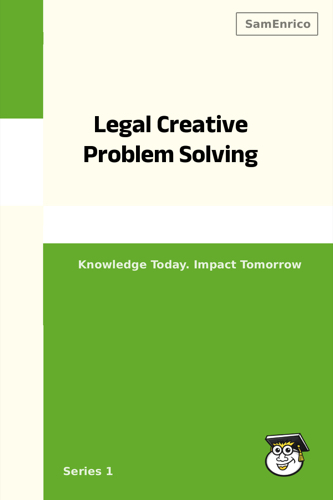
Legal Creative Problem Solving eBook
Find novel solutions to legal challenges using thi
Find novel solutions to legal challenges using this practical creativity guide for attorneys.
Formats
Free sample
Chapter 1: The Precedent Prison--–- The senior partner’s voice echoed through the conference room, a blend of confidence and condescension. “We’ll win the motion,” she said, sliding a crisp legal brief across the mahogany table. “Their argument is weak. The precedent is clear. Summary judgment is ours.”The client, a mid-sized manufacturing executive named Diane, nodded slowly.
She had come to this firm six months ago, desperate. A supplier had allegedly delivered defective parts, causing a three-million-dollar production delay. The legal team had done exactly what law school trained them to do: identify the issue, find the rule, apply the analysis, and conclude with a victory. And a victory they had achieved. The court granted summary judgment in Diane’s favor.
The supplier was ordered to pay $2.2 million in damages.Diane won. The firm celebrated. The partner added the win to her monthly billable tally.But six months after the judgment, Diane’s company filed for bankruptcy. The supplier, a small family-owned operation, could not pay the $2.2 million. They had no assets to seize, no insurance to trigger.
The judgment was a piece of paper worth nothing. Worse, the litigation had burned every bridge in the industry. Other suppliers, terrified of being sued, refused to work with Diane. The “victory” had destroyed her business.The partner never understood what went wrong. She had done everything correctly.
The law was on her side. The motion was flawless. But she had solved the wrong problem. Diane did not need a judgment. She needed a functioning supply chain.
She needed a renegotiated payment schedule. She needed a solution that preserved relationships, not destroyed them.This is the quiet catastrophe of legal training. It teaches you to be right. It does not teach you to be useful.The IRAC Trap: How Law School Breaks Your Brain Every lawyer knows the mantra. You learned it in your first month of law school, probably in a cold, windowless classroom while a professor in a tweed jacket called on you unexpectedly.
Issue. Rule. Application. Conclusion. IRAC.
It is the skeleton of every legal argument, the architecture of every brief, the DNA of judicial opinions.On its face, IRAC is a perfectly reasonable tool for organizing legal analysis. You identify the legal question. You state the governing rule. You apply the rule to the facts. You conclude.
This is clear, logical, and linear.But here is the problem that no law professor tells you: IRAC is a reactive framework. It assumes the problem has already been framed. It assumes the issue is correctly identified. It assumes the rule is the right tool. And it assumes that the conclusion is the end of the story.None of these assumptions are true in creative problem-solving.IRAC trains lawyers to wait for a problem to be handed to them.
A client walks in with a dispute. The lawyer’s first instinct is not to ask “What is really going on here?” but to ask “What is the issue?” That subtle shift is devastating. By jumping immediately to the issue, the lawyer accepts the client’s framing of the problem. If the client says “My partner breached our contract,” the lawyer starts researching contract breach. But what if the partner breached because they felt disrespected?
What if the real problem is not a legal breach at all, but a breakdown in communication? What if the solution is not a lawsuit, but an apology, a revised payment schedule, or a mediator?IRAC has no room for those questions. IRAC is a machine that takes a legal question and produces a legal answer. It cannot tell you whether the legal question is the right question to ask.This is what I call the Precedent Prison. It is a cognitive enclosure where every new problem is forced to fit inside an old legal framework.
The walls of the prison are built from case law, statutes, and procedural rules. The guards are the partners and professors who reward doctrinal mastery. The sentence is a lifetime of analytic paralysis: the inability to generate novel solutions because your brain is locked in precedent-matching mode.Consider the research of psychologist Daniel Kahneman, whose work on cognitive biases earned him a Nobel Prize. In his book Thinking, Fast and Slow, Kahneman describes two systems of thinking. System 1 is fast, intuitive, pattern-based, and automatic.
It is the voice that tells you a stranger’s face looks angry or that a joke is funny before you analyze why. System 2 is slow, deliberate, analytical, and effortful. It is the voice that calculates a tip, reads a dense statute, or constructs a legal argument.Law schools are factories for System 2. They reward the slow, careful, precedent-driven analysis that produces the “correct” answer on a final exam. They punish System 1 as sloppy, emotional, or unprofessional.
But here is the secret that creative problem-solvers understand: breakthrough solutions almost never come from System 2. They emerge from System 1 — from intuition, pattern recognition, and the ability to see connections that are not logically obvious.The tragedy is that lawyers have perfectly good System 1 capabilities. They are human beings, after all. But years of legal training atrophy those capabilities. By the time a lawyer has spent five years in practice, their default response to any novel situation is to reach for a rule, a precedent, or a procedural maneuver.
They have forgotten how to ask “What if?” because they have been trained to ask “What is the law?”The Anatomy of Analytic Paralysis Let me give you a clearer picture of how analytic paralysis manifests in daily practice. You have probably experienced all of these symptoms. You may not have had a name for them.Symptom One: The First Solution Fallacy A client describes a problem. Within thirty seconds, you have identified a potential legal solution. You cling to that first idea, researching it, refining it, defending it against all comers.
The problem is not that the first solution is always wrong. The problem is that you have stopped looking for other solutions. You have fallen in love with your firstborn idea and ignored all subsequent siblings.Research in cognitive psychology calls this “anchoring.” The first piece of information you receive becomes the anchor around which all subsequent thinking orbits. In legal practice, the first plausible legal theory you identify becomes the anchor. You spend hours or weeks building a case around that anchor, even when a different approach — a settlement, a creative contract structure, a non-legal intervention — would serve your client better.Symptom Two: The Certainty Mandate Lawyers are paid to be certain.
Clients come to you because they are uncertain, and they want you to absorb their anxiety and return a confident prediction. This creates a powerful incentive to project omniscience, even when you are guessing.The problem is that certainty is the enemy of curiosity. When you believe you already know the answer, you stop asking questions. You stop exploring alternative framings. You stop listening for the weak signals — the hesitation in a client’s voice, the oddly worded clause in a contract, the unusual procedural move by opposing counsel — that might reveal a different path forward.The best creative problem-solvers are comfortable with uncertainty.
They say “I don’t know” frequently and openly. They treat every problem as a hypothesis to be tested, not a…
This is the end of the free sample. Get the eBook to keep going. Buy now
About this book
Details
- Author
- Cardenas Johnie
- Publisher
- SamEnrico
- Language
- English
- Genre
- Non-Fiction, Self-Help, Legal Innovation
- Released
- 2026-06-06
- Pages (approx.)
- 151
- Available as
- eBook, Audiobook

Read better in the ZLOADR app
Your eBooks on your phone or tablet. Sign in with your SamEnrico account and start reading.
More by Cardenas Johnie
 Insurance and Liability OutlookCardenas Johnie$11.99
 Office Chair Meditation CourseCardenas Johnie$11.99
 The Prolonged Grief Treatment GuideCardenas Johnie$11.99
 The Blue Zone Herbal TeasCardenas Johnie$11.99
 The Sword and the Rose: Love and Blood in the Baltic CrusadesCardenas Johnie$11.99
 Category Insights ExecutiveCardenas Johnie$11.99
 Understanding Stickler SyndromeCardenas Johnie$17.99
 Fixed Asset AI GuideCardenas Johnie$12.99
 Dynamic Discounting GuideCardenas Johnie$12.99
 How to Become a Pipe-and-tank FabricatorCardenas Johnie$11.99
You may also like
 Hong Kong Handover 1997Dunn Johnnie$11.99
 Zumba For Postnatal Recovery CourseNeal Christian$11.99
 Zumba for BeginnersLadner Nikia$11.99
 YouTube Comment Mining GuideHumes Pandora$12.99
 Worry Box MeditationCarlin Rudy$11.99
 Workplace Stress MeditationNguyen Lynn$11.99
 Workplace Stress and Sleep RepairHawley Ivory$11.99
 Workplace Perfectionism CureDelaney Jeffry$11.99
 Workplace Injustice Anger GuideWallen Isabelle$11.99
 Work Addiction and Burnout LinkGreenwood Ester$11.99
 Women in Yoga and WellnessBeattie Galina$11.99
 Women in Stand Up ComedyChun Evangeline$11.99