
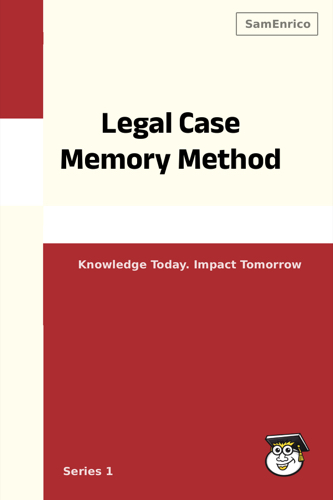
Non-FictionSelf-HelpLegal Studies
Legal Case Memory Method eBook
Apply method of loci to remember case names statut
Apply method of loci to remember case names statutes and precedents.
Formats
Free sample
Chapter 1: The Curious Paradox...-- Every law student knows the feeling. You sit in the library for six hours, highlighters in hand, case briefs stacked like cards. You read Palsgraf v. Long Island Railroad not once but three times. You write the rule in your own words.
You say it aloud. You are certain, absolutely certain, that you have memorized it. Then the professor calls on you. The room goes quiet. Thirty faces turn in your direction.
And suddenly, the only thing you can remember is that the case involved something about a woman and a scale. Or was it a train? Your mind is a whiteboard that someone just erased.This is not a failure of intelligence. It is not a lack of effort. It is not a sign that you do not belong in law school.
It is, instead, a predictable consequence of how the human brain was designed to work – and how law school inadvertently asks you to use it in exactly the opposite way.The problem is not you. The problem is the mismatch between the kind of memory that legal education demands and the kind of memory that most study methods train. You have been trying to store abstract legal rules in a brain that evolved to remember landscapes, predators, food sources, and social relationships. You have been using a system built for hunting and gathering to store the holdings of Chevron v. NRDC.
And when that mismatch reveals itself under the pressure of a cold call or a three-hour exam, you conclude that you are simply bad at memorization. You are not. You have just been using the wrong tool for the job.This chapter begins with a simple diagnosis of why traditional law study methods fail. Then it introduces the surprising solution: a technique older than written language, used by Greek orators to memorize speeches of epic length, and now adapted specifically for the unique demands of legal education. By the end of this chapter, you will understand not only why you forget but also why forgetting is not your enemy – it is simply data telling you to change your approach.The Great Illusion of Recognition Before we can solve the problem of recall under pressure, we must understand the difference between two fundamentally different cognitive operations: recognition and recall.
Most law students confuse these at their own peril.Recognition is the ability to identify information when you see it. You recognize a case name when it appears in a multiple-choice question. You recognize a legal rule when your professor states it aloud. Recognition feels like familiarity. It is passive.
It requires only that the information has crossed your awareness at some point in the past. Recognition is why you can look at a list of fifty case names and think, "Yes, I've seen all of these before."Recall is the ability to produce information from memory with no external cues. Recall is what happens when someone asks, "What is the holding of Palsgraf?" and you must generate the answer from nothing. Recall is active. It requires that the information not only passed through your awareness but was also encoded, stored, and indexed in a way that allows for voluntary retrieval.
Recall is why the same list of fifty case names feels impossible when you close the book.Here is the cruel trick of law school: almost all of your study methods train recognition, but almost all of your exams and cold calls demand recall. Highlighting trains recognition. Re-reading casebooks trains recognition. Typing and retyping your outlines trains recognition. Even traditional flashcards, if used passively (reading the front and then flipping to the back), train recognition more than recall.
You spend dozens of hours becoming an expert recognizer of legal information, and then you are tested on your ability to recall it.The Socratic method is a recall machine. A professor does not ask, "Does this sound familiar?" A professor asks, "What is the rule?" with no cues, no prompts, no multiple-choice options. The bar exam's essay portion is a recall test. Oral arguments are recall tests. Client meetings are recall tests.
The entire profession beyond law school runs on recall. But law school teaches you recognition and calls it studying.Why Your Working Memory Collapses Under Pressure The second piece of the puzzle is cognitive load. Working memory – the part of your mind that holds information in conscious awareness while you manipulate it – is painfully small. The psychologist George Miller famously proposed that working memory can hold approximately seven plus or minus two chunks of information. More recent research has revised that number downward: under real-world conditions, most people can hold only about four discrete chunks at once.Consider what happens when a professor asks you a Socratic question.
You must simultaneously hold in your mind: the name of the case, the key facts, the legal issue, the rule of law, the court's analysis, the holding, any dissenting opinions, and how all of that applies to a hypothetical variation the professor just invented. That is easily ten to fifteen chunks of information. Your working memory is designed to hold four. The result is not a graceful degradation of performance. The result is a crash.This is why you blank.
This is why you say something like, "The case involved a train... or maybe a boat... and something about a package?" Your brain, under cognitive overload, defaults to the most primitive retrieval mode: it grasps for anything at all. The specificity and precision that legal analysis requires evaporate because your working memory has been asked to do the impossible.Linear notes do not solve this problem. Outlines do not solve it.
Briefs do not solve it. These methods store information externally – on paper, on a screen – but they do not reduce the cognitive load of retrieval. During an exam, you cannot consult your outline. You are alone with your memory. And if your memory is organized the same way your outline is organized (hierarchically, abstractly, linearly), you will struggle to find anything in the chaos of pressure.The Evolutionary Glitch That Saves You Here is where the story takes an unexpected turn.
The human brain has one type of memory that is extraordinarily powerful, nearly limitless in capacity, and remarkably resilient under pressure. That memory system did not evolve for law school. It evolved for survival.Spatial memory is the system that allows you to navigate your environment. You use it every day without thinking. You know the layout of your apartment.
You can walk from your bedroom to the kitchen in the dark without bumping into furniture. You remember where you left your keys not because you memorized their location as an abstract fact, but because you have a mental map of your home. You can recall the floor plan of your childhood home with stunning accuracy decades after you last lived there.This is not a metaphor. Spatial memory is physiologically distinct from the memory systems that handle abstract facts and verbal information. The hippocampus, a seahorse-shaped structure deep in your brain, is specially adapted for encoding and retrieving spatial relationships.
This system has enormous capacity. It operates automatically, without conscious effort. It does not degrade significantly under stress – in…
This is the end of the free sample. Get the eBook to keep going. Buy now
About this book
Details
- Author
- Kelsey Twanda
- Publisher
- SamEnrico
- Language
- English
- Genre
- Non-Fiction, Self-Help, Legal Studies
- Released
- 2026-06-07
- Pages (approx.)
- 145
- Available as
- eBook, Audiobook

Read better in the ZLOADR app
Your eBooks on your phone or tablet. Sign in with your SamEnrico account and start reading.
More by Kelsey Twanda
 Burnout Prevention for ProfessionalsKelsey Twanda$11.99
 Asynchronous Creative CollaborationKelsey Twanda$11.99
 Gacy's Criminal Record Before KillingsKelsey Twanda$11.99
 Antwerp Heist Accomplice NetworkKelsey Twanda$11.99
 Retirement Assets Minor ChildrenKelsey Twanda$11.99
 Periodic Leg Movement GuideKelsey Twanda$11.99
 Nicotine And Anxiety WorkbookKelsey Twanda$11.99
 Fibroid Menstrual ManagementKelsey Twanda$11.99
 Whispers of the Vanishing: The Last Speakers of the World’s Most Endangered LanguagesKelsey Twanda$11.99
 Into the Frozen Abyss: Exploring the Arctic's Hidden DepthsKelsey Twanda$11.99
 The Raven’s Gambit: How Coyote Outwitted the ThunderbirdsKelsey Twanda$11.99
 The Dancer's Guide to KathakKelsey Twanda$11.99
You may also like
 Hong Kong Handover 1997Dunn Johnnie$11.99
 Zumba For Postnatal Recovery CourseNeal Christian$11.99
 Zumba for BeginnersLadner Nikia$11.99
 YouTube Comment Mining GuideHumes Pandora$12.99
 Worry Box MeditationCarlin Rudy$11.99
 Workplace Stress MeditationNguyen Lynn$11.99
 Workplace Stress and Sleep RepairHawley Ivory$11.99
 Workplace Perfectionism CureDelaney Jeffry$11.99
 Workplace Injustice Anger GuideWallen Isabelle$11.99
 Work Addiction and Burnout LinkGreenwood Ester$11.99
 Women in Yoga and WellnessBeattie Galina$11.99
 Women in Stand Up ComedyChun Evangeline$11.99