
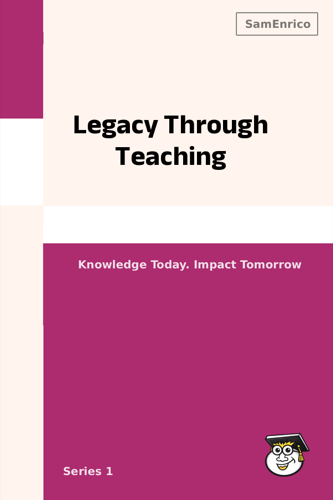
Legacy Through Teaching eBook
Educates others as lasting impact.
Educates others as lasting impact.
Formats
Free sample
Chapter 1: The Invisible Ripples--–- Every September, Maria Castillo walked into her third-grade classroom and did something that looked, from the outside, utterly ordinary. She arranged desks in a lopsided circle. She wrote the day's agenda on a chalkboard that had been there since 1987. She sharpened eight pencils and placed them in a tin cup beside a wilting peace lily. A visitor watching Maria would have seen nothing remarkable—no TED Talk charisma, no viral teaching trick, no stack of educational awards on a dusty shelf.
And yet, thirty years later, a man named Devon would name his first daughter Maria. A surgeon named Priya would keep a laminated bookmark Maria had given her, now taped inside her locker at the hospital. A felon named Terrence, serving eighteen years for armed robbery, would write Maria a letter every Christmas, beginning each one the same way: "You were the only one who looked at me like I was still there."What Maria did cannot be measured by standardized tests. It cannot be captured in a value-added assessment model or a district-mandated observation rubric. Maria Castillo did not teach lessons that appeared on any exam.
She taught, instead, from a place that educational bureaucracies have never known how to quantify: the quiet, relentless, often invisible work of becoming the kind of teacher whose influence ripples outward for decades, touching people she will never meet, shaping lives she will never fully see.This book is about becoming Maria Castillo. Not the myth of the perfect teacher—the one who never loses patience, who grades papers on Sunday nights with a serene smile, who transforms struggling readers into novelists by Christmas break. That teacher does not exist, and chasing her is a recipe for burnout and shame. This book is about the real legacy teacher: the one who stumbles, who apologizes to students, who has days when the only victory is that nobody cried. The one who understands that legacy is not built in grand, dramatic moments of inspiration but in the small, specific, sometimes painfully ordinary acts of attention that accumulate over a career like sediment becoming stone.Before we go any further, let me tell you what this chapter is not.
It is not a set of lesson plan templates. It is not a list of "seven habits of highly effective teachers" that will magically fix a broken classroom by Tuesday. It is not another plea to work harder, stay later, care more—as if the problem with most teachers is insufficient martyrdom. Those books exist already, and they have left millions of educators exhausted, disillusioned, and convinced that their failure to achieve "greatness" is a personal moral failing.This chapter is something different. It is an invitation to redefine what legacy means in the first place.The Funeral Test There is a thought experiment that circulates quietly among educators, usually late at night over lukewarm coffee at a kitchen table covered in ungraded essays.
It goes like this: Imagine your funeral. Not the somber gathering itself, but the stories people tell afterward. Years from now, when your name comes up in conversation among your former students—perhaps at a reunion, perhaps in a therapy session, perhaps in the quiet way people remember those who shaped them—what will they say?Will they say, "She really knew how to structure a persuasive essay unit?" Will they say, "His classroom management was flawless; I never once saw a cell phone?" Will they say, "Her students scored in the ninety-fifth percentile on the state exam three years running?"No. They will not.At your funeral, nobody will mention your pacing calendar. Nobody will toast to your beautifully formatted lesson plans.
Nobody will whisper, with tears in their eyes, about your meticulous adherence to the district's scope and sequence. What they will remember—what they will feel—is whether you saw them. Whether you believed in them when they did not believe in themselves. Whether you were a source of shame or a source of courage. Whether you left them larger than you found them or smaller.This is the Funeral Test.
And by its measure, most of what passes for "good teaching" in our current educational system is not good at all. It is efficient. It is measurable. It is defensible in a parent-teacher conference. But it is not, in the deepest sense, legacy material.The distinction between a good teacher and a legacy teacher is not a distinction of skill alone.
Both can manage a classroom. Both can design rigorous assessments. Both can differentiate instruction for diverse learners. The difference is one of orientation, of ultimate aim, of the question that drives their work.The good teacher asks: Did they learn what I taught?The legacy teacher asks: Did they become someone different because of how I taught them?The good teacher measures success by the answer on the test. The legacy teacher measures success by the person at the reunion.
The good teacher is concerned with coverage. The legacy teacher is concerned with uncovering—the slow, patient excavation of a human being's capacity for wonder, for courage, for connection.Neither orientation is easy. Both require exhausting amounts of energy. But only one produces students who, thirty years later, name their children after you.The Once-a-Teacher, Always-a-Teacher Mindset There is a moment that comes for many teachers, usually in their third or fourth year, when the grind becomes visible. The lesson plans blur together.
The faces of students begin to feel like a tide you are endlessly swimming against. The stack of grading on your kitchen table becomes a kind of low-grade moral accusation: You should be doing more. You should be better. Why aren't you better?In this moment, many teachers make a quiet, devastating choice. They decide that teaching is a job.
A career. A way to pay the bills while preserving energy for the parts of life that actually matter.This is not a failure of character. It is a survival mechanism. The system does not reward the kind of deep, relational teaching that builds legacy. The system rewards compliance, test scores, and paperwork completed on time.
To survive, many teachers learn to give the system what it wants while saving their real selves for evenings and weekends and summer breaks when they can finally breathe.But here is the painful truth that this book will not let you avoid: you cannot build a legacy on a part-time identity.The legacy teacher operates with what I call the "Once a Teacher, Always a Teacher" mindset. This does not mean you never stop working—that is burnout, not legacy. It means that the identity of teacher becomes so integrated into who you are that you cannot turn it off like a light switch at 3:15 PM. It means that when you see a former student years later at a grocery store, you do not feel a jolt of performance anxiety. You feel still yourself.
It means that the way you listen to a struggling colleague, the way you speak to your own children, the way you show up in a committee meeting—all of it flows from the same deep well of presence…
This is the end of the free sample. Get the eBook to keep going. Buy now
About this book
Details
- Author
- Putman Samara
- Publisher
- SamEnrico
- Language
- English
- Genre
- Non-Fiction, Self-Help, Education
- Released
- 2026-06-08
- Pages (approx.)
- 158
- Available as
- eBook, Audiobook

Read better in the ZLOADR app
Your eBooks on your phone or tablet. Sign in with your SamEnrico account and start reading.
More by Putman Samara
 Gambling Addiction Withdrawal SymptomsPutman Samara$11.99
 Appetite and DivorcePutman Samara$11.99
 The Reading Span TaskPutman Samara$11.99
 HIIT Injury Prevention GuidePutman Samara$11.99
 Notion Kanban Board AdvancedPutman Samara$11.99
 Family Business SuccessionPutman Samara$11.99
 LinkedIn Comparison GuidePutman Samara$11.99
 The Codebreaker Heist: How a Teen Hacker Toppled a Tech EmpirePutman Samara$11.99
 The Cairo Betting Scandal: When the Olympics Met the Underground Gambling RingPutman Samara$11.99
 How to Produce Motor Vehicle Sensors and GaugesPutman Samara$11.99
 How to Produce Industrial BrakesPutman Samara$11.99
 Growing Barbarea (Yellow Rocket Or Winter Cress)Putman Samara$11.99
You may also like
 Hong Kong Handover 1997Dunn Johnnie$11.99
 Zumba For Postnatal Recovery CourseNeal Christian$11.99
 Zumba for BeginnersLadner Nikia$11.99
 YouTube Comment Mining GuideHumes Pandora$12.99
 Worry Box MeditationCarlin Rudy$11.99
 Workplace Stress MeditationNguyen Lynn$11.99
 Workplace Stress and Sleep RepairHawley Ivory$11.99
 Workplace Perfectionism CureDelaney Jeffry$11.99
 Workplace Injustice Anger GuideWallen Isabelle$11.99
 Work Addiction and Burnout LinkGreenwood Ester$11.99
 Women in Yoga and WellnessBeattie Galina$11.99
 Women in Stand Up ComedyChun Evangeline$11.99