
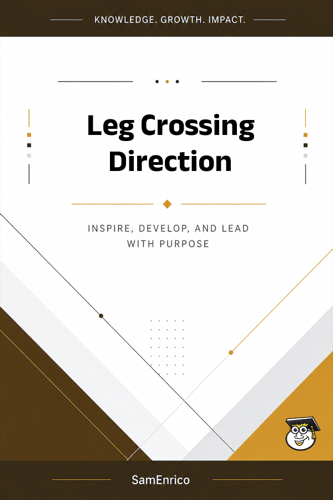
Leg Crossing Direction eBook
Read which leg is crossed to gauge openness or def
by Stull Shea
Read which leg is crossed to gauge openness or defensiveness.
Formats
Free sample
Chapter 1: The Honest Limb--–- The young woman sat perfectly still. Her face was a mask of calm—relaxed forehead, soft eyes, a gentle smile that would have passed any polygraph pretest. She had rehearsed this expression for three days. Her hands rested motionless on the table, fingers interlaced in what body language books call a "confidence steeple." By every conventional measure, she appeared truthful, composed, and cooperative.Her legs, however, were telling a different story.Beneath the conference table, her ankles were locked together so tightly that her calves bulged. Her right foot was wrapped behind her left calf—a posture known as the Leg Wrap.
And every forty-five seconds, she would uncross and recross her ankles in a silent, repetitive cycle. She did this unconsciously, as if her lower body were trying to escape while her upper body remained chained to the chair.The interrogator, a retired FBI agent who had abandoned facial-reading techniques years earlier, watched only her feet. He saw the Leg Wrap—which field research identifies as a high-anxiety gesture associated with holding back a secret—and asked a single question: "What aren't you telling me?"She confessed within ninety seconds. She had been embezzling for eleven months.This actually happened. And it happens every day, in boardrooms and bedrooms, in courtrooms and coffee shops, in job interviews and first dates.
The most honest part of your body is not your face. It is not your hands. It is your legs.This chapter establishes the core biological premise that underpins everything you are about to learn: the legs are the most honest—and therefore the most valuable—signal source in human communication. Unlike the face, which is socially trained from childhood to mask emotion through rehearsed expressions, the legs are distal limbs, located farthest from the brain's conscious control centers. They leak truth while your face manufactures lies.
By the end of this chapter, you will understand why your legs never lie, how to distinguish psychological signals from physical noise, and the ten fundamental leg gestures that will appear throughout this book.The Brain Drain Theory: Why Your Legs Betray You Let us begin with neuroscience, because without it, body language becomes fortune-telling.The human brain processes social threats and rewards through the limbic system, a primitive network that evolved long before language. When you experience stress, excitement, fear, or attraction, the limbic system activates long before your conscious neocortex even registers the emotion. This activation triggers a cascade of physiological changes: heart rate shifts, breathing patterns alter, and blood flows away from the extremities toward large muscle groups—preparing you to fight, flee, or freeze.Here is the crucial insight: while your face has thirty-six muscles that you have been training since infancy to control (the "poker face" is a real, learnable skill), your legs have no such social training. No parent ever told a toddler, "Cross your ankles calmly during that tantrum." No job interview coach ever said, "Make sure your foot-pointing direction aligns with your verbal agreement." Your legs are limbic loudspeakers, broadcasting your true emotional state whether you want them to or not.The Brain Drain Theory formalizes this observation. When cognitive load increases—meaning when you are thinking hard, feeling strongly, or trying to deceive—neural energy drains from the higher cortical functions down to the limbs.
This is not metaphorical. Functional MRI studies show that motor cortex activity increases during deceptive speech, particularly in regions controlling the lower body. Your legs become a release valve for neurological pressure. They bounce, lock, cross, point, wrap, and shift—not because you choose to move them, but because your brain is offloading excess activation into the only muscles it can move without conscious oversight.Think of it this way: your face is a press secretary, carefully crafting statements for public consumption. Your hands are junior staffers, mostly loyal but occasionally leaky.
Your legs are the whistleblower hiding in the parking lot, ready to tell the truth to anyone who bothers to look.Fight, Flight, or Freeze: The Knees Know Before your ancestors had language, they had legs. When a predator appeared, the limbic system made a split-second decision: fight (stand your ground, legs planted wide), flee (turn and run, weight shifting toward the exit), or freeze (lock every muscle, including the legs, to avoid detection). These three responses—fight, flight, freeze—remain hardwired into your nervous system, and they manifest in your leg postures during modern "threats" like a difficult boss, an awkward date, or a high-stakes negotiation.Consider the Fight Response. In the body, fighting requires a stable base. Feet plant flat on the floor, hip-width apart, toes pointing toward the threat.
This is the Parallel Stance, and when you see it in a meeting, the person is psychologically ready to argue. They may not throw a punch, but they will throw objections. The Competitive Four (Chapter 3) is a seated variation of the fight response—the ankle locks onto the opposite knee, and the raised knee points like a battering ram at the opponent.The Flight Response manifests as weight shifting. A person who wants to leave—psychologically or physically—will point their feet toward the nearest exit, even if their face is smiling at you. In seated postures, flight shows up as the Scissor Cross with knees pointing away from the speaker, or as the Standing Cross with weight repeatedly transferring from one foot to the other.
In extreme cases, the person will actually rotate their chair slightly toward the door without realizing it.The Freeze Response is the most common and the most overlooked. When freezing, the body locks down. Ankles cross tightly. Legs wrap around each other. The person becomes smaller, narrower, less visible.
This is not relaxation—relaxed legs splay open. Freezing is tension. It is the body saying, "If I do not move, the threat will not see me." The seated Ankle Lock (ankles crossed directly under the chair) and the Leg Wrap (one foot hooked behind the opposite calf) are classic freeze signals. They appear in depositions, job interviews, and anywhere else a person feels evaluated or endangered.These three responses are not theoretical. They are observable in real time, often within the first thirty seconds of an interaction.
And once you learn to see them, you cannot unsee them.Exception: When Physical Urgency Overrides Psychology Before we proceed, an honest acknowledgment. Not every leg movement is a psychological signal. Sometimes a crossed leg is just a crossed leg. The most important exception—and the one that trips up beginners more than any other—is physical urgency.The human body has needs that override the limbic system. A full bladder, extreme temperature, uncomfortable clothing, injury, or even a cramping muscle will produce leg movements that look psychological but are purely mechanical.
The Urgency Cross, which we will explore fully in Chapter 5, is a perfect example: a standing person crosses their legs tightly while shifting weight rapidly from foot to foot. This looks exactly like anxiety. In nine cases out of ten, however, it means the person needs a bathroom.Similarly, a man who crosses into a Scissor Cross rather than a Four may simply be…
This is the end of the free sample. Get the eBook to keep going. Buy now
About this book
Details
- Author
- Stull Shea
- Publisher
- SamEnrico
- Language
- English
- Genre
- Non-Fiction, Self-Help, Leg Crossing, Openness
- Released
- 2026-06-12
- Pages (approx.)
- 141
- Available as
- eBook, Audiobook

Read better in the ZLOADR app
Your eBooks on your phone or tablet. Sign in with your SamEnrico account and start reading.
More by Stull Shea
 Mobile Money Transfer ReceiptsStull Shea$11.99
 Financial Incentives for Smoking QuitStull Shea$11.99
 Gacy Property SalesStull Shea$11.99
 The Stockholm Syndrome Stand-Off: The Bank Heist That Redefined Hostage Psychology (1973)Stull Shea$11.99
 FirefighterStull Shea$11.99
 AI for Meeting Sentiment AnalysisStull Shea$12.99
 10 Ways to Use Fava Beans (Recipe Book)Stull Shea$11.99