
Non-FictionHealth & WellnessRepurposing
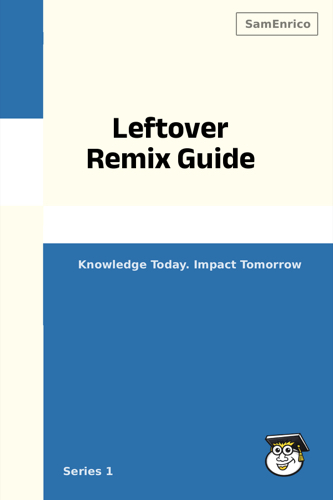
Leftover Remix Guide eBook
Teaches transforming leftovers into new meals crea
Teaches transforming leftovers into new meals creatively.
Formats
Free sample
Chapter 1: The Roast Chicken Theorem--–- The 5:00 PM dread is real. You open the refrigerator door, stand in the cold glow, and stare at a container of something from three nights ago. You don’t remember what it originally was. It has become, in your mind, “leftovers”—a culinary gray zone between edible and obligation. You shut the door.
You order takeout. You feel a little guilty. Tomorrow, that container will still be there, and the cycle will repeat.This book exists because that moment is not a moral failure. It is a design problem.Every great cook I have ever known shares one secret that most recipe books never mention: they cook for tomorrow, not just for tonight. When a chef roasts a chicken, they are already imagining the sandwich.
When they cook a pot of rice, they are already seeing the fried rice two days away. This is not miserliness. This is not “being good with leftovers.” This is strategy. And strategy, unlike willpower, works every time.Welcome to the first and most important chapter of this book. Before we remix a single scrap, before we transform stale bread or resurrect wilting herbs, we must change how you cook in the first place.
The Leftover Remix Guide is not a book of damage control. It is a book of intentional design. And intentional design begins with a single, powerful idea: cook once, eat twice—or three times, or four.The $1,500 Refrigerator Let us begin with a number that should frighten you and then liberate you. The average American household throws away approximately $1,500 worth of food every year. That is not a typo.
Fifteen hundred dollars. For a family of four, the number climbs closer to $2,000. This is not food that spoils dramatically on the counter. This is food that dies slowly in the refrigerator—the leftover lasagna that seemed like a good idea on Sunday but by Wednesday has become a Tupperware tomb.Here is what that $1,500 represents: two weeks of groceries. A plane ticket.
A new refrigerator. A month of student loan payments.And here is what it really represents: time. The time you spent chopping those vegetables. The time you spent standing over that stove. The time you spent cleaning those dishes.
When you throw away leftovers, you are not throwing away food. You are throwing away your own labor.The conventional solution to this problem has been, for decades, a combination of guilt and hopeful reheating. “We should eat those leftovers,” you tell yourself. But you do not. Because leftovers, as traditionally understood, are boring.
They are the same meal, same texture, same flavor, served again in a slightly sadder context. No wonder you order pizza instead.The solution is not more discipline. The solution is a completely different relationship to the food you cook.The Mindset Shift: From Repeats to Ingredients Here is the sentence that will change how you cook for the rest of your life:Leftovers are not second-rate versions of first meals. Leftovers are pre-cooked ingredients.Read that again. Let it settle.When you have leftover roasted broccoli, you do not have “broccoli that needs to be reheated.” You have pre-roasted vegetables that can be dropped into a frittata, pureed into a soup, chopped into a salad, or blitzed into a pesto.
When you have leftover rice, you do not have “rice that needs to be microwaved until it stops clumping.” You have pre-cooked starch that is already at the perfect texture for fried rice, rice pudding, or crispy rice cakes.This is not a semantic trick. This is a functional shift. Once you stop thinking of leftovers as “meals to repeat” and start thinking of them as “ingredients to use,” your entire cooking process changes. You stop asking “What do I reheat?” and start asking “What can I build?”The difference is everything. Reheating is passive.
Building is creative. Reheating looks backward. Building looks forward.The Roast Chicken Theorem Let me give you a concrete example that will anchor this entire chapter. I call it the Roast Chicken Theorem, and it is the single most useful cooking strategy I have ever encountered.On Sunday afternoon, you roast a whole chicken. Not a chicken breast.
Not a package of thighs. A whole bird. You season it simply—salt, pepper, maybe some thyme or rosemary. You surround it with root vegetables: potatoes, carrots, onions. You put it in a 400-degree oven for about an hour and fifteen minutes.
You eat a magnificent dinner. The skin is crisp. The meat is juicy. The vegetables are caramelized. It is, by any measure, a great meal.But here is the theorem: the meal is not the point.
The leftovers are the point.Because that one chicken, cooked with intention, can become:Monday lunch: Cold chicken sliced over a salad with the leftover roasted vegetables Monday dinner: Chicken tacos with the shredded dark meat, using some of those same vegetables as filling Tuesday dinner: Chicken and rice soup made from the carcass and the last bits of meat Wednesday lunch: Chicken salad sandwiches with the remaining white meat Plus: Chicken stock from the bones that you freeze for future soups That is five or six meals from one chicken. And not one of those meals tastes like “leftover chicken.” Each one is distinct. Each one has its own personality. Each one was designed, not discovered.The Roast Chicken Theorem works because of a simple structural truth: when you cook a whole chicken, you are not cooking one ingredient. You are cooking multiple ingredients simultaneously.
The breast is different from the thigh. The skin is different from the meat. The bones are different from everything. Each part wants to go somewhere different.This is the opposite of cooking a single chicken breast. That gives you one meal and one leftover—a smaller, drier version of the same thing.
A whole chicken gives you abundance through variety.Blank Canvas Cooking The Roast Chicken Theorem extends far beyond poultry. It is a philosophy I call “blank canvas cooking,” and it is the most important technique in this entire book.Blank canvas cooking means preparing large batches of neutral, unseasoned (or lightly seasoned) components that can be deployed in multiple directions throughout the week. You are not cooking meals. You are cooking meal components. And because they are neutral, they are infinitely adaptable.Consider rice.
If you cook a large batch of plain jasmine or basmati rice on Sunday, you have a blank canvas. On Monday, you can turn two cups into coconut rice pudding with cinnamon and raisins. On Tuesday, you can turn two cups into fried rice with soy sauce, eggs, and scallions. On Wednesday, you can turn two cups into a rice frittata bound with eggs and Parmesan. On Thursday, you can add it to soup for body.
On Friday, you can press it into patties and pan-fry them until crispy.One pot of rice. Five completely different dishes. The rice itself is not the meal. The rice is the medium.The same principle applies to beans. A large pot of plain white beans—cooked from dried, not from a can, though canned work too—can become: a bean salad with…
This is the end of the free sample. Get the eBook to keep going. Buy now
About this book
Details
- Author
- Mayberry Rochell
- Publisher
- SamEnrico
- Language
- English
- Genre
- Non-Fiction, Health & Wellness, Repurposing
- Released
- 2026-06-05
- Pages (approx.)
- 132
- Available as
- eBook, Audiobook

Read better in the ZLOADR app
Your eBooks on your phone or tablet. Sign in with your SamEnrico account and start reading.
More by Mayberry Rochell
 Dark Room Sleep MeditationMayberry Rochell$11.99
 Dream Incubation for Scientific ResearchMayberry Rochell$11.99
 Reginald Dwayne Betts PoetryMayberry Rochell$11.99
 Hammock Beach Palms GuideMayberry Rochell$11.99
 The H1B FounderMayberry Rochell$11.99
 Benzodiazepine Emotional BluntingMayberry Rochell$11.99
 Wings of the Iron Curtain: The Cold War's Secret Airline WarMayberry Rochell$11.99
 Attention Residue EliminationMayberry Rochell$11.99
 The Dog That Brought Down the Cartel: K9 Heroics in La SabanetaMayberry Rochell$11.99
 Service Providers Guide to Clothing & Accessories DesignMayberry Rochell$11.99
 A Collector's Handbook to the Lotus Eclat S1Mayberry Rochell$11.99
 Inflation Rate Calculator GuideMayberry Rochell$12.99
You may also like
 Hong Kong Handover 1997Dunn Johnnie$11.99
 Zumba For Postnatal Recovery CourseNeal Christian$11.99
 Zumba for BeginnersLadner Nikia$11.99
 YouTube Comment Mining GuideHumes Pandora$12.99
 Worry Box MeditationCarlin Rudy$11.99
 Workplace Stress MeditationNguyen Lynn$11.99
 Workplace Stress and Sleep RepairHawley Ivory$11.99
 Workplace Perfectionism CureDelaney Jeffry$11.99
 Workplace Injustice Anger GuideWallen Isabelle$11.99
 Work Addiction and Burnout LinkGreenwood Ester$11.99
 Women in Yoga and WellnessBeattie Galina$11.99
 Women in Stand Up ComedyChun Evangeline$11.99