
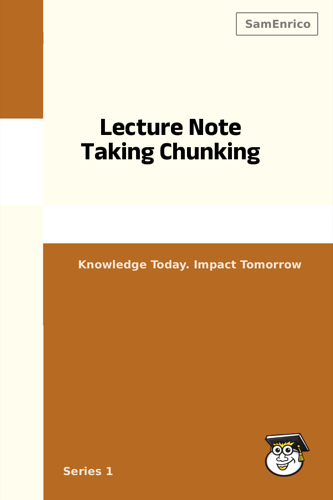
Lecture Note Taking Chunking Audiobook
Organize notes into topic clusters for easier revi
Organize notes into topic clusters for easier review.
Formats
Free sample
Chapter 1: The Forgetting Epidemic--The lecture hall is warm, the projector hums, and your pen moves across the page with furious intent. You capture every bullet point, every definition, every offhand remark that the professor repeats twice. When the class ends, you close your notebook with a satisfied snap. You did the work. You took the notes.Twenty-four hours later, you open that same notebook and stare at your own handwriting as if encountering a foreign language.
The terms are familiar—you remember writing them—but the connections are gone. The argument that seemed so clear yesterday has dissolved into isolated facts floating on lined paper. You close the notebook, defeated, and tell yourself that you just need to reread everything before the exam.This is the Forgetting Epidemic. And nearly every student suffers from it.The German psychologist Hermann Ebbinghaus discovered the phenomenon more than a century ago, but his findings have never been more relevant than in today's lecture halls. Through meticulous self-experimentation, Ebbinghaus mapped what he called the Forgetting Curve: a steep, unforgiving decline in retention that begins the moment learning stops.
Within one hour of hearing new information, the average person forgets approximately 50 percent of it. Within 24 hours, that figure climbs to 70 percent. Within one week, nearly 90 percent of what seemed so clear during the lecture has vanished from accessible memory.Let those numbers settle. Ninety percent. If you take no action between the lecture and the exam, you are essentially relearning the material from scratch.The natural response to this grim statistic is to double down on the method that caused the problem in the first place: rereading.
Students highlight their notes in bright colors, copy them into cleaner notebooks, read them aloud, or listen to recordings of the lecture while driving. These strategies feel productive because they require effort. But cognitive science has repeatedly demonstrated that rereading is one of the least effective study methods available. It creates fluency illusions—the material feels familiar, so the brain mistakes familiarity for understanding.You have experienced this. You have reread a paragraph three times, understood every word, and then closed the book unable to summarize a single sentence.
The words were on the page. You saw them. But they did not stick.The problem is not your memory. The problem is not your intelligence or your work ethic. The problem is the format of your notes.Linear notes—the chronological…
This is the end of the free sample. Get the Audiobook to keep going. Buy now
About this book
Details
- Author
- Keenan Adelia
- Publisher
- SamEnrico
- Language
- English
- Genre
- Non-Fiction, Self-Help, Note Taking
- Released
- 2026-06-08
- Pages (approx.)
- 147
- Available as
- eBook, Audiobook

Listen in the VoxFlicks app
Audiobooks and audio dramas wherever you go. Sign in with your SamEnrico account and press play.
More by Keenan Adelia
 Food Addiction Recovery Acupuncture GuideKeenan Adelia$11.99
 Anger in In-Law RelationshipsKeenan Adelia$11.99
 Beginner Group Fitness ClassKeenan Adelia$11.99
 Project Manager Interruption GuideKeenan Adelia$11.99
 The Last Whisper of the DodoKeenan Adelia$11.99
 Orbiting Dreams: The Forgotten Pioneers of Space HabitationKeenan Adelia$11.99
 Fitness InstructorKeenan Adelia$11.99
 Understanding Encephalocele FrontalKeenan Adelia$17.99
 Bookkeeping Scope CreepKeenan Adelia$12.99
 Oversized Cargo TransportKeenan Adelia$12.99
 How to Start a Prefabricated Buildings Made of Wood (commission Agent) Business (Beginners Guide)Keenan Adelia$11.99
You may also like
 Note Taking Systems for StressPederson Elizbeth$11.99
 Note Taking Systems GuideBlodgett Loise$11.99
 Cornell Note Taking GuideSanborn Suzann$11.99
 The Evernote Memory Capture GuideBader Bo$11.99
 RemNote Study System GuideSchulze Retta$11.99
 Chunking Lecture NotesDayton Mellissa$11.99
 Cornell Note Taking SystemGuerin Kindra$11.99
 Name First Impression NoteGonsalves Patience$11.99
 Name Backup RecordingBurton Barry$11.99
 Note Taking Stress ReductionAdkins Kristopher$11.99
 The Note Taking Stress GuideJohns Carissa$11.99
 Creating Effective Study Notes GuideMaldonado Rick$11.99