
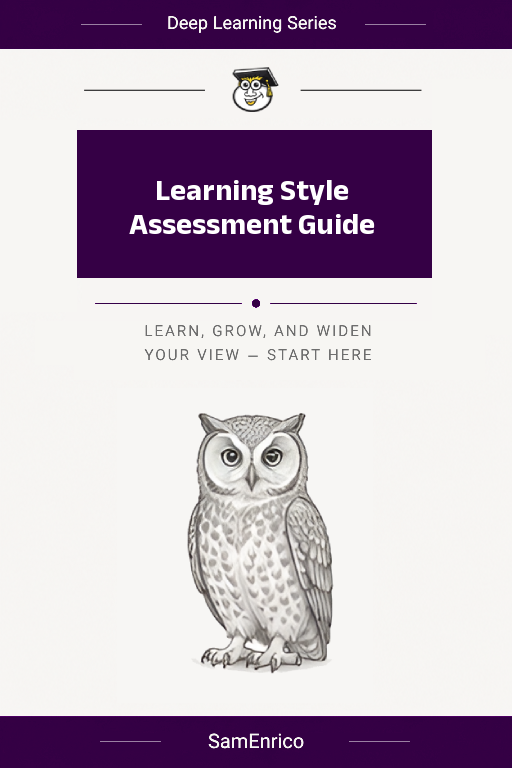
Non-FictionProfessional's Cheat SheetLearning StylesSelf Assessment
Learning Style Assessment Guide eBook
Identify your learning style to choose effective d
Identify your learning style to choose effective development activities aligned with how you absorb information.
Formats
Free sample
Chapter 1: The Hidden Truth...--–- The email arrived at 11:47 PM on a Tuesday. Sarah, a 34-year-old marketing director with two advanced degrees and a six-figure salary, had just spent three hours on a mandatory “Leadership Agility” webinar. She understood every word. She took copious notes. She answered three poll questions correctly.
And yet, as she closed her laptop, she felt exactly the same as when she started: frustrated, exhausted, and secretly convinced that everyone else must be faking their enthusiasm for professional development.This was not an isolated incident. Over the previous eighteen months, Sarah had completed twelve online courses, attended four in-person workshops, and read five business bestsellers recommended by her boss. Her completion rate was 100%. Her retention rate, by her own honest estimation, was near zero. She could not recall a single actionable strategy from any of those twelve courses without revisiting her notes.
The shame was quiet but persistent: Maybe I’m just not a good learner. Maybe I’ve peaked. Maybe everyone else is smarter.Then, last weekend, Sarah’s ten-year-old nephew asked for help building a robot from a kit. She had never touched a soldering iron. She had no interest in engineering.
Within twenty minutes, she had built the entire chassis, debugged a wiring issue the manual didn’t mention, and was explaining torque ratios to a child who had stopped listening three steps ago. She learned faster in that single afternoon than in all twelve corporate courses combined.The difference was not intelligence. It was not effort. It was not motivation.The difference was alignment.The One Question No One Asks If you have ever closed a textbook after thirty minutes and remembered nothing, you have probably blamed yourself. If you have ever sat through a training session feeling your mind drift to grocery lists and unpaid bills, you have probably labeled yourself undisciplined.
If you have ever abandoned a skill midway—a language, a coding language, a musical instrument—you have probably concluded that you lack persistence or talent.Here is the question that almost no one asks, and it is the most important question in this entire book:Was the method designed for how your brain actually works?That question sounds simple. It is not. Because for most of your life, you have been operating under a hidden assumption: that learning is a single, universal process, and if you struggle with it, the problem must be you.This assumption is wrong. Not slightly inaccurate. Not a harmless oversimplification.
Completely, demonstrably, dangerously wrong.The Hidden Assumption That Ruins Learners Walk into any corporate training room. Open any online course platform. Look at the standard advice for learning a new skill: “Set aside dedicated time. Take notes. Review regularly.
Test yourself.” These are not bad strategies. For some people, they work beautifully. For others, they are a slow, grinding path to resentment.The hidden assumption behind most learning materials is that all brains process information the same way. This assumption is so deeply embedded that we rarely notice it. We treat learning like digestion: you put information in, and if the system is working correctly, the information gets absorbed.
If it doesn’t absorb, the system must be broken.But brains are not stomachs. Digestion follows essentially the same chemical process in every healthy human. Learning does not. Your brain is not a generic processing unit. It is a unique biological organ shaped by your genetics, your environment, your personality, and your life history.
The way you learn best is as specific to you as your fingerprint.And yet, from elementary school through executive education, the default method remains the same: lectures, reading assignments, multiple-choice tests, and standardized timelines. This is not because that method is scientifically proven to be best. It is because that method is easiest to deliver to thirty people at once. Efficiency for the teacher has been mistaken for effectiveness for the learner.The Case of the Competent Failure Let me introduce you to three people. All of them are smart.
All of them work hard. All of them have been called “lazy” or “unfocused” by someone who did not understand them.Marcus is a 28-year-old software engineer. He learns best by doing. When he encounters a new programming language, he opens the editor and starts breaking things immediately. He reads documentation only after he has hit a wall.
His former manager required him to complete online tutorials before touching the codebase. Marcus failed those tutorials three times. His manager put him on a performance improvement plan. Six months later, under a new manager who let him learn by building, Marcus became the team’s top contributor.Priya is a 45-year-old hospital administrator. She learns best by listening.
She retains information from podcasts, meetings, and conversations with near-perfect recall. But she struggles with written reports. When her organization switched to a text-heavy compliance manual with no audio version, her error rate spiked. She was told to “read more carefully.” She was already reading each page three times. The problem was not her attention.
The problem was the medium.David is a 19-year-old college sophomore. He learns best by understanding the “why” before anything else. In his physics class, he cannot solve a single problem until he understands the conceptual framework behind the formula. His professor moves at a pace that assumes students will memorize equations first and understand later. David is failing.
He is not lazy. He is not stupid. He is being taught in the wrong sequence.These are not edge cases. They are the majority of learners who have been mislabeled as difficult, unmotivated, or incapable. Every day, thousands of smart, hardworking people conclude that they are bad at learning because the methods imposed on them were never designed for their brains.What This Book Is (And What It Is Not)Before we go any further, let me be clear about what this book will and will not do.This book is not a scientific defense of every learning styles theory ever proposed.
You may have heard the “debate” about learning styles—the legitimate criticism from cognitive psychologists that some commercial versions of “learning styles” are oversimplified or lack empirical support. I have read those critiques. Some of them are correct. The idea that every person fits neatly into one of three boxes (visual, auditory, kinesthetic) and should only learn in that modality is not supported by research. That is a caricature, and we will not use it here.This book is a practical guide to identifying your genuine learning preferences—not rigid boxes, but tendencies that influence how easily you absorb, retain, and apply information.
The research is clear on this point: people do have reliable differences in how they prefer to process information. These differences affect learning outcomes, especially over long periods and with complex material. The question is not whether preferences exist. They do. The question is how to use that knowledge to make better choices about your own development.This book draws from the most influential and well-supported models in the field:The 4MAT model (developed by Bernice Mc Carthy), which focuses on how people prefer to approach new information—whether they need to know…
This is the end of the free sample. Get the eBook to keep going. Buy now
About this book
Details
- Author
- Trejo Alethea
- Publisher
- SamEnrico
- Language
- English
- Genre
- Non-Fiction, Professional's Cheat Sheet, Learning Styles, Self Assessment
- Released
- 2026-06-01
- Pages (approx.)
- 137
- Available as
- eBook, Audiobook

Read better in the ZLOADR app
Your eBooks on your phone or tablet. Sign in with your SamEnrico account and start reading.
More by Trejo Alethea
 TM EEG Alpha CoherenceTrejo Alethea$11.99
 Delegation for TranslatorsTrejo Alethea$11.99
 Men's Congenital Heart Adult GuideTrejo Alethea$11.99
 Innocence Project Missouri CasesTrejo Alethea$11.99
 The Pink Panther Heist: A Jewelry Caper That Shocked the WorldTrejo Alethea$11.99
 The First Mind Mappers: Decoding the Prehistoric Brain in the Atlantic DepthsTrejo Alethea$11.99
 Understanding Chromosome 15q, TrisomyTrejo Alethea$17.99
 Venusian Atmospheric Energy HarvesterTrejo Alethea$11.99
 Canadian Degree Express EntryTrejo Alethea$12.99
 How to Become a Transmission-and-protection EngineerTrejo Alethea$11.99
You may also like
 Hong Kong Handover 1997Dunn Johnnie$11.99
 Zumba For Postnatal Recovery CourseNeal Christian$11.99
 Zumba for BeginnersLadner Nikia$11.99
 YouTube Comment Mining GuideHumes Pandora$12.99
 Worry Box MeditationCarlin Rudy$11.99
 Workplace Stress MeditationNguyen Lynn$11.99
 Workplace Stress and Sleep RepairHawley Ivory$11.99
 Workplace Perfectionism CureDelaney Jeffry$11.99
 Workplace Injustice Anger GuideWallen Isabelle$11.99
 Work Addiction and Burnout LinkGreenwood Ester$11.99
 Women in Yoga and WellnessBeattie Galina$11.99
 Women in Stand Up ComedyChun Evangeline$11.99