
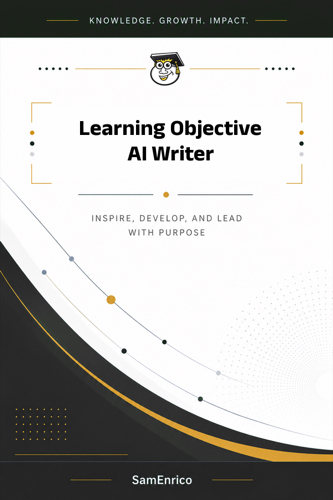
Non-FictionAI OperatorObjectives
Learning Objective AI Writer eBook
Craft measurable, student-friendly learning object
by Furr Melony
Craft measurable, student-friendly learning objectives from content standards.
Formats
Free sample
Chapter 1: The Saturday Night Panic--–- The email arrived at 7:14 PM on a Saturday. Three words in the subject line: Lesson plans due Monday.Rachel, a fourth-year teacher with a stack of ungraded essays beside her cold dinner, opened the attachment. Forty-seven rows. Forty-seven content standards to turn into actual lessons by Monday morning. She knew the standards by heart—"Determine the main idea of a text and explain how it is supported by key details" —but translating that sentence into something twenty-eight restless eleven-year-olds could actually do felt like decoding an ancient language.She typed: "Students will understand main idea."Then deleted it.
Understand was a trap. What did "understand" even look like? A worksheet? A thumbs-up? A prayer?She typed: "Students will find the main idea."Better.
But find where? In every paragraph? In the title? By circling? Highlighting?
Sacrificing a red pen to the grading gods?At 9:47 PM, Rachel gave up and searched her hard drive for last year's lesson. She found it, copied the objective verbatim, and promised herself she'd "fix it later." Later never came. The next day, twenty-eight students completed the worksheet. Fourteen got it right. Fourteen guessed.
Rachel moved on to fractions because the pacing guide said so.This chapter is for Rachel. And for you, if you have ever stared at a standard, felt the weight of a Sunday evening, and wondered why something as simple as telling students what they are supposed to learn has become so impossibly hard.The problem is not you. The problem is not the standards. The problem is a broken translation layer between bureaucratic language and actual learning. This book provides a new tool—AI as a Clarity Coach—to fix that translation.
But first, we have to understand what clarity actually costs when it is missing.The 0.75 Effect Size That Changes Everything In 2009, John Hattie published Visible Learning, a meta-analysis synthesizing over 800 studies involving more than 150 million students. He ranked 252 influences on student achievement by effect size. The average effect size of all educational interventions was 0.40—roughly one year of academic growth for one year of school.Teacher Clarity came in at 0.75.Let that number land. An effect size of 0.75 means that when teachers are crystal clear about what students are supposed to learn and what success looks like, students learn nearly twice as fast as they would in a typical classroom. To put it differently: a student in a high-clarity classroom for one school year learns as much as a student in an average classroom for nearly two years.Hattie defined Teacher Clarity as five interconnected practices:Organizing lessons around explicit learning intentions Articulating success criteria before instruction begins Explaining concepts in multiple ways Checking for understanding throughout the lesson Providing feedback tied directly to the learning intentions Notice what is not on that list: charisma, entertainment value, beautiful slideshows, or expensive classroom decor.
Clarity is not about being a more exciting teacher. It is about being a more precise teacher.And yet, when researchers have measured actual classroom practice, they have found that fewer than 20% of lessons begin with a clear, measurable, student-friendly objective. The other 80%? Ghost lessons. We will return to those shortly.The Ghost Lesson: What Happens When Clarity Dies Imagine two fourth-grade classrooms.
Both are studying the American Revolution. Both have the same standard: "Explain the causes of the American Revolution, including the Stamp Act, the Townshend Acts, and the Boston Tea Party."Classroom A (low clarity): The teacher says, "Today we're going to learn about the American Revolution. Open your textbooks to page 142. Read the section on the Stamp Act, and then we'll watch a video." Students read. They watch.
They fill out a worksheet with twelve questions. At the end of the period, the teacher asks, "Did everyone learn about the Revolution?" Heads nod. But when the teacher gives a quiz the following week, half the class cannot explain why the colonists were angry. The lesson was about something. It did not teach to anything.Classroom B (high clarity): The teacher begins by writing on the board: "By the end of this lesson, you will be able to explain three reasons the colonists were angry at Britain before the Revolutionary War, using evidence from at least two primary sources." The teacher then shows students a simple checklist: "My explanation names the Stamp Act, the Townshend Acts, OR the Boston Tea Party.
My explanation says WHY each act made colonists angry. My explanation uses a sentence stem like 'The colonists were angry because...'" Students know exactly what they are aiming for. They self-check during the lesson. The teacher circulates and says, "You have named the Stamp Act—now add the 'why.'" When the quiz comes, 85% of students succeed.Classroom B did not have a better teacher, smarter students, or more expensive materials. Classroom B had something more fundamental: alignment between the standard, the objective, the instruction, and the assessment.The ghost lesson is Classroom A.
It is the lesson that feels productive—students are busy, papers are moving, voices are murmuring—but when you look closely, no one can tell you what was actually learned. Ghost lessons are the single greatest source of wasted instructional time in American schools. They are also entirely preventable.A note on the term "ghost lessons": We will use this term throughout the book to describe activities that lack measurable learning. When you see it again in later chapters (Chapter 7 on success criteria, Chapter 11 on lesson planning), simply recall this definition. We will not re-explain it each time.The Hidden Cost of Vague Objectives Vague objectives do not just confuse students.
They create cascading failures across every other instructional decision.Failure 1: Inconsistent Assessment When four teachers in the same grade level are given the standard "Understand the water cycle," they will create four completely different assessments. Teacher A asks students to label a diagram. Teacher B asks students to write a paragraph explaining evaporation. Teacher C gives a multiple-choice test. Teacher D has students build a terrarium and calls it good.
All four teachers report that their students "met the standard." But did they meet the same standard? No. They met four different interpretations of the same seven words.This is not a teacher failure. It is a clarity failure. The standard did not specify what understanding looks like, so each teacher filled the gap with their own best guess.
The result is that a student who transfers from Teacher A to Teacher B mid-year is suddenly failing a standard they had already "passed."Failure 2: Activity-Driven Planning Vague objectives encourage teachers to plan activities instead of learning. Consider these two planning approaches:Activity-first: "I need something for Thursday. Let me check Pinterest. Oh, a simulation where students role-play as colonists and tax collectors. That looks fun.
I will do that."Objective-first: "Students need to explain three causes of the Revolution. What activity would give them practice at explaining causal relationships? A simulation might work—but only if they have to verbally justify their arguments during the simulation."The activity-first teacher (driven by a vague objective like "Understand the Revolution" ) chooses activities based on engagement alone. The objective-first teacher chooses activities based on alignment. Both…
This is the end of the free sample. Get the eBook to keep going. Buy now
About this book
Details
- Author
- Furr Melony
- Publisher
- SamEnrico
- Language
- English
- Genre
- Non-Fiction, AI Operator, Objectives
- Released
- 2026-06-07
- Pages (approx.)
- 140
- Available as
- eBook, Audiobook

Read better in the ZLOADR app
Your eBooks on your phone or tablet. Sign in with your SamEnrico account and start reading.
More by Furr Melony
 The Eisenhower Matrix for ConsultantsFurr Melony$11.99
 Mindful Breathing MBSR CourseFurr Melony$11.99
 The Czech Immigrant SuccessFurr Melony$11.99
 Growth Hormone and VisionFurr Melony$11.99
 The Golden Brush: The Visionary Art of El AnatsuiFurr Melony$11.99
 Understanding Megalencephaly-cystic LeukodystrophyFurr Melony$17.99
 How to Become a Tube CoaterFurr Melony$11.99
 German Raise Mastery GuideFurr Melony$12.99
 Digital Marketing Skills GuideFurr Melony$12.99
 Proximity MarketingFurr Melony$11.99
You may also like
 Hong Kong Handover 1997Dunn Johnnie$11.99
 Zumba For Postnatal Recovery CourseNeal Christian$11.99
 Zumba for BeginnersLadner Nikia$11.99
 YouTube Comment Mining GuideHumes Pandora$12.99
 Worry Box MeditationCarlin Rudy$11.99
 Workplace Stress MeditationNguyen Lynn$11.99
 Workplace Stress and Sleep RepairHawley Ivory$11.99
 Workplace Perfectionism CureDelaney Jeffry$11.99
 Workplace Injustice Anger GuideWallen Isabelle$11.99
 Work Addiction and Burnout LinkGreenwood Ester$11.99
 Women in Yoga and WellnessBeattie Galina$11.99
 Women in Stand Up ComedyChun Evangeline$11.99