
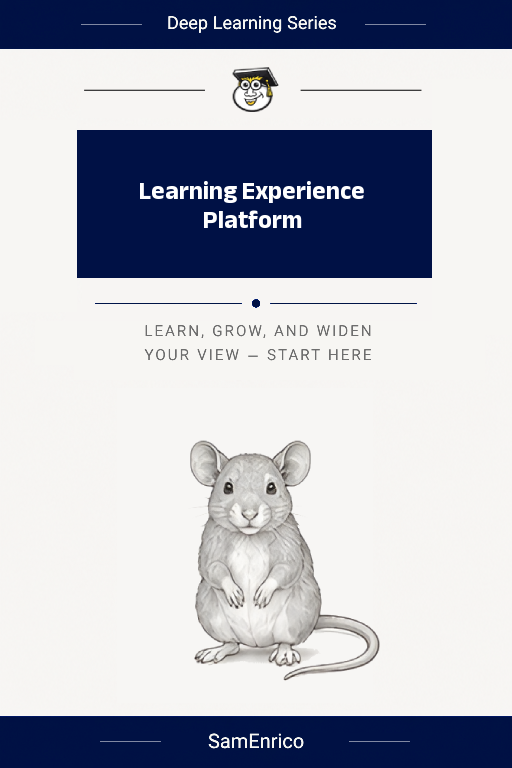
Non-FictionForecast & OutlookLXP
Learning Experience Platform eBook
Discover AI-driven LXP replacing LMS with personal
by Ruth Merlene
Discover AI-driven LXP replacing LMS with personalized content recommendations and social learning.
Formats
Free sample
Chapter 1: The $200 Billion Lie--–- The email arrived at 8:47 on a Tuesday morning. Subject line: "Mandatory Q3 Compliance Training – Action Required." Inside was a link to a 47-minute video about data privacy policies, followed by a 20-question quiz. The employee, a senior software engineer at a Fortune 500 company, had seen this exact training six times in eight years. He clicked "Mark as Read" without opening the video, closed the email, and returned to debugging a production outage. Thirty seconds later, he opened You Tube and searched for "how to fix API timeout error Python." He found a 4-minute tutorial posted by a stranger, solved his problem, and never thought about the compliance training again.This scene plays out millions of times every day across corporate America.
It is not a story of lazy employees or broken work ethics. It is a story of systemic failure—a failure so deeply embedded in how organizations think about learning that most leaders have stopped noticing it. The average employee now spends less than 24 minutes per year on formal, assigned training, according to research from Degreed. Yet the same employees will spend more than four hours per week watching You Tube tutorials, reading industry blogs, or asking questions in Slack channels. They are learning constantly.
They are just not learning from you.This gap—between what organizations spend on training and what employees actually use—is the single largest wasted investment in modern business. Global corporate training spending exceeded 400billionin2024,accordingto Training Magazine.Ofthat,roughly400 billion in 2024, according to Training Magazine. Of that, roughly 400billionin2024,accordingto Training Magazine.Ofthat,roughly200 billion is effectively thrown away on content that never gets watched, platforms that never get used, and compliance exercises that change exactly zero behaviors. This is not a rounding error. This is the $200 billion lie: the collective pretense that assigning a course is the same as building a skill.The problem is not that employees are lazy or that training is inherently useless.
The problem is that the dominant technology of corporate learning—the Learning Management System, or LMS—was designed for a world that no longer exists. It was built for administrators, not learners. It was optimized for tracking, not teaching. And it has been stretched, patched, and contorted far beyond its original purpose until it now resembles a digital filing cabinet with a search bar. The LMS is not evil.
It is just obsolete for most of what we ask it to do.This book is about what comes next. It is about a new category of technology—the Learning Experience Platform, or LXP—that finally aligns how we learn at work with how we learn everywhere else. It is about artificial intelligence that recommends content like Netflix, social features that capture knowledge like Reddit, and design principles that prioritize human curiosity over administrative convenience. But more than that, this book is about a fundamental shift in how leaders think about learning: moving from push to pull, from compliance to capability, from courses to skills.Before we can build the future, we have to understand why the past is failing. And to understand that, we have to go back to the origins of the LMS—and the assumptions baked into its DNA.The Birth of the LMS: A System Built for Administrators The first Learning Management Systems emerged in the late 1990s, born from a very specific set of needs.
Universities needed to manage student enrollments, track grades, and distribute course materials online. Corporations needed to prove to regulators that employees had completed mandatory training—think sexual harassment prevention, workplace safety, and data privacy. These were legitimate needs. No one is arguing that compliance training should disappear.But here is the crucial detail: the LMS was never designed to teach. It was designed to track.
The original architecture prioritized four functions above all others: assigning content, recording completions, generating reports, and managing user roles. Everything else—discussion forums, quizzes, even the content itself—was bolted on later as an afterthought. The LMS is, at its core, a database with a login screen.This administrative DNA shapes everything about how an LMS works. The default view for most LMS platforms is not "what should I learn today?" but "what has been assigned to me?" The primary metric is not "what can you now do?" but "which boxes have been checked?" The user experience is built around the needs of the compliance officer, the HR generalist, and the IT administrator—not the human being trying to solve a problem at 2 PM on a Tuesday.Consider the mental model of an LMS. It assumes that learning happens in courses.
Courses have start dates and end dates. They contain modules that must be completed in a specific order. They end with a quiz that proves retention. This is a perfectly reasonable model for teaching algebra to ninth graders or certifying airplane mechanics. It is an absurd model for teaching a salesperson how to handle a new objection, or helping a developer debug a microservices architecture, or showing a manager how to give difficult feedback.The LMS also assumes that learning is something that happens apart from work.
You log into a separate system, watch a video in a separate window, answer questions on a separate screen, and then return to your actual job. This separation is not a bug; it is a feature of the original design. The LMS was built for a time when work was place-bound and desk-bound, when "training" meant a conference room and a Power Point, when the flow of work was slow enough that stepping away for an hour did not feel like a crisis. That time is gone.The Consumerization Gap: Why Employees Vote with Their Clicks Every employee reading this book has, in their pocket, a device that delivers personalized recommendations with terrifying accuracy. Netflix knows what you want to watch before you do.
Spotify surfaces songs you have never heard but somehow love. Amazon shows you products you did not know you needed. These platforms have trained an entire generation to expect that technology will anticipate their needs, adapt to their preferences, and reduce friction to zero.Now ask those same employees to log into their company's LMS. The contrast is jarring. The interface looks like it was designed in 2005—because it was.
The search function returns irrelevant results. The recommended courses are based on job title alone, ignoring everything the employee has actually shown interest in. The videos are 45 minutes long in a world of 4-minute You Tube tutorials. The quizzes test recall of policy documents rather than application of skills.This is the consumerization gap: the growing chasm between what employees experience in their personal lives and what they tolerate at work. And the gap is widening every year.
A 2023 study by Gartner found that 73% of employees say their company's learning offerings are either irrelevant, too time-consuming, or both. Among employees under 35, that number jumps to 82%. These are not disengaged workers. These are people who are desperate to learn—just not through the tools you are giving them.The data is damning. According to research from the Brandon Hall Group, the average completion rate…
This is the end of the free sample. Get the eBook to keep going. Buy now
About this book
Details
- Author
- Ruth Merlene
- Publisher
- SamEnrico
- Language
- English
- Genre
- Non-Fiction, Forecast & Outlook, LXP
- Released
- 2026-05-30
- Pages (approx.)
- 152
- Available as
- eBook, Audiobook

Read better in the ZLOADR app
Your eBooks on your phone or tablet. Sign in with your SamEnrico account and start reading.
More by Ruth Merlene
 Sleep Apnea Meditation SupportRuth Merlene$11.99
 Mexican Solar Depreciation RulesRuth Merlene$11.99
 Individual OKR Setup GuideRuth Merlene$11.99
 Benzo Anxiety Rebound ProtocolRuth Merlene$11.99
 The Last Broadcast: The Day Radio Saved LivesRuth Merlene$11.99
 The Last Dot-Com Billionaire: The Rise and Fall of Boo.comRuth Merlene$11.99
 Understanding Ichthyosis Hepatosplenomegaly Cerebellar DegenerationRuth Merlene$17.99
 Make Ready TechnicianRuth Merlene$11.99
 Trust And LLC Transparency ManualRuth Merlene$12.99
 How to Start a British Humanist Association Business (Beginners Guide)Ruth Merlene$11.99
You may also like
 Hong Kong Handover 1997Dunn Johnnie$11.99
 Zumba For Postnatal Recovery CourseNeal Christian$11.99
 Zumba for BeginnersLadner Nikia$11.99
 YouTube Comment Mining GuideHumes Pandora$12.99
 Worry Box MeditationCarlin Rudy$11.99
 Workplace Stress MeditationNguyen Lynn$11.99
 Workplace Stress and Sleep RepairHawley Ivory$11.99
 Workplace Perfectionism CureDelaney Jeffry$11.99
 Workplace Injustice Anger GuideWallen Isabelle$11.99
 Work Addiction and Burnout LinkGreenwood Ester$11.99
 Women in Yoga and WellnessBeattie Galina$11.99
 Women in Stand Up ComedyChun Evangeline$11.99